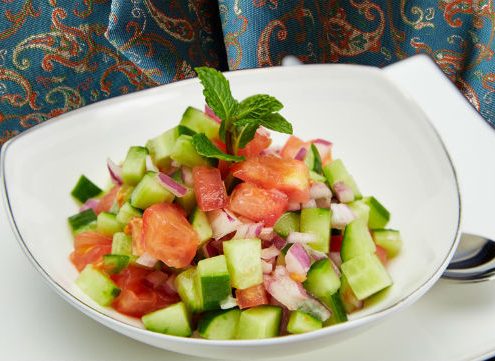
A bowl of Shirazi salad, a popular Iranian appetizer
As the name reveals, Shirazi Salad is originated from Shiraz, capital of Fars province, southwest Iran. It’s mainly considered a refreshing dish during hot summers of Iran although served with many Iranian foods all year round.
It’s one of the most popular green salads among Iranians which is very easy and convenient to make. It has a lot of fans throughout the country. And here, I’m going to share the joy with you and explain how to make the savory Shirazi salad. It will be ready in a very short time.
Ingredients for This Iranian Appetizer:
3 medium size cucumbers (peeled or unpeeled, optional)
2 medium size tomatoes
1 medium size onion
Dried mint leaves, crushed
Dried or fresh parsley leaves (optional)
1 cup unripe grape juice
Salt and black pepper powder
2-3 tbsps. olive oil (optional)
Directions to Make Shirazi Salad:
1. Finely dice the cucumbers, tomatoes, and onion. Then blend them in a large bowl.
Note:
Primary ingredients for this Iranian appetizer are what I mentioned here. But if you like, you can add some diced scallion and bell pepper.
2. Add some dried mint and parsley to your taste and mix.
Notes:
If the parsley leaves are fresh, you have to mince them, and if dried, crush them before adding.
You can also use dried pennyroyal leaves instead of mint.
3. Add the unripe grape juice, salt, and pepper. Adjust the amounts to your taste.
Note:
Although unripe grape juice is originally used for seasoning this Iranian appetizer, if it’s not available, you can substitute it with lemon or lime juice.
4. Add the olive oil and mix the ingredients well. Now you’re almost ready to serve.
Note:
It would be better to refrigerate your Shirazi salad for about 1 hour before you serve it. In this way, the flavors mingle perfectly and the salad will taste more delicious.
How to Serve This Popular Salad:
Transfer the salad into a big serving bowl or some small ones. You can cut designs into tomatoes, cucumbers, onions, or bell peppers, and use them for garnishing. Just make use of your creativity to do it.
You can serve Shirazi Salad as an appetizer or a side dish with many of Iranian foods, especially those including rice. The pleasant sour and salty flavor alongside the crispy texture you feel in your mouth give you a great taste experience. You’ll be a fan of this popular, traditional salad like most Iranians.
https://kalouttour.com/wp-content/uploads/2017/08/kalout-300x225-80x80.png00adminhttps://kalouttour.com/wp-content/uploads/2017/08/kalout-300x225-80x80.pngadmin2017-07-15 14:28:002017-07-15 14:28:00How to Prepare Tasty Shirazi Salad An Iranian Appetizer
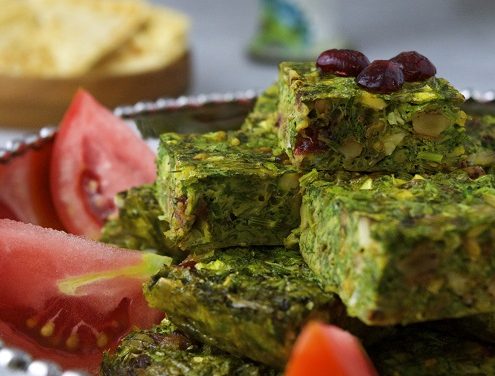
Kookoo Sabzi, an Iranian dish ideal for vegetarians and others
With a tempting aroma and flavor, it comes from a large family called Kookoo with eggs as the basic ingredient. And Sabzi means herbs in Persian. So, Kookoo Sabzi is an egg based vegetarian Iranian dish.
If you don’t have enough time but you want to prepare something enjoyable to eat, this recipe would be a good suggestion.
Ingredients of Kookoo Sabzi:
½ cup minced chives
½ cup minced parsley
½ cup minced dill
½ cup minced cilantro (optional)
4-5 lettuce leaves, minced
3 garlic cloves, minced (optional)
6 eggs
1 tsp. baking powder
1 tsp. turmeric powder
1 tbsp. flour
½ cup chopped walnut (optional)
2 tbsps. dried barberries (optional)
2/3 cup vegetable oil
Salt and black pepper powder
Directions to Make This Vegetarian Iranian Dish:
1. Crack the eggs into a big bowl. Add baking powder, turmeric powder, flour, salt, and black pepper powder. Whisk until mixed smoothly.
2. Add the prepared herbs, lettuce, and garlic to the bowl and mix them well. Then, add the walnuts and dried barberries and stir to combine.
Note:
Before mincing the lettuce leaves remove the stems.
3. Heat the oil in a nonstick pan until sizzling over medium low heat. Then, transfer your mixture to the pan and get it flat with the back of a tablespoon with a little pressure. After that, cover the pan and let your Kookoo Sabzi cook gently. Tilt the lid.
4. After about 20 minutes, check your food. When the sides look brown, remove the pan from heat.
5. Remove the lid. Place a large plate over the pan and invert the Kookoo onto the plate. Next, slide the Kookoo back into the pan gently.
Note:
You can also cut the Kookoo into wedges and then invert them in the pan separately.
6. Cover and continue heating until the other side gets brown, too. Now you have a vegetarian Iranian dish to serve.
Note:
it’s better to make your Kookoo Sabzi at most about 3 cm thick. Otherwise, it doesn’t cook properly in the middle.
How to serve Kookoo Sabzi:
Transfer the Kookoo onto a serving platter and cut it into wedges. You can sauté some dried barberry and use it for garnishing along with some chopped walnut. This Iranian dish has to be serve with bread. And as a side dish you can have yogurt, pickles, or Shirazi salad.
Each person can take a wedge on their plates, cut a small piece at a time, and warp it in a piece of bread to eat. To cut the wedge into small pieces, most of the people use a fork or even a spoon, but you can also use a knife if you wish.
If you’re looking for something healthy, delicious, convenient, and quick among Iranian food, I highly recommend you try KooKoo Sabzi.
https://kalouttour.com/wp-content/uploads/2017/08/kalout-300x225-80x80.png00adminhttps://kalouttour.com/wp-content/uploads/2017/08/kalout-300x225-80x80.pngadmin2017-07-15 14:24:322017-07-15 14:24:32Kookoo Sabzi a Quick Vegetarian Iranian Dish
This traditional dish is one of the specialties in Iranian cuisine. As the name reveals, this Iranian dish is originated in Tabriz, the capital of East Azerbaijan province, northwest of Iran. What makes Koofteh Tabrizi one of a kind among all other Iranian foods is not just the ingredients but the way it gets prepared and cooked.
This recipe may take you much time but the outcome is so delicious that you’ll admit it’s worth trying.
Ingredients Needed for Koofteh Tabrizi:
500 g ground veal (about 85% lean, ground twice)
1 large onion, grated and the juice squeezed out
½ cup half-cooked, yellow split peas
1 cup rice, half-cooked without salt
1 medium potato, boiled and peeled
1 egg
¼ cup finely chopped chives
¼ cup finely chopped parsley
1 tbsp. crushed, dried summer savory (if unavailable, just leave it out)
1 tbsp. crushed, dried tarragon
½ tbsp. crushed, dried mint leaves
1/8 tsp. saffron powder, presoaked using 1 small ice cube
Salt, turmeric powder, hot and black pepper powder
The Fillings:
2-3 hard-boiled eggs, peeled
6 yellow prunes, presoaked for about 30 minutes
1 medium onion, finely diced and fried to golden brown
½ cup dried barberry, presoaked for about 30 minutes, drained
1 cup coarsely crushed walnut
vegetable oil
For Sauce:
3 tbsps. tomato paste
1 medium onion, finely diced
1/8 saffron powder
Cooking oil
Salt, turmeric powder, hot pepper powder
3-4 cups hot water
Directions to Cook This Iranian Dish:
1. Process the rice, yellow split peas, and potato all together using a food processor until uniform. Set them aside. Be careful not to over process them to paste.
2. In a large bowl, mix the ground meat and grated onion thoroughly. Note: High fat meat, and also, not squeezing out the onion juice can cause this Iranian dish falling apart while cooking.
3. Add the rice mixture prepared through processing, egg, herbs, liquid saffron, salt, and turmeric and pepper powder. Mix them all completely using your hand. Then, continue kneading for about 10-15 more minutes.
Note:
Add the rice mixture, the herbs, and the egg and condiments separately in three phase. Add one of them, mix well, and then add the other one. Mixing and kneading play an important role because it prevents your meatballs from falling apart.
4. Refrigerate your paste like mixture for about 1 hour. Meanwhile, prepare the fillings and the sauce.
Notes:
You can also prepare the mixture one day earlier and refrigerate it overnight.
It’s even possible to freeze your mixture for up to one month and use it to make Koofteh Tabrizi whenever you feel like it.
5. Sauté the barberry and walnut separately just for a few minutes and set them aside.
6. In a large pot, fry the diced onion with some turmeric powder until golden brown over medium heat.
7. Add tomato paste, salt and pepper. Stir for about one minute and then about 4-5 cups hot water. Stir a bit. Increase the heat to bring it to a boil.
8. Add the saffron. Reduce heat to low. Cover the pot and let the sauce get thick while simmering gently.
9. Line a bowl with a cheese cloth. To fix the cloth, you can use a rubber band around the bowl.
10. Remove the paste like mixture from refrigerator. Knead it a little.
11. Add about half of the mixture to the bowl. Use your fingers to spread it at the bottom and bring it up toward the sides.
Notes:
Choose a bowl big enough which can hold half of your mixture.
Keep a bowl of cold water next to yourself. To prevent the mixture from sticking to your hands, wet them in cold water then start making meatball.
12. Put 2 hard-boiled eggs at the middle. Add the other fillings all. Then, place the remaining mixture on top and press down with your palm to get the two halves sealed. Go around the edges and make sure they’re sealed.
Notes:
You can exclude the Boiled egg from your Koofteh Tabrizi recipe if you don’t like it.
Take about one tablespoon of fried onion and one tablespoon of sauté barberries, and set them aside for garnishing this Iranian dish.
13. Tie the cloth closely. Be careful not to leave any corner open. Make a bow since it’s easier to open.
14. Pick up your gigantic meat wrap gently and pass it from hand to hand a few times to shape it like a ball.
15. Go back to the sauce. Remove the lid. Increase the heat to medium to maintain a low boil. Then place your meatball gently into the pot. Within the first 30 minutes, don’t cover the pot and also don’t move or turn the Koofteh.
16. By the end of 30 minutes, the Koofteh starts changing color and it feels firmer. At this time, reduces heat to low, and baste your Koofteh with some of the sauce using a spoon or a ladle. Then cover the pot (tilt the lid) and let it simmer gently for about 1 hour and 30 minutes.
Notes:
While the meatball is being cooked, toss it gently and carefully once in a while to get it cooked evenly in all parts. You can also baste the top with the sauce occasionally. Don’t forget to cover the pot again.
The reason for wrapping your Koofteh Tabrizi in a cloth is to prevent it from falling apart while cooking.
Instead of making a gigantic Koofteh, you can divide your mixture and make about two or three smaller meatballs in size of an orange. In that case, there is no need to use cheese cloth, just use a bowl in an appropriate size as a scoop for making meatballs. You’ll also need 1 hard-boiled egg for each meatball.
In case of making orange size Koofteh, have some cold water next to yourself. Add about ½ tablespoon cold water to the bowl using as a scoop, then add the mixture and continue making a ball. This way it would be easier to get your meatball out of the bowl. You just need to invert the bowl on your palm and tap it a few times. Do the same with the rest of meatballs.
Arrange the small meatballs in the pot with about 1 cm space in between.
17. Finally, when your Koofteh Tabrizi is cooked completely and the meat in it doesn’t smell raw, it’s ready to serve. Turn off heat and let the Koofteh sit in the pot for about 15 minute, cooling down a little bit.
Note:
At the end, there will be just about a cup of the thick sauce left in the pot.
How to Serve This Iranian Dish:
Transfer your gigantic meatball into a serving bowl or onto a deep serving plate. Then, remove the cloth and baste your Koofteh with some sauce. To garnish, use the fried onion and sauté barberries you’ve set aside. In a separate bowl, serve the remaining sauce, too. You can also shred some bread in the sauce and eat it.
As side dishes, you can have table vegetables, sliced raw onion, fresh lime/lemon or lemon juice, and pickles. The most preferred kind of bread with this Iranian dish is Sangak (a traditional Iranian bread). And about drinks, it would be Doogh (Iranian yogurt drink) as usual.
If you’ve cooked a gigantic Koofteh Tabrizi, it would be better to help your guests serving themselves by cutting it into halves or quarters. Or if you’ve prepared orange size meatballs, each person can have one in their plates. Then, spoon a small amount of it onto a piece bread and enjoy the taste. (Watch out for the pits of the prunes while eating and warn everyone about them).
It may not be a quick and effortless recipe, but it’s worth trying. You’ll love it. The wonderful flavor is convincing enough.
https://kalouttour.com/wp-content/uploads/2017/08/kalout-300x225-80x80.png00adminhttps://kalouttour.com/wp-content/uploads/2017/08/kalout-300x225-80x80.pngadmin2017-07-15 13:58:182017-07-15 13:58:18Koofteh Tabrizi Gigantic Meatballs an Iranian Delicious Dish
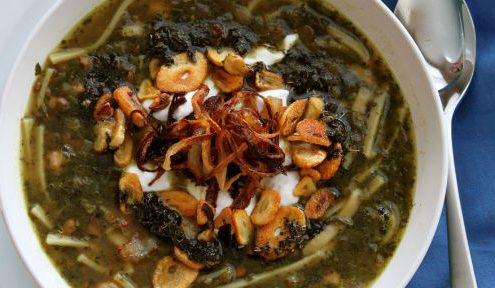
Before I explain Ash-e Reshteh, I must mention this point that what’s called Ash in Iranian cuisine is a food looking like a thick soup, mainly consisting of herbs and legumes. It’s the same for Ash-e Reshteh. What’s more here is reshteh, a kind of Persian noodle. This soup is one of the most delicious, popular, and well known ones among Iranian soups, and is more preferred in winter.
This Iranian thick soup is a delicacy which has a special position among Iranian foods in different Iranian events, ceremonies, or gatherings, specifically religious ones. It’s also commonly cooked and served in Nowruz gatherings. Some people believe that noodles in this soup symbolize good fortune and success for the following days of the new year. In addition, neighboring countries also have this soup in their cuisines just with some slight differences in the recipe.
½ cup lentils- 300 g. Persian reshteh (if unavailable, substituted with linguine)
3 medium onions, sliced into thin slivers
6 garlic cloves (optional)
2 cups kashk (a whitish dairy product made from yogurt or sour milk)
4 tbsps. crushed, dried mint leaves
Salt, turmeric powder, and hot pepper powder
Vegetable oil
2 tbsps. wheat flour (if necessary)
Directions to Cook Ash-e Reshteh:
1. Cook the legumes in boiling water separately until tender and set them aside.
2. Fill a big pot with about 5 cups water and bring it to a boil. Then add the prepared herbs and let them simmer over medium heat until they don’t taste raw anymore. Meanwhile you can prepare the other ingredients.
Note:
Don’t cover the pot in this phase. If you do so, the herbs get dark brown while cooking. It’s better to preserve them greenish.
3. Heat about 2-3 tablespoons oil in a frying pan. Add the onions and stir until golden brown. Take about half of the fried onions and set them aside for garnishing. Add about ½ tablespoon turmeric powder to the remaining onions. Stir for a few more seconds and then set them aside.
4. Mince 3-4 garlic cloves. Fry them until golden brown. Then, add about 2 teaspoons turmeric powder and stir a few more seconds. Set them aside.
5. Slice the remaining garlic cloves paper-thin. Fry them until golden brown and set them aside for garnishing this Iranian soup.
6. In a small pan, heat about 3 tablespoons oil until sizzling. Add dried mint, stir a little, and remove it from heat immediately. Set it aside.
7. Go back to the herbs. Add cooked legumes, fried onions with turmeric powder, fried minced garlic, about half of the sauté mint, and some hot pepper powder (to your taste) to the pot. Stir a little to get them mixed. Let them simmer with the lid on for about 10-15 minutes. It helps the flavors come together.
Note:
Tilt the lid to prevent boiling over.
8. Break up reshteh strips into 3 pieces and add them to the pot. Stir them well to make sure they don’t stick together in the mixture. Reduce heat to low and continue simmering for about 15-20 more minutes until reshteh gets completely tender.
Note:
After adding reshteh, the soup starts getting thick. So from this phase on, you have to stir your soup every so often to prevent the ingredients from sticking to the bottom of the pot.
9. Dilute the kashk with 1 cup water. Add about half of it to the mixture and stir. Continue heating for about 5 more minutes and then remove the pot from heat.
Notes:
It would be better to boil the diluted kashk for about 20 minutes before adding it to your Ash-e Reshteh.
Adding kashk in this phase is optional. You can use it just for garnishing.
You can substitute kashk with sour yogurt or sour cream. But in case of using yogurt, you can’t add it when the soup is simmering over heat because it starts to separate into curds. Use it just for garnishing.
10. When all of the ingredients are cooked completely, the flavors are intermingled thoroughly, and your Iranian soup is thick enough, you’re done.
Notes:
What you have at the end has to be a kind of a thick soup. So if it looks watery, dissolve the wheat flour in a cup of cold water and add it to the soup. Let the mixture continue simmering for a while until it gets the desired thickness. Just bear it in mind that Ash-e Reshteh tends to get thicker a little more by resting and cooling down. And if it looks too thick while cooking or at the end, you can add some boiling water.
Adjust seasoning, especially for salt, as the final phase. Because the kashk and reshteh used in this Iranian soup are a little bit salty and usually there is no need to add more salt.
You can adjust the amount of sauté dried mint, fried garlic, and kashk to your taste.
How to Serve Ash-e Reshteh:
Transfer the soup into a big serving bowl. Let it rest and cool down for a while and then start garnishing. Otherwise, all the toppings get mixed and don’t stay on the surface. Use fried onion and garlic, diluted kashk, and sauté mint to decorate your food.
You can have some Kashk or yogurt, vinegar, or even various kinds of pickles with this Iranian soup. In some areas of Iran like Kerman province, people mix vinegar with grape syrup and use it alongside their soup. This soup can be served as an appetizer or a main course for dinner.
Finally, if you’re searching for something special, savory, nutritious, and also vegetarian among Iranian foods, I highly recommend you Ash-e Reshteh. You’ll enjoy it.
https://kalouttour.com/wp-content/uploads/2017/08/kalout-300x225-80x80.png00adminhttps://kalouttour.com/wp-content/uploads/2017/08/kalout-300x225-80x80.pngadmin2017-07-15 13:49:022017-07-15 13:51:09How to Cook Ash-e Reshteh, The Vegetarian Iranian Soup
Joined Nations Educational, Scientific and Cultural Organization (UNESCO) has included the authentic surface of Yazd in focal Iran to its rundown of world legacy destinations.
The site was engraved on the world legacy list amid the 41st session of UNESCO’s World Heritage Committee in Krakow, Poland, on Sunday, July 9, ifpnews.com composed.
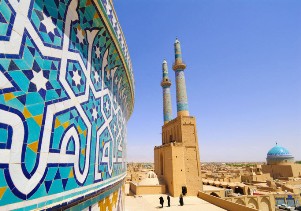
The authentic structure of Yazd is a gathering of open religious engineering with a vast degree containing Islamic building components reaching out finished distinctive times of history in the concordant mix with climatic conditions.
Iran named Arasbaran Protected Zone in East Azerbaijan Province and the chronicled city of Yazd for 2017 UNESCO World Cultural Heritage posting.
Mohammad Hassan Talebian, the appointee leader of Iran’s Cultural Heritage, Handicrafts and Tourism Organization, said prior: “While Arasbaran Protected Zone is Iran’s second normal legacy site to be proposed for UNESCO enrollment, Yazd is the primary city in Iran to be assigned for enlistment as a world legacy site.”
He brought up, “Yazd is a standout amongst the most critical forsake urban communities of Iran. The city bears particular indications of development and imagination, a lion’s share of which were advanced between the tenth and twentieth hundreds of years CE.
“The old surface of Yazd is in a superior shape than other verifiable urban communities of Iran.”
Yazd is Iran’s biggest adobe city and its landmarks brag high building esteems.
“The social standpoint of Yazd is yet to be modernized and therefore most of the landmarks including mosques, minarets, houses, and reservoirs impeccably reflect old Islamic-Iranian design,” he said.
The authority said Yazd turned into a settlement with the foundation of storages.
“One can see different eco-accommodating design styles in Yazd, as though the old natural surroundings knew about the standards of maintainable advancement. Old occupants of the city attempted to apply wind, soil, and water energies in a route not to harm the earth,” he said.
Yazd has been an indication of the brightest social legacy and antiquated progress all through history with human settlement going back to the third thousand years BCE.
Tribes, who relocated from Balkh to Pars, called this land “Yazdan” amid the Pishdadi time. The most vital early settlements in Yazd incorporate Mehrpadin (Mehriz), Fahrashan or Pahreh (Fahraj), Khormish and Adar (Ardakan), Aqda and Eshkezar.
Yazd is the principal adobe city on the planet and is the second authentic city after Venice, Italy.
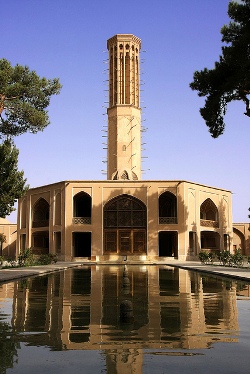
Yazd is known as the city of wind towers. Truth be told, wind towers enhance ventilation. They can be seen in private units and antiquated houses.
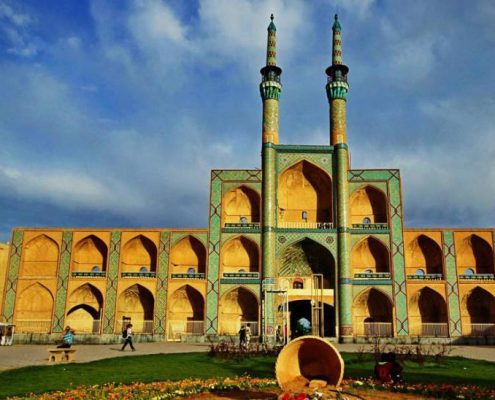
Yazd’s authentic landmarks incorporate Yazd Jame’ Mosque, Seyyed Rokneddin Mausoleum, Amir Chaqmaq Complex, Lariha House, Alexander Prison, Narin Castle, Chak Temple and Water Museum.
What’s more, 77 territories of Yazd known as ‘Yazd Historical Texture’ were enlisted as No. 15,000 on the National Heritage List in 2005.
Gharbal Biz (Mehriz), Tamehr (close Taft) and Masih (Harat) are among the essential springs of Yazd.
The secured zones in Yazd are among alternate attractions of the region.
Taft is the center point of pomegranate and silkworm in Yazd Province. Its pomegranates are sent out. Peaches are likewise a popular agro item in Taft.
Additionally, Taft’s water has been outstanding all through the historical backdrop of the territory. A back road in Yazd is known as ‘Abdominal muscle e Taft’, which shows the vivacity of Taft.
Because of certain climatic and monetary conditions and in addition its remoteness, the occupants of Yazd have been included in making painstaking work. Yazd painstaking work has pulled in the consideration of craftsman and workmanship mates the nation over since time long past circumstances.
https://kalouttour.com/wp-content/uploads/2017/08/kalout-300x225-80x80.png00adminhttps://kalouttour.com/wp-content/uploads/2017/08/kalout-300x225-80x80.pngadmin2017-07-10 10:48:022017-07-10 10:48:02Yazd engraved as UNESCO heritage site
Marco Polo described Yazd as “a good and noble city” with “a great amount of trade”. This noble city now stands a chance to become another UNESCO cultural and architectural site in Iran.
THE 40th UNESCO World Heritage Committee begins to review 34 global nominations in Krakow, Poland, including Iran’s candidate, the historical texture of Yazd. The 21 members of the committee are to discuss the tentative list from all corners of the world in 10 days to reach a verdict which to some are really important such as the Fort and Shalamar Gardens in Lahore, Pakistan, Historic Centre of Vienna, Austria, Cerrado ecoregion in Brazil.
It has been 9 years since the registration of Historic city of Yazd in the tentative list; however, due to several ill-matched and uncommon constructions which unbalance the historical texture of Yazd, it is still on a lengthy waiting list of Iran. The UNESCO International Council on Monuments and Sites (ICOMOS) finds a number of defects in the texture of the city which look somewhat incongruous to the homogeneous clay structure of the area. According to the World Heritage Site website “The historical structure of Yazd is a collection of public-religious architecture in a very large scope comprising of different Islamic architectural elements of different periods in a harmonious combination with climatic conditions.”
For the past two years, Iranian officials of the Cultural Heritage Organization cooperating with the locals and authorities of Yazd by arranging and conducting workshops and meetings, has been doing its best to pave the way for the 22nd UNESCO World Heritage Site in Iran and today finally Yazd joined in the World Heritage List of Iran.
https://kalouttour.com/wp-content/uploads/2017/08/kalout-300x225-80x80.png00adminhttps://kalouttour.com/wp-content/uploads/2017/08/kalout-300x225-80x80.pngadmin2017-07-09 16:37:502019-03-09 13:36:49Glorious Day for Historical City of Yazd
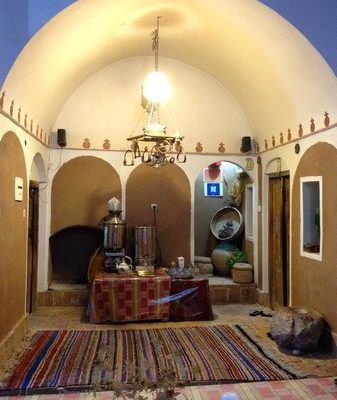
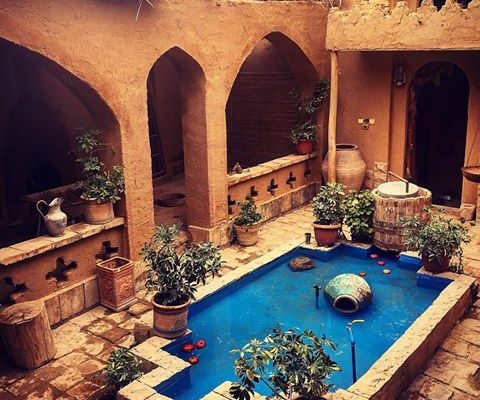
In the heart of desert there is a village called Garmeh, near the border of Isfahan & Yazd provinces. The founder of this house is Maziar who is one of the first people to convert his house to an eco-lodge. During your stay there, you’ll enjoy the unique sound of didgeridoo & percussion that Maziar plays.
Agha Mir is a 100-year-old house in Sadat-shahr , Fars province. Agha Mir is the founder of Astro tourism in Iran & supports the environment, planting trees & specially the Pasargadae Brown Bear. The food is organic & traditional; and they try to keep the culture & customs alive. Beside the Astrology & eco tours, there is Nomad tour too…
The Eco lodge is a place for nature lovers, responsible tourists and a base for scientific researchers.it provides tourists with opportunities to be in close contact with nature. It was started in 2009 with an aim of supporting The Golestan National Park programs and helping local communities around this National Park which is a biosphere reserve too. Turkmen Eco lodge has a first-of- its-kind cooperative agreement with a National Park authority in Iran. We offer educational and participatory experience through • Wildlife tour • Trekking • Eco-safari • Hiking • Rural museum • Kids Eco camp