When you travel to Iran, you may want to get in touch with your family, friends, etc. This is possible through various means of telecommunication and internet in Iran. You can use landlines, mobile phones, fax, internet, etc. There are generally particular advantages and disadvantages of using such devices everywhere in the world and some local issues in Iran that you’d better get prepared for them before you travel to Iran.

Using Land Lines in Iran

While you’re staying in hotels, you can dial a certain number (it varies in different hotels) and when you hear a particular beep, you can begin dialing country code, area code and phone number … Will it be wise to do so? Sometimes it could be although the price you pay is higher compared to other methods. You may go to certain telecommunication organizations or their branches at cities, towns, villages, etc and ask the operator to get you connected to the number you present them with. Then, you’ll be put through and you can use the landline. Using Phone Cards in Iran Also, there are some phone cards these days in Iran that you can buy for very low prices and use them from both landlines and mobile phones. You can read the instructions on the back of these cards and follow the steps so that you can make a phone call to any part of the world. There are various prices that you would pay depending on the destination you call. In general, you will pay very little amount compared to using direct numbers of those destinations. While using such cards, you will be charges for the landline (like you’re calling a number in the same city or country) and certain amount for each destination. Altogether, it will be lower than what you should have paid for a direct phone making using a landline or mobile phone. Using Mobile Phones in Iran

While you’re staying in hotels, you can dial a certain number (it varies in different hotels) and when you hear a particular beep, you can begin dialing country code, area code and phone number … Will it be wise to do so? Sometimes it could be although the price you pay is higher compared to other methods.
You may go to certain telecommunication organizations or their branches at cities, towns, villages, etc and ask the operator to get you connected to the number you present them with. Then, you’ll be put through and you can use the landline.
Using Phone Cards in Iran
Also, there are some phone cards these days in Iran that you can buy for very low prices and use them from both landlines and mobile phones. You can read the instructions on the back of these cards and follow the steps so that you can make a phone call to any part of the world. There are various prices that you would pay depending on the destination you call. In general, you will pay very little amount compared to using direct numbers of those destinations.
While using such cards, you will be charges for the landline (like you’re calling a number in the same city or country) and certain amount for each destination. Altogether, it will be lower than what you should have paid for a direct phone making using a landline or mobile phone.
Using Mobile Phones in Iran

Mobile-Telecomunication-Coverage

Mobile-Telecomunication-Coverage

In general, depending on the agreements between Iranian Telecommunication service provider and your mobile phone service provider, you may be or may not be able to use your phone from inside Iran. If such agreement is in place, you could use your phone in Iran and pay for it to your service provider. Of course, this is regardless of the roaming charges.

You can also buy some pre-paid SIM card in Iran and use it as an Iranian uses it for local phone calls and international ones. Also, you can use the phone cards explained above together with such SIM cards during your stay in Iran.

There are a few mobile phone operators working in Iran. The coverage you get in different parts of Iran using their SIM cards is varied. In general, it’s not a bad idea to use such service during your stay in Iran. This must also be taken into consideration that:

  • There are lots of high and low altitudes in Iran,
  • There are not satellite mobile phone service providers,
  • You may travel to far distances and remote areas in Iran without coverage,
  • etc

For purchasing your SIM card, you just need to make sure that you buy from particular authorized agents who install the SIM cards in your cell phones and make it operational for you. Ask for a test call to ensure it works the way the agent has explained it to you.

Using Fax Machines in Iran

fax-machine

fax-machine


Inside most of the hotels, you can ask for this service if you need to send a fax. There are some small and large shops in most of cities and towns in Iran that provide fax submission services too. All you need is to have a blank A4 sheet of paper to write your message on or print your file on and go to one of these places and ask for the service. You will be charged a small fee to receive the service.

Don’t expect to have such a machine in your hotel room anywhere in Iran.  You can simply go to the reception or business center of your hotel and ask for this service and you will be provided with it.

Using Internet Service in Iran

internet

internet

Iranians have used Internet for a long time. You may want to check your emails and stay in touch with your family and send some message to them via Internet. You will be able to do this without any worries.

Hotels have included the service in recent years as WIFI service. It doesn’t mean anywhere you go, you will have some great service inside your rooms. As of today, they are in the process of optimizing their services. This usually takes some time.

Most of 5-stars provide good service. Lower-grade hotels are still struggling these days. Some have fantastic service. Some haven’t hired capable professionals to make it operational for them. Therefore, you may face some issues. Therefore, you may have to:

  • Use the internet only in the lobby,
  • Use the Internet for some limited time,
  • Use the Internet only for limited amount of download,
  • Etc

In some hotels, the access points are not placed in all the floors or the right spots on the floors. As a result, some rooms in some floors may have good access while others are struggling. Depending on which factor in a hotel is of highest priority, you can ask for a better room.

Also, I must add that in some hotels, without your own device, you may not be able to get connected, because there are not any PC or laptops that you could use. As a matter of facts, several hotels have got some device to help you get connected to the Internet.

Outside hotels, there are Internet Cafes where you can hire a station or get WIFI login info to get access to Internet too. They are the shops you may find in various cities, towns, etc. In smaller towns, they are more popular.

Recently, some coffee shops, restaurants, hotel lobbies, etc offer free wireless internet access service to their guests, but it’s going to take some time to see everyone incorporates such policy for their businesses. So, don’t count on it everywhere you go.
According to many who have already visited Esfehan, it can be considered the most charming and attractive city in Iran. It seems that there’s something in the air that makes the city so likable. As it’s got some of the highlights of a trip to Iran, the absolute majority of tour operators plan the itineraries in a way that Esfehan is the last stop before getting back to the capital city, Tehran.

Zayandeh Rud (The River) Cuts through the City

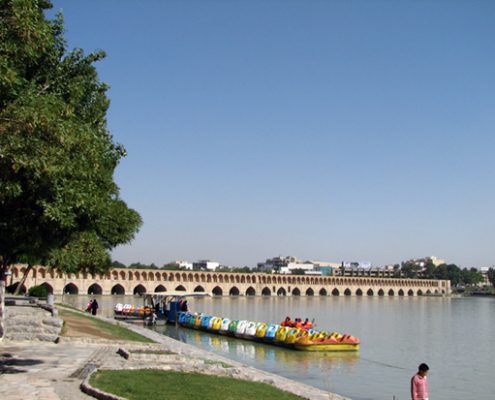
Si-o-Se Pol, a Safavid bridge in Esfehan

Si-o-Se Pol, a Safavid bridge in Esfehan


As the name explains it, the reproductive river, gives life to the farms all along it for 400 km, creates perfect living condition for people, etc. There are parks on both banks of the river for kilometers and this lets the people from Isfahan and environs to spend some time relaxing at the shade of the trees, stroll with friends and family and revitalize themselves and enjoy their time.

This river has been redirected in form of narrow streams of water snaking through residential areas and irrigating trees on both sides of it thus creating shady neighborhoods and stunning ambiance. Some of the royal gardens of Safavids (16th to 18th centuries) were irrigated this way.

City Planning of Esfehan

A lot can be said about the city planning at this beautiful city, but I suffice to what can be seen immediately. First of all, it’s green. You see several fully-shaded streets with pleasant sidewalks for pedestrians. There are some major boulevards like Chahar Bagh that split the city into Eastern and Western halves. There’s such a broad shaded space in the middle of the street that city hall has placed benches for the people to sit down and relax.

Like I’ve mentioned before, there are parks all along the river on both Northern and Southern banks. You can go jogging, walking, etc for hours. You can go on a picnic like the majority of Iranians do. You can hire a boat and go peddling. There are fabulous bridges with traditional tea houses attached to them where you can sip your tea while enjoying the sound of water and watching the life going on around you.

There are also good highway system that helps you make your inner city trips shorter at the outskirt of the city. A lot of overpasses and underpasses have been constructed to ease the traffic.

The way the city hall is working, like in most of the cities in Iran, the streets and alleys are all very clean. The street sweepers are working around the clock and people care very much about the cleanliness and attractiveness of their cities.

Historical Monuments of Esfehan

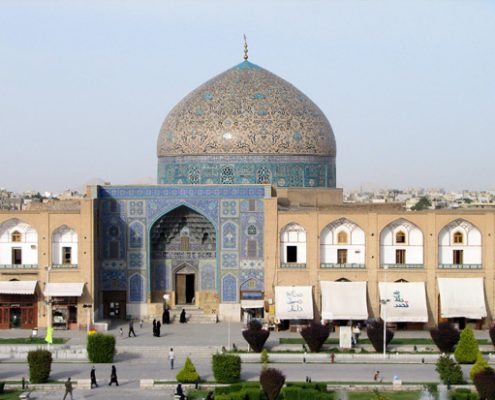
Sheikh Lotfollah Mosque in Isfahan

Sheikh Lotfollah Mosque in Isfahan

Needless to say, when you visit Isfahan at the end of your tour to Iran, you leave the ultimate beauty of Islamic architecture to be seen during the last days of your stay in this country. Iranian architecture of each historical era has got its own charm, but when it comes to the structural techniques, tile glazing and decorating skills, there are no other old monuments in Iran that could match the buildings in Esfehan.

The famous Naqsh-e-Jahan Square (Emam Khomeini Square) is the heart of the historical city. The early 17th century square with its monuments and set of shops all around it has created a unique setting you won’t see anywhere else in Iran. The royal mosques, palace and the famous Qeysarieh bazaar have all contributed to make this place an unforgettable one.

There are other mosques like the old Friday mosque of Esfehan that are astonishing and worth visiting. There are other palaces like Chehel Sotun and Hasht Behesht that couldn’t be ignored while you’re in Esfehan. The old bridges and the arches on which the bridges are built together with their illumination at night are the attractions you cannot simply cross out of your list.

Handicrafts of Esfehan and Its Artists

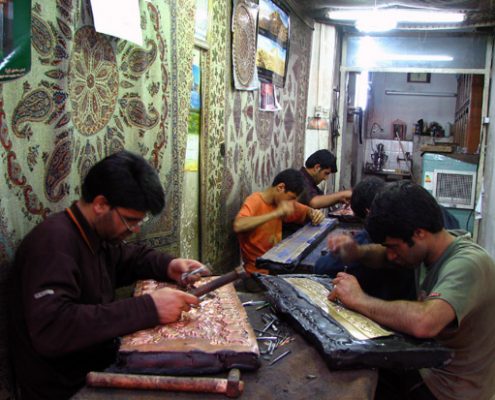
A group of craftsmen working in a metalworking workshop in Esfehan

A group of craftsmen working in a metalworking workshop in Esfehan

There are several workshops and art galleries where you can see the actual artists and craftsmen who are creating beautiful works of art. Out of approximately 150 different handicrafts produced in Iran, almost half of them are made in this city. Great collections of artistic works, carpets, miniature paintings, etc make Esfehan the city to do the shopping during your stay in Iran.

The globally recognized Iranian miniaturists who are working in their galleries in Esfehan, are open to welcome travelers in their shops. These people are keeping this Iranian art alive by following the traditional styles of centuries of miniature painting in Iran.

Armenian Quarter of Jolf

On the Southern bank of the river, where the community of Armenians have settled since 17th century, the time of Shah Abbas the first, Jolfa is the quarter worth visiting for both its fascinating churches as well as culture. There are lots of good coffee shops here that you can enjoy spending time in and having something to drink. Coffee is part of Armenians’ culture. So, if you want some good ones in some interesting ambiance, Jolfa is the place.

People

The last but not the least is hospitable local people, who are so proud of their city and happy to welcome foreign travelers. Even among Iranians, this is an attractive destination and every Noruz, Iranian New Year,  as well as summer holidays, there are millions of Iranians who visit Isfahan and explore its beauty. So, the local people have got the reason to feel proud of their legacy.

Esfehan, because of what you’ve read so far, is the place where people have been exposed to tourists very much. Tourism has brought business and employment to the city. The local people are happy to see tourists and are helpful to them.

In general, if there’s a reason why some travelers come back to visit Iran again and again, it’s the people who are kind, generous and welcoming. You have to see it for yourselves to enjoy it.

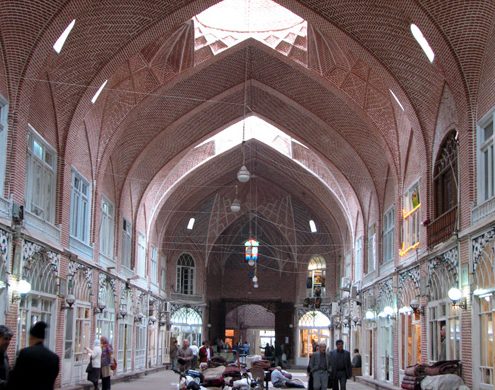
Carpet Shops in Tabriz Bazaar

Carpet Shops in Tabriz Bazaar

The bazaar of Tabriz is one of the top tourist attractions of the city. No tours to Iran or trips to the North West of the country makes sense without including Tabriz bazaar in it. This roofed bazaar is one of the oldest in the Middle East, and according to some people, the largest of its type in the world. The fact is this place is awesome and highly recommended to visit.

History of Tabriz Bazaar

In fact, the history of this bazaar goes back to the time of Seljuks, 12th century. As Tabriz has been on the main trading route of the east-west and Silk Route, its bazaar had gained a very significant place as the economy heart of a large city in prosperous Persia. All throughout the history, travelers and historians have mentioned in their notes what has continually contributed to the popularity of Tabriz bazaar is the abundance of commodities like fruits, high-quality textile, precious stones and gems, etc in this city.

When Baghdad was destroyed by Mongols in 13th century, Tabriz gained even more importance. In 14th century, it prospered so much to the point that Marco Polo and Ibn Battuta described it as one of the richest trading centers in the world. In 16th century, under Safavid rulers, Tabriz was brought to the center of attention and its bazaar showcased the economy of the country. Manufacturing of items made of copper and leather was increased. Making of weapons, rugs and soap was boosted.

In 17th century, when Shah Abbas I moved the capital city from Tabriz, the bazaar lost part of its importance but kept it somewhat both in the city as well as North West of Iran till now. Despite several shopping centers and other trade areas in Tabriz, many people still prefer to go to this place for their shopping needs.

A devastating earthquake in late 18th century brought a lot of damages to the city as well as its economy and the bazaar. In 19th century, Tabriz bazaar was flooded and was subject to lots of damages.

As I’ve already mentioned about the bazaars of Iran, one shouldn’t look at bazaars as traditional shopping centers of the old times. They are a lot more than that. For instance, they have had a decisive role in the politics of the country. They have played major roles in solidarity with religious, revolutionary and economic movements in Iran. They are living communities in which plenty of life is continuing. That’s why the House of Constitution, where revolutionaries used to hang out in approximately one century ago,  is at the periphery of Tabriz bazaar.

It was in 20th century that the city economy thrived and its bazaar was largely repaired and reconstructed. Tabriz bazaar played a major part in supporting Islamic revolution in 1979.

Various Parts of Tabriz Bazaar

Tabriz Bazaar is a large compound that consists of several caravansaries, Tim, Timcheh, Sara, Saracheh, etc. The gradual formation and combination of these sections have interconnected them functionally to one another so that best services could be rendered to the customers and merchants while local traders could provide, sell and distribute the products most conveniently. Among all these sections, you may find Amir Bazaar (for gold and jewelry), Mozzafarieh (a carpet bazaar), a shoe bazaar, etc.

If you ever take a tour to Iran and visit Tabriz bazaar, make sure you remember spending some time in one of its traditional tea houses. The setting, decoration, style of serving tea and set of tall water pipes on top of all tables are spectacular. Water pipes at Tabriz traditional tea houses are not anything recently added for fun or popular among young generation. The customers seem to take smoking more seriously than how young guys do the same.

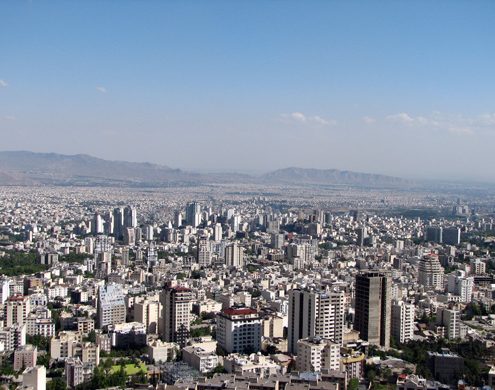
Tehran, the Capital City of Iran

Tehran, the Capital City of Iran

Tehran, the capital city of Iran has got plenty of interesting things to offer to culture-oriented travelers. It is highly recommended to visit Tehran at the beginning of your trip to Iran for several reasons. Everything happens in Tehran first!

Visit Tehran to See Its Modernization Process

When you take a tour to Iran, make sure you spend some time in Tehran. The very first observation of any traveler to Tehran is its size, number of cars, crowd of people, etc. A city with an area of 750 square kilometer and the population of over 8,500,000 cannot continue its traditional life. It has to shift its nature into a modern one. This transition is an interesting one. Visiting Tehran provides an opportunity for you to explore its modern aspects.

Visit Tehran’s Cultural Centers

There are lots of Culture Houses in Tehran in which various activities are performed. There are art classes, movie theaters, art exhibitions, book stores, etc.

There are several theater halls in Tehran where different plays are performed. Artists are supported by local enthusiasts who are keen fans.

Iranian movie industry has gained huge amount of global attention in post-revolution era. There are good numbers of new movies made in Iran for their fervent fans. Most of these actors and actresses are from Tehran.

There are some music concerts from time to time in Tehran where pop, classical, traditional, etc musicians play and sing for the music lovers. The frequency and size of such events in Tehran are much larger than those of other cities of Iran.

Visit Tehran’s Museums

Tehran’s Iran Bastan museum is the best of its category among the national museums of Iran. The exquisite items on display at this museum can give you a thorough insight in what you will go through during your tour to Iran.

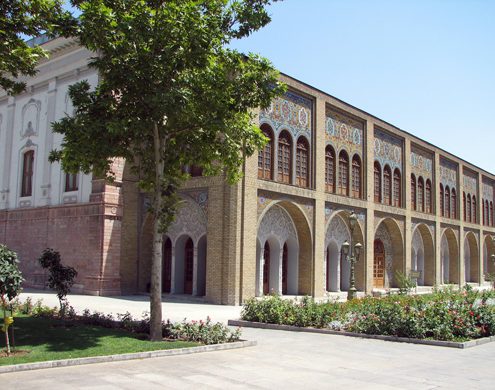
Golestan Palace Compound in Tehran

Golestan Palace Compound in Tehran


Royal palaces of Qajars in Golestan palace compound are great examples of architecture at this period. Also, the items showcased at its galleries provide you with a view on Qajar kings’ lifestyle. Sa’ad Abad palace compound as well as Niavaran palace compound introduce the lifestyle of Pahlavy dynasty that ended in the revolution at 1979.

Museums of various arts like contemporary arts, Under-Glass Painting, calligraphies of Reza Abbasy, Glassware and Potteries of Abgineh, etc are the best in their genres. The unique Treasury of National Jewels leaves every visitor in great shock with nothing equally dazzling and ornate anywhere in the world.

Carpet Museum presents its visitors with an exclusive collection of the best examples of Iranians’ art in one place. The items on display at this museum cannot be found anywhere else in any carpet galleries or stores across Iran.

Parks in Tehran

There are lots of parks and green areas in Tehran and a lot being planned to be opened to public. In addition to the obvious use of fresh air and peaceful setting of parks, there are other activities going on in these places. Some parks are just for women. Some offer classes on various traditional and modern arts. Some are hangouts for certain groups who exercise on regular basis. And a lot more …

Shopping Malls

Bazaars are not the only centers of purchasing goods anymore. People need a different type of place for their shopping. Shopping malls of Tehran are not the largest ones in Iran, but the quality of the items offered there are some of the best. Entertainment areas for children, coffee shops, restaurants, etc are among the points of interest at such places. Taking a walk in one of such places in Tehran provides good comparison point when you travel to the traditional cities of Iran.

Skiing Resorts

If you happen to arrive in Tehran in skiing season, there are a couple of possibilities to go skiing around the city. The largest skiing field in the Middle East is in Dizin, close to Tehran. You may take a skiing tour to Iran in Winter as well.

Mountain Hiking

Every weekend in Iran, Thursdays and Fridays, lots of people go hiking and walking at the mountain paths located at the north of Tehran where the high mountains are. This sport activity happens during weekdays as well, but if you want to see large number of people, make sure you choose weekends.

Explore Rasht Traditional Bazaar in Iran

Explore Rasht Traditional Bazaar in Iran

I want to explain the benefits of private tours to Iran versus group tours traveling inside Iran. By private tours, I mean the high-quality journeys you agree upon so that you achieve goals that are otherwise hard to achieve due to the group nature of the trip.

In private tours, you will decide who will travel with you, what the itinerary is, etc and you will make major decisions of your trip.

Here is, therefore, a general list of what could be gained in this style of traveling:

1) You Plan Your Private Tours inside Iran

Unlike group traveling prearrangement, you are in the process of selecting a tour itself from the beginning, asking for details, customizing the tour, adding your personal touch to it, reducing the less attractive parts, etc. As a result, the outcome will be what you’ve designed yourself to be the way you enjoy it most. Group traveling doesn’t offer you this opportunity.

2) You Spend Desirable Time Everywhere

In practical part of the journey, the final decision is yours. Although in a guided tour, you ask your guide about the possible time in each sight so that you can bring the day to an end in a suitable way, it will be you to decide if you want to be absorbed by the beauty and richness of a sight and skip others or leave a place sooner so that you spend more time somewhere else.

This could be a highly useful benefit as the variety of sightseeing in a well-planned private tour to Iran could offer so much that you would need to apply changes on the spot. Group tours in Iran or other destinations don’t provide such possibilities.

3) You Eat Whatever at Anywhere You Want

What’s your favorite dishes among the possible choices in Iran? Do you have any preference regarding how much and when you eat? Are there settings you prefer to eat in? These and other interests of yours could be under your complete control when traveling privately in Iran. Lots of Iranians love going on picnic and eat out that way. Many go to restaurants of different styles, particularly traditional ones. You can choose whichever you like.

Some nationalities are used to have one hot meal a day whereas others prefer two. For some, lunch is a major meal while others take a bigger meal at dinner. Time of eating, frequency of eating snacks, brunches, upper-class restaurants, less expensive popular places, etc are all waiting for your decision.

4) You Communicate with Locals

There are lots of aspects of Iranians’ lives that are unknown to the people of the world. You may want to get more detailed information about political structure and functionality, marriage and divorce, land and property ownership, education and employment, women and their professional lives, etc. While having a guided private tour to Iran, you can ask plenty of questions.

Iranian tour guides are very well-educated and aware of the societies they’re living in. They have gone through some higher education and speak foreign languages proficiently. You can learn a lot by asking your guide. Also, being exposed more to the local people in tea houses, sights, restaurants, etc, you will notice that Iranians like to see foreigners travel to their country and they will be happy to communicate with you. In the limited time during group tours, this won’t be easily possible.

5) You Further Customize Your Trip

Sometimes during the trip, you may want to spend a couple of days more in Tehran at the end of the tour, relax a bit in a neighboring country, etc. During the journey, if there’s sufficient time to do so, you can ask the tour operator to apply these changes for you. Such services are catered to your requirements and can be done.

6) You Spend Better Time for Shopping

In a group tour, limited time will be allocated to the group for shopping. In a private tour to Iran, you can ask your guide or driver to take you to specific places so that you can spend more time on finding what you like to buy without the hassle of group’s deadline to go back to the bus, hotel, etc.

You can stop on the way, go to some local shops where buses won’t stop, to look for what you would want to purchase.

7) You Can Stop Anywhere to Relax

There are sometimes long distances between the cities and you may get tired of sitting in the car. You can ask your driver to stop somewhere to stretch your legs, buy some snack, get some fresh air, etc. This can be done as much as you want and anytime you want during a private trip to Iran.

Therefore, there are several benefits in taking private tours to Iran that could make your journey an enjoyable and unforgettable one.

Citadel of Karim Khan e Zand

Citadel of Karim Khan e Zand

While reading and preparing to take a trip to Iran, you will easily notice there are a lot of historical sights and monuments to visit in each part of the country. Shiraz is also an ancient city with several old monuments still standing in good conditions. What you read here is an introduction to one of the most outstanding structures remained from Zand Dynasty, 2nd half of 18th century, Arg-e-Karimkhani .

Arg-e-Karimkhani (Karim Khan Citadel)

This structure can be easily found at a corner of Shahrdary Sq close to Shiraz bazaar. The appearance of the building resembles a solid fortress entirely made from bricks with military as well as residential functions. The construction of Karimkhan Citadel goes back to the second half of 18th century when Karimkhan-e-Zand was ruling in Iran from Shiraz, his capital city.

The structure reminds you of the plain brick-made buildings of 11th and 12th centuries when Seljuks were ruling in Iran. The corner bastions are very robust and decorated with bricks. One won’t realize how delicate some of the details inside the building could be without exploring it. At the south eastern corner of the citadel, a bastion is leaning like it’s going to fall down! It’s been like that for years and has been reinforced to stand on its place.

Above the entrance gate, you will notice a sizable tile-worked scene of Rostam’s battle against a demon. Rostam is the protagonist character of Shahnameh, the epic poem book of Ferdowsy, the most well-known Iranian poet of 10th and 11th centuries. After entering the vestibule a corridor leads you into the large courtyard with an astonishing orange garden!

The garden inside the large courtyard of Arg-e-Karimkhani takes approximately up to 80% of the area. The rest, courtyard floor, is all covered by marble stone from the time of construction. A pathway from the center of the garden leads to the middle of each side of the courtyard opposite a portico leading to some of the rooms of the building.

Main Rooms of Karimkhan Citadel

As you enter the courtyard from the vestibule, at the opposite side of the courtyard, under the large wind catcher, there’s a portico that could be seen right away. Inside the beautifully decorated rooms of this section, attractive wax statues revive the setting inside the court of Karim Khan where he met with officials and ruled over the territories under his domination.

The fresco embellishment of the walls and ceilings are fabulous examples of how beautifully Zand art vitalized official and non-official buildings of that period. A combination of gold leafs with relatively dark red colors were used to give elegant taste to the interior walls of the royal buildings.

Adjacent to this mail room, sometimes a couple of other rooms are opened to the public to see the local costumes of Iranian women of various ethnic groups. The colorful gowns seen here are still worn by local people when you travel to different parts of Iran.

Bathhouse of Arg-e-Karimkhani

On the very south eastern part corner of the courtyard, there’s a door that leads to the Arg-e-Karimkhani’s bathhouse, Hammam. This handsome bathhouse has got all the architectural sections of any similar structures, which make it worth a visit. The simple yet likable plasterwork decorations on the walls of this hammam, imply the love in flowers and nature, what Shirazi artists have always been inspired by.

Marble floors and seats, insulated pools for hot and cold water, clay-made pipes for heating beneath the floors and transferring water, and so forth are all observable and the echo returning your voice inside the big hall of this hammam reminds you of the lively setting of old bathhouses where royal family met and had themselves washed and massaged by the servants.

Pars Museum of Shiraz inside Nazar Garden

Pars Museum of Shiraz inside Nazar Garden


Pars Museum is a relatively small yet magnificent building constructed inside Nazar garden during late 18th century when Karim Khan Zand was in power in Shiraz, his capital city.

It’s part of a royal project where several buildings were built for the administration of Zand court and the public use of Shirazi people. Other buildings at this project include Arg-e-Karimkhani (Karim Khan Citadel), Vakil Mosque, Vakil Bazaar, Vakil Bathhouse, etc.

Location & Appearance of Pars Museum

This museum is a pavilion located inside Nazar garden, which goes back to Safavid period. While traveling in Iran and visiting historical monuments of Shiraz, you can find this site relatively opposite Karimkhan’s Citadel at a corner of Shahrdary Sq.

The garden used to be larger than what it is today, but it’s large enough to accommodate the building of this museum. The pavilion was called Kolah Farangy (foreign hat) building, a name attributed to similar buildings constructed after the influence of European arts in Iran.

The building itself is octagonal in shape from outside. The exterior of Pars Museum is decorated by beautiful tiles decorated with floral patterns and tree-of-life design where lots of birds and flowers are depicted in delicate harmony. The multi-sided design of this structure makes it look like burial buildings.

Since 1934, it was decided that it should be used as a museum. Therefore, some very exquisite items have been displayed inside the showcases of Pars Museum. The interior walls are elegantly embellished with Zand style frescoes and specific color combinations of the period, dark red and gold.

The inner space of the museum resembles a cruciform plan where showcases are arranged. On the walls, there are also, small items inviting art-appreciating eyes to themselves.

Karim Khan received dignitaries, officials and other VIPs at this building. As a matter of fact, it was a small hall for particular meetings.

Attractive Items on Display at Pars Museum

Some of the fascinating water-color paintings of Suratgar-e-Shirazy, the well-known Zand period artist, are on display here. There are beautiful calligraphic styles on old Qorans, spells, etc with high levels of artistic value. Also some very interesting armors and cold weapons (daggers and swords) are on display.

The burial place of Karim Khan Zand is also here at this pavilion. His tomb stone can be seen inside as well.

Inside Shabestan of Vakil Mosque in Shiraz

Inside Shabestan of Vakil Mosque in Shiraz

Today, when you are traveling in Iran and visit Shiraz, Vakil Mosque is a must-see for both Iranians and non-Iranians visitors. Karim Khan, the founder of Zand dynasty in 18th century, built it as part of his grand development project in the heart of his capital city. The mosque is connected to Vakil Bazaar and almost attached to Vakil Bathhouse with a lane in between. Before you enter the mosque, you can see one of the corridors getting you to the middle of the main passageway of Vakil Bazaar on the left-hand side. Therefore, there has been easy access from different directions for everyone to find their ways to the mosque.

Specifications of Vakil Mosque

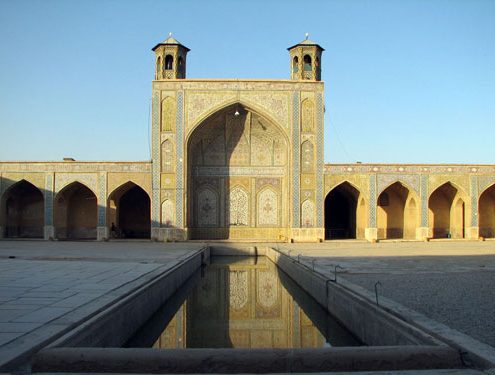
The entire structure is extravagantly built with spacious sections in mind. There’s a vast courtyard with a relatively long pool in the middle of it. Around the courtyard, there are two eyvans (iwans) at the Northern and Southern sides in a symmetric way. On Eastern and Western sides, there are not any eyvans hence finalizing the structure as a twi-eyvan courtyard plan.

Courtyard of the Vakil Mosque in Shiraz, Iran

Courtyard of the Vakil Mosque in Shiraz, Iran


The vast courtyard is covered by stone slabs, which has recently undergone some reconstruction and new slabs have been installed. Such flooring is extended from all corners to the central pool and vise versa. As there’s no garden in the courtyard, this flat space has added to the greatness of the courtyard and allows the beauty of the tile façade of all sides shine and project their livelihood.

The decoration on the Shirazi “haft rangi” (seven-color) tiles of the entrance portal and these two eyvans are eye-catching and similar. Tree-of-life patterns are clearly occupying major parts of these sections giving a peaceful wave to the square feel of the façade tiles.

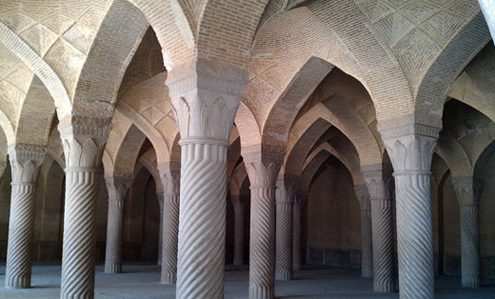
At the Southern Eyvan, there’s an entrance leading to a roofed columned hall (shabestan) with 48 monolithic pillars joining one another on top through vaulted brickworks. The pillar shafts are carved in a spiral way and decorated in form of acanthus leaves at their capitals. Color of the stone pillars and those of brick-formed ceiling match.

All ceiling decoration has been made by plain bricks except the one line coming from the southern eyvan directly toward the mihrab of the mosque. This part is an amazingly splendid corridor-like pathway set by its ceiling tile decoration embellished by Shirazi “haftrangi” (seven-color) tiles.

Famous Minbar of Vakil Mosque in Shiraz, Iran

Famous Minbar of Vakil Mosque in Shiraz, Iran


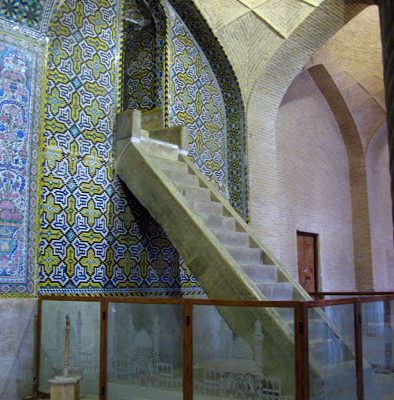
The builders of the mosque have made a minbar (preacher’s seat) out of a piece of green marble with a flight of 14 steps leading to the seat on top. This minbar is an exemplary work at Zand-period mosques.

Visit Zand Monuments during Traveling in Iran

It won’t easily happen to see several Zand monuments when you are traveling in Iran unless you visit Shiraz and pay a visit to such sights. Therefore, I cannot recommend enough spending some quality time in these buildings and quench your thirst for the taste of Zand architects and their masterpieces. Also, Shirazi artists have their own lively touch no matter which period they have been living in. That’s why I think you won’t regret spending more time at this beautiful city.

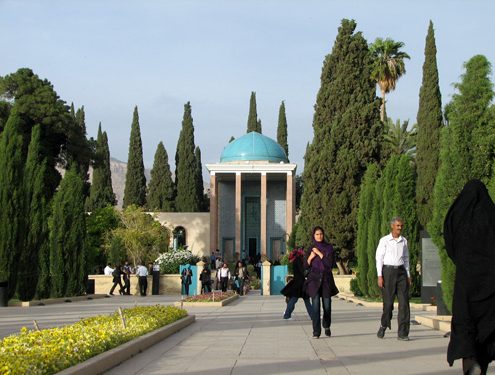
Mausoleum of Saadi Shirazi, The Persian Poet of 13th Century

Mausoleum of Saadi Shirazi, The Persian Poet of 13th Century

The mausoleum of Saadi, known also as the tomb of Sa’dy or Sadiyeh, is one of the major tourist attractions of Shiraz. Huge number of Iranians and non-Iranians pay a visit to this burial place and show their respect to Saadi and interest in his works, prose and poems. This Iranian poet is a globally known scholar whose words have touched many hearts across the world and wakened up many minds to take new steps in their lives to reach higher levels of humanity. The ambiance of this location is much more attractive than its architecture although it has got interesting character by itself.

A Few Words about Saadi

Saadi lived in 13th century, but he’s a man for all centuries. The rich depth of his writings and ideas with social and moral values have gone beyond time. His words have been quoted by Persian speaking people inside Iran and outside alike. Even Western sources have quoted him and continue to do so. He’s  widely recognized as one of the great masters of classical Persian literature. Some even title him second only after Ferdowsy whose position for saving the Persian Language is unparalleled and no one could even do what he did.

The reputation of Saa’i in Persian literature is because of his eloquence in using the language. After 8 centuries, his works are still easy to understand and his ideas are still admirable for the speakers of the language. His style of Farsicizing borrowed words from Arabic in Persian made it a lot easier to use those words in everyday use and understand them although Arabic was not a language of the same origin as Persian.

Saadi was a man of learning. Spending infancy and childhood without a father and going through youth in poverty and hardship never stopped him from pursuing learning. Therefore, he left his birthplace to Baghdad where Nezamieh university was the center of knowledge and many studied there in the Islamic world. Among various subjects that he studied there, he proved to be excellent in Arabic literature, Islamic sciences, history, governance, law and Islamic theology.

Saaadi was a man of traveling. Mongols invasion and unstable situation in Iran led him a lifetime of living abroad in various countries like Anatolia, Syria, Egypt,Iraq, Sindh (Today’s Pakistan), India, Central Asia, Hijaz (Today’s Saudi Arabia), etc. Eventually, after 30 years, he returned to his birthplace as an elderly man and was welcomed and highly respected.

He was titled “Sheikh” because of his knowledge and found followers who pursued his values and words.

Saadi’s Literary Works

Saadi’s Mausoleum inside a Persian Garden, Shiraz, Iran

Saadi’s Mausoleum inside a Persian Garden, Shiraz, Iran

Within two years after his return to Shiraz, Saadi wrote his two most famous books: Bustan, also known as Bostan (The Orchard) in 1257 and Golestan, known as Gulistan (The Rose Garden) in 1258. Bostan is entirely in verse introduces moral virtues and Gulistan is mainly in prose containing stories and personal anecdotes.

His works in forms of Lyrics and Odes are also well-known by the enthusiasts of Persia literature. He has created some works in Arabic as well.

I’d like to quote one of his most famous works. There are several translations of his works, but I’d rather use the one by M. Aryanpoor as below:

Human beings are members of a whole,
In creation of one essence and soul.
If one member is afflicted with pain,
Other members uneasy will remain.
If you’ve no sympathy for human pain,
The name of human you cannot retain!

The Construction & Architecture of the Mausoleum of Saadi

Tiles Decorating the Entrance of Saadi Mausoleum

Tiles Decorating the Entrance of Saadi Mausoleum


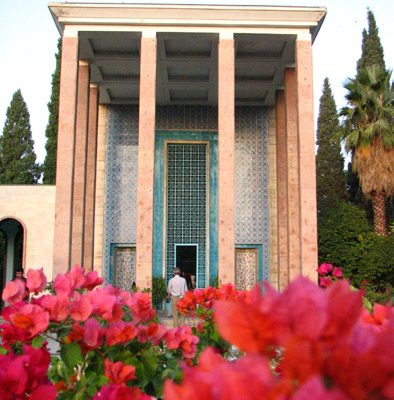
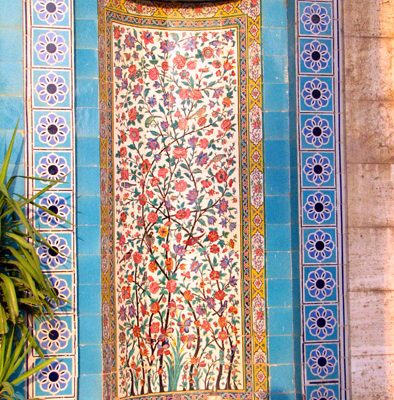
Saadi was buried in a village outside Shiraz which is now part of the city although it’s at the outskirt in a relatively poor neighborhood. Under Karimkhan-e Zand, the 18th century ruler of Shiraz, the present Saadi’s mausoleum was built to further honor him. It’s in form of a multi-sided building with a cupola on top. From outside it may look like a square structure due to its flat facade decorated with Shirazi tiles depicting tree of life in various colors. Inside, you can see the 8 corners of the building and large lamp hanging from the ceiling. His grave is beautifully carved in Persian.

Later this building was connected to another tomb of a Shirazi poet, Shurideh Shirazi by a colonnade portico. Under Reza Shah, the father of the last Shah of Iran and founder of Pahlavi dynasty, the mausoleum was restored and annexed by some newer parts. Andre Godard, the French architect had been assigned the task of restoring several historical monuments in Iran and so forth.

The Mausoleum of Saadi is located inside a garden where beautiful flowers and several cypress trees are planted to make the setting even more beautiful. A fish pond in an underground reached by some steps lead visitors to some water channels that has been in use since the time of Saadi at this place. Today there’s some fish crossing channels and coming to the center where people can see them.

Recently, as more and more people come to this place to visit Saadi’s Mausoleum and show their respect to the poet, the garden has been enlarged and can accommodate three times more visitors in it.


Mausoleum of Hafez in Shiraz, Iran

Mausoleum of Hafez in Shiraz, Iran

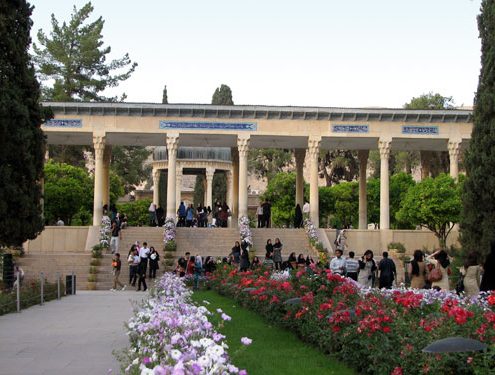
You should visit the mausoleum of Hafez if you go to Shiraz. Hafez is the 14th century poet of Iran who was born, lived and died in Shiraz. Iran was ruled by Ilkhanid era. Shiraz exceptionally escaped the devastation and massacre of foreign Mongol invaders. Yet, living was tough and difficult for the intellectuals who wanted to express themselves and criticize the ruling system. This led Hafez to use figurative language in his works, a feature that has added to the beauty of his poems.

Father of Hafez was a wealthy merchant who died and left him and his mother in poverty. Therefore, he had to work hard and spend some time working in a bakery. However, he proceeded in learning literature and soon proved his proficiency in composing Persian poems. Many were attracted to his poems and since then he’s considered the master of Persian ghazals and no one else has been able to create such literary works.

Despite all dreadful restrictions when nobody could violate from the authority rules, Hafez used his tactfulness and brought his ideas to the public in the language of poetry without being a victim of his bold action. This quality is called “Rendy” in Persian.  He mentioned several concepts of human life in his works, but one concept has always been continually present in his works – love.

The reputation of Hafez went beyond the borders of Iran and found some followers in India. Gute, the German poet was later inspired by him. When Hafez died, he was buried in the graveyard of Shiraz. That area has been the cemetery of the city. That’s why even today there are lots of graves in that area and some family tombs can be seen in the vicinity of the mausoleum of Hafez.

The Architecture of Hafez Mausoleum

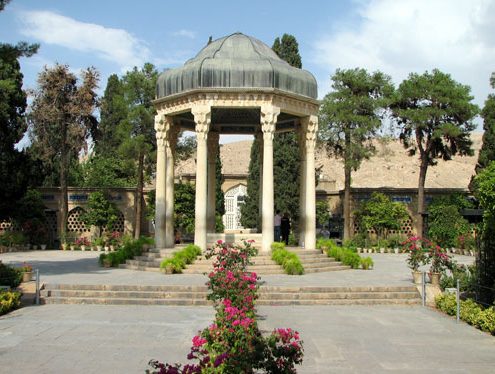
Colonnade Portico divides the garden into two parts between the entrance and the tomb itself

Colonnade Portico divides the garden into two parts between the entrance and the tomb itself

Under Karimkhan-e-Zand, a mausoleum was built to honor Hafez at his burial place with eight pillars supporting a roof made of copper. The ceiling of the mausoleum of Hafez  is decorated with mosaic works that shines in lively colors. This structure is located in a garden with family tombs on one side and a wall decorated by arches on the other side. Lots of flowers are planted and always kept in good condition by the organization in charge of maintaining the garden.

Under Reza Shah, the founder of Pahlavy dynasty, the last ruling monarchs of Iran, beginning with 1925, more redesigning of the mausoleum occurred. Andre Godard, the French architect was assigned the task of expanding and replanning the garden to make it more beautiful. As lots of visitors from inside and outside Iran go to this mausoleum everyday, more pace is needed. Therefore, the adjacent gardens have been connected through new doors recently to provide more space for the people.

A foundation of Hafez enthusiasts has got an office in the mausoleum of the poet. It’s located in a beautiful building to the west of the the main tomb. Together with the office of the mausoleum, this foundation hold exhibitions, provides information, etc to make this famous Iranian poet and poetry-related traditional arts more known to the public.

How Iranians Visit The Mausoleum of Hafez

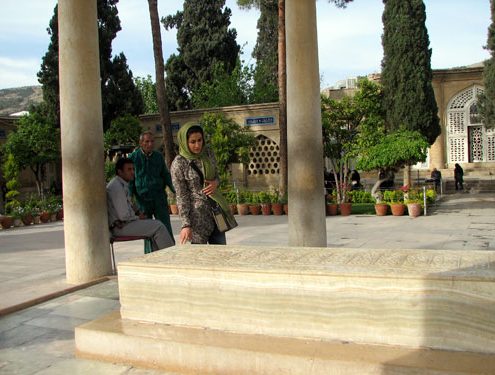
Iranian woman praying at Hafez tomb

Iranian woman praying at Hafez tomb


For Iranians, visiting the Hafez tomb is like going to a relative’s tomb. The feelings, of course, are more with respect than grievance. Some bring rosewater to wash the tombstone and put some flowers on the grave. Then, they touch the tombstone with few fingers praying by reciting a chapter of Koran to ask for blessing of his soul. Some proceed to request Hafez to talk to them through his poems and tell them about the state of their lives or give them some wise advice through the words in his poems. Then, they open their eyes and open the book on any page it randomly opens and continue to read it enthusiastically.

The concepts and topics mentioned in Divan-e-Hafez, his complete works, are so life-related and overwhelmingly attractive that one connects to them easily as if the poet is living at this time and offers us his wise words in a friendly manner to enrich our lives. That’s why man y love him and keep reading his poems on a daily basis.