Naqsh-e Rustam, the Ancient Necropolis of Powerful Persian Kings

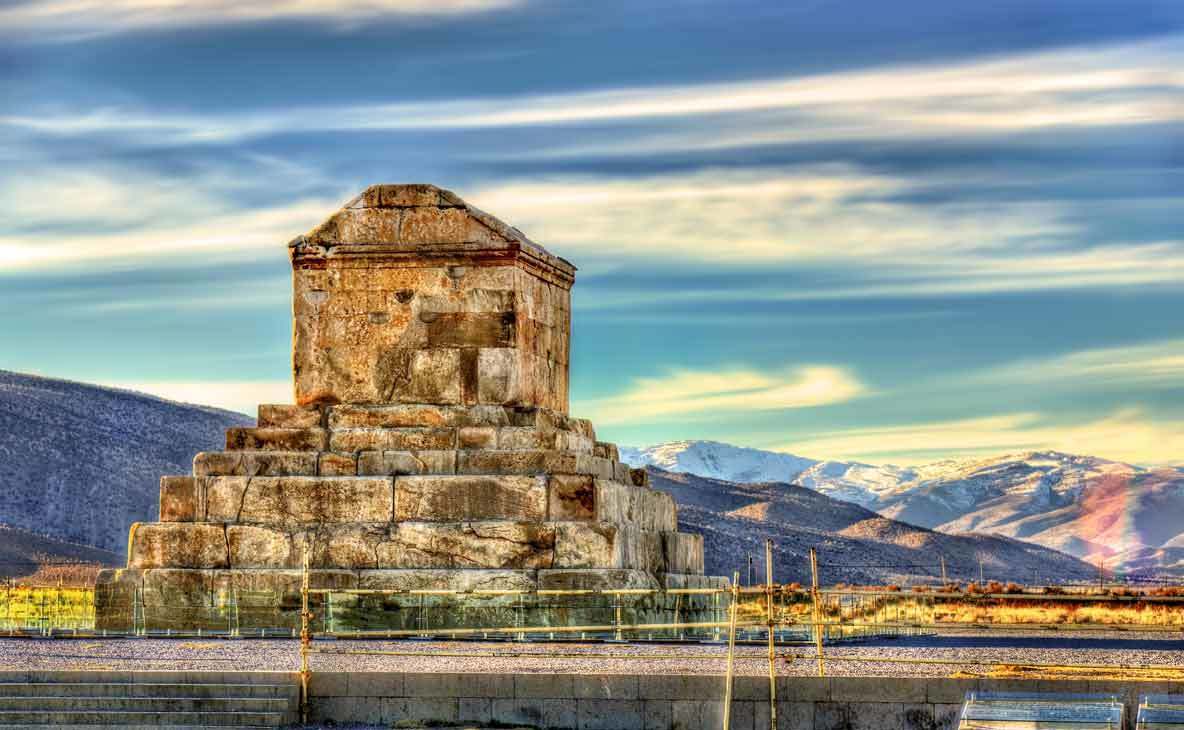
Naqsh-e Rustam is an ancient necropolis situated northwest of Persepolis, the capital of the Achaemenid Empire. Naqsh-e Rustam (Naqsh-e Rostam) is an impressive reminder of once glorious Achaemenid Persian Empire (c. 550–330 BC) and it stands as a magnificent manifestation of ancient Persian art. Naqsh-e Rustam is the house for the immense rock tombs cut high into the cliff. The rock tombs belong to four Achaemenian kings. The ancient tombs attracted Sasanian kings as well. They wished to imitate the glory of the Achaemenian kings; maybe that is why they created huge reliefs besides the tombs. The immense rock reliefs mainly depict the investiture scenes and the equestrian fights of the Sasanian kings. However, the history of Naqsh-e Rustam is not limited to  the Achaemenid and Sassanid periods. There is evidence that the site exists from the Elamite period.  An ancient rock relief dating back to Elamite period indicates that Naqsh-e Rustam had been a sacred place during the ancient times. That might be the reason Darius I ordered to carve his monumental tomb into the cliff at the foot of Mt. Hosain (Huseyn Kuh). His rock tomb is famous for its two inscriptions known as the king’s autobiography. The inscriptions indicate that Darius the Great had been the king who ruled according to justice. Travel to Iran and enjoy visiting so many great cultural attractions especially the great ones registered on UNESCO World Heritage List or waiting to be registered. Pasargadae, Persepolis, Naqsh-e Rajab that lies a few hundred meters from Naqsh-e Rustam, and Naqsh-e Rustam, the ancient necropolis of the powerful Persian kings are the best cultural attractions of Iran located in Shiraz, Fars province,.

Achaemenid Tombs

Naqsh-e- Rustam houses four rock tombs carved out of rock face. Since the façades of the four Achaemenian tombs look like Persian crosses- chalipa- some call it Persian Crosses as well. The entrance to each tomb is located at the center of the cross and it leads to a small chamber where the king’s body lay in a sarcophagus. It is not clear whether the bodies were directly put into the sarcophaguses or the bodies were exposed to a tower of silence, and then the bones were put there. What is certain is that the tombs were closed after the burial, but the doors were smashed and the tombs were looted after the invasion of Alexander the Great in the 4th BC.

Naqsh-e-Rustam-travel-to-Iran
Darius I standing on a platform in front of an altar and the winged figure of Ahuramazda

Ka’ba-ye Zartosht 

In front of the rock tombs, there is a square tower known as the Ka’ba-ye Zartosht that means the Cube of Zoroaster (Ka’ba is the famous monument as a holy site for Muslims located in Mecca). The structure of the building is a copy of a sister building at Pasargadae known as the Prison of Solomon; however, this building is a few decades older than Ka’ba-ye Zartosht. On the wall of the tower, there is an inscription in three languages from Sasanian time and it is considered as one of the most important inscriptions of that period. It is not obvious what the purpose of the building had been. It might have been a library for the holy books, a place to keep the holy fire, or maybe a treasury.

Naqsh-e-Rustam-travel-to-Iran
Ka’ba-ye Zartosht in front of the rock tombs at Naqsh-e Rustam

According to Persepolis fortification tablets, there must have been trees at Necropolis that apparently it refers to Naqsh-e Rustam. The experts believe that there must have been three lines of trees in the area between the tower and the tombs; however, it has been a long time since the trees have disappeared.

Sassanid Reliefs

Besides the tombs, there are seven over-sized stone reliefs dating from the 3rd century AD.  The huge rock reliefs mainly belong to the Sassanid period and they depict scenes of imperial conquests and royal ceremonies. What is amazing about the reliefs is that they indicate details of events carved in the heart of rough rocks. Therefore, they can give the visitors a visual insight into the spirits of the ancient times.

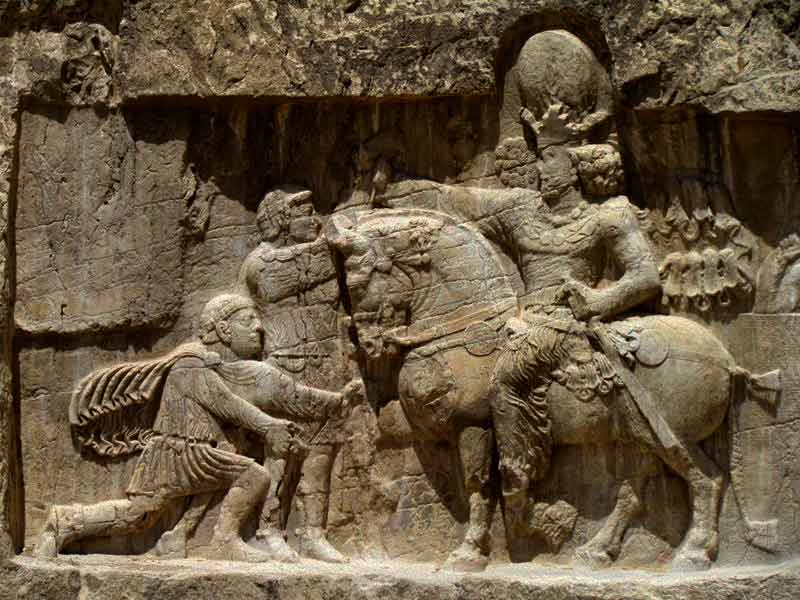
The most famous rock relief at Naqsh-e Rustam belongs to the Sasanian king Shapur I. The relief depicts his victory over two Roman emperors; Valerian and Philip the Arab. Shapur I is on the horseback, while Valerian is bowing to him and Philip the Arab is holding Shapur’s horse.
Naqsh-e-Rustam-travel-to-Iran
Shapur I celebrates his victory over two Roman emperors; Valerian and Philip the Arab

The investiture relief of Ardashir I as the founder of the Sassanid Empire is also depicted. The relief indicates Ohrmazd giving Ardeshir the ring of kingship. The inscription also has the oldest use of the term “Iran”.

There are also the equestrian reliefs such as equestrian relief of Hormizd II at Naghsh-e Rustam. The relief depicts Hormozid and above the relief, one would see a badly damaged relief that apparently is depicting Shapur II with his courtiers.

The relief of Bahram II depicts the king with an oversized sword. On the left, five figures stand and they seem to be the members of the king’s family. On the right, three courtiers stand and one of them is apparently Kartir- a highly prominent Zoroastrian priest.

The Oldest Relief at Naqsh-e Rustam

The oldest relief at Naqsh-e Rustam dates back to approximately 1000 BC and it dates back to the Elamite period. Though the relief is severely damaged, it depicts a faint image of a man with an unusual head-gear. He is thought to be an Elamite one.

Why Is It Called Naqsh-e Rustam?

Sassanid reliefs mainly depict equestrian fights or investiture scenes. Since the equestrian fights of the Sasanian kings represent the tales of chivalry, locals believed that the man depicted on reliefs was Rustam, the hero of Shahnameh. The epic of Shahnameh is the masterpiece of Ferdowsi, the great Iranian poet of the 10th and 11th the century. Therefore, the site is called Naqsh-e Rustam (meaning the carvings of Rustam); because the locals believed that the carved man on the reliefs was their epic hero” Rustam”.

Naqsh-e-Rustam-travel-to-Iran
Locals believed that the carved man on the reliefs was their epic hero” Rustam”

The history and design of Niavaran Palace

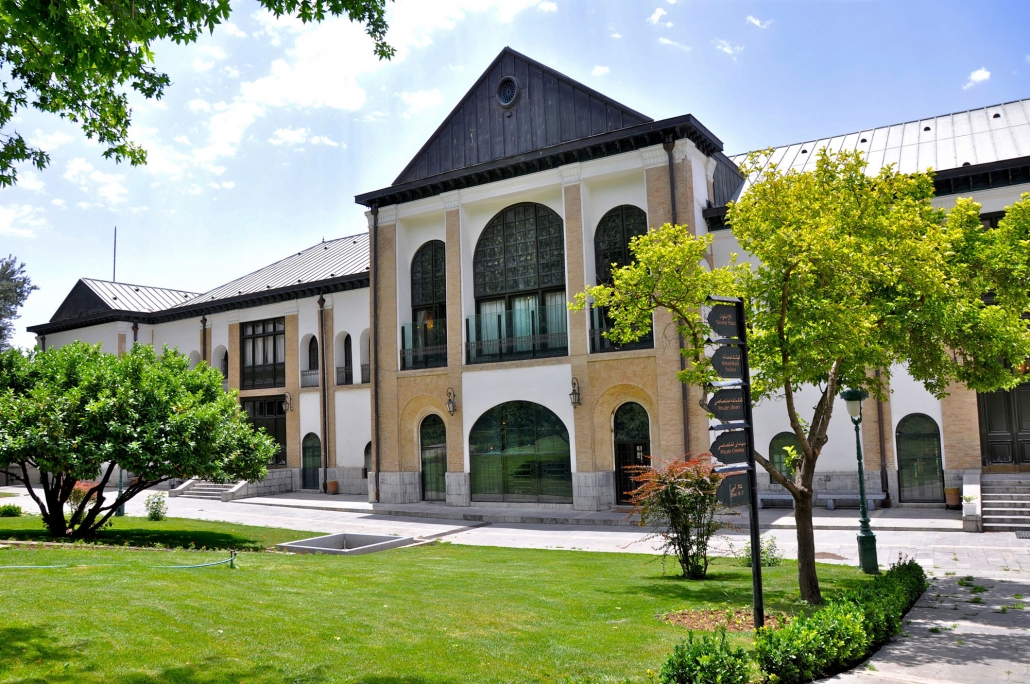
Culture tour to Iran includes visits to graceful attractions dating back to different period of Iran’s history. This article introduces one of the most splendid attractions in Tehran that should not be missed in your travel to Iran. There is a historical construction in the middle of an elegant garden in the northern part of Tehran called Niavaran Palace. Covering an area of 9000 square meters, it comprises five buildings. Niavaran Palace was in fact the famous Qajar king’s, Naser al-Din Shah, summer resort which was later expanded by Mohammad Reza Pahlavi. The main Niavaran Palace was completed in 1968, which was supposed to be a reception hall for royal guests, but changed into the royal residence later. The king and his royal family lived here until the Islamic revolution in 1979.

After the revolution, the palace was conquered by revolutionary forces, however, three years later it was transferred to Ministry of Culture and Islamic Guidance. The complex was open to public in 1986 for the first time.

Its interior design is inspired by Iranian architecture and a touch of modern technology. Although the interior decoration and furniture has been designed and implemented by a French group, a stunning combination of Iranian pre and post-Islamic art is evident in it. There are some precious paintings by Iranian and foreign artists, valuable French and German dishes and treasured Iranian carpets all over the place. The harmony of carpets and curtains is quite eye-catching.

The palace is constructed in two floors and a half; the first floor enjoys a great hall for VIP guests and several rooms including a dining room, waiting room halls and a private cinema. The bedrooms of all family members are situated in the second floor, the half floor was also allocated to Leila, the youngest family member. Its architectural design is by Mohsen Foroughi, plaster work has been carried out by Master Abdollahi, mirror work by Master Ali Asghar and tile works by Master Kazempour and Ilia.

Niavaran

Sahebqaraniyeh Palace

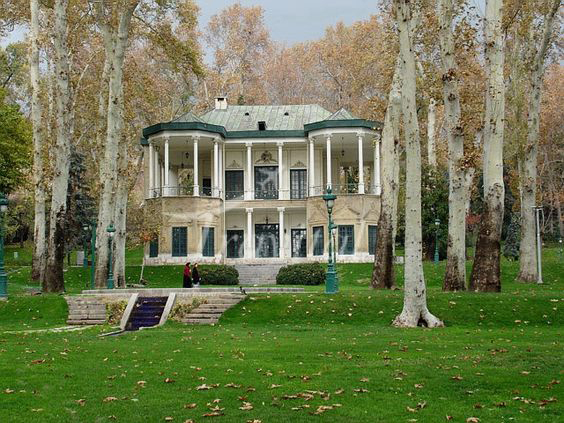
Sahebgharaniyeh is the oldest building of Niavaran palace which was constructed as a summer resort for Naser al-Din Shah, it became his favorite resort later; although, however, he never chose to live there permanently. His son Mozafar al-Din Shah made slight changes to the building later. And, the building underwent greater changes during Mohammad Reza Pahlavi reign.

Sahebgharaniyeh is a white building with green gable roof. Graceful Persian architectural elements such as mirror work, colorful glasses and delicate gypsum are noticeable in this construction. There are magnificent paintings everywhere in this palace, most of them portraying Qajar kings and landscapes in Iran.

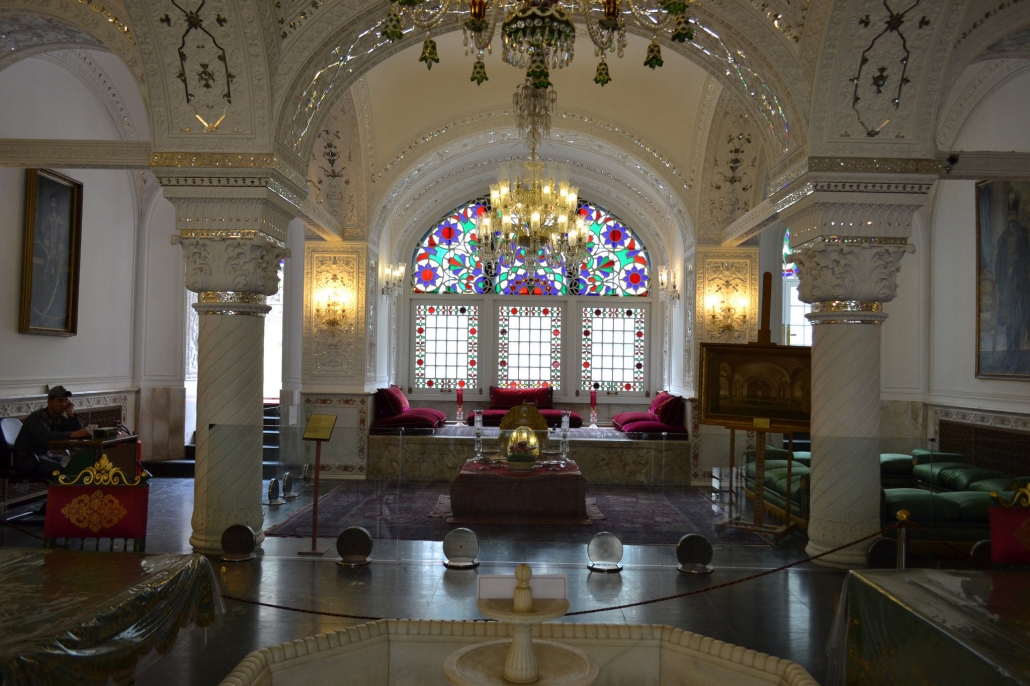
One of the most magnificent parts of this building is the mirror hall, which is also known as “Jahan Nama” hall. The mirror works in this huge hall is extraordinary. The northern and southern windows of the palace overlook a view of Shemiran mountains in Tehran. Mirror hall was mainly used for formal parties a meeting and its reputation is primarily due to the

“Persia Constitution of 1906” signed by Mozafar al-Din Shah in this palace.

Sahebqaraniyeh-Palace

Ahmad shahi Pavilion

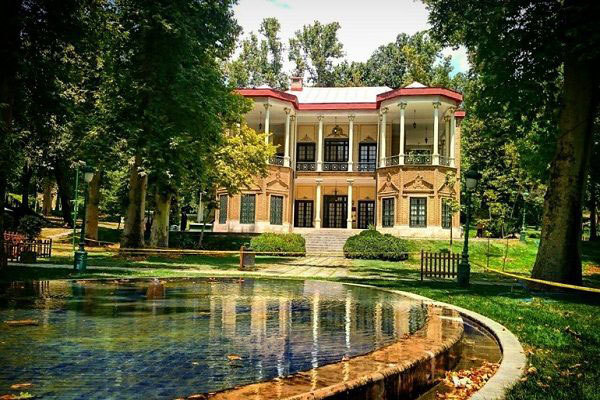
Ahmad Shahi pavilion is a two-story building with an area of approximately 800 square meters. The architectural design is especially unique and graceful compared to the other buildings in this complex. There is no concrete evidence of its construction date, some attribute it to Ahmad Shah’s summer resort, the last Qajar king who ruled for a short time. Therefore, it might be about a hundred years old which turns out to be a popular photography subject.

During Reza Shah Pahlavi, Niavaran palace was abandoned until Mohammad Reza went married and the young couple decided to live here, however it did not take long.

During Mohammad Reza reign, this building was used as the residence of the crown prince, Reza, after restoration and some changes in decoration by a group of French designers.

Ahmad Shahi pavilion was closed for ten years after the revolution, until 1989 which was open to the public, following a recovery. Today, the pavilion is one of the most outstanding buildings in Niavaran palace. Reza’s properties including his stone collection and model planes impress many visitors.

Ahmad-shahi

Jahan Nama Museum

Jahan Nama is a museum in Niavarn which was added to the complex in 1977 to host the international gifts of Farah Diba, the queen, and also the various objects she had bought from different parts of the world. Today, ancient objects of great civilizations are displayed in this museum. Among these, works of distinguished artists of 20th century such as Andy Warhol, Pablo Picasso, Salvador Dali, Marc Chagall, George Braque, Amedeo Modigliani, Paul Gauguin and many contemporary Iranian artists are remarkable.

jahan_nama_museum

Private Library

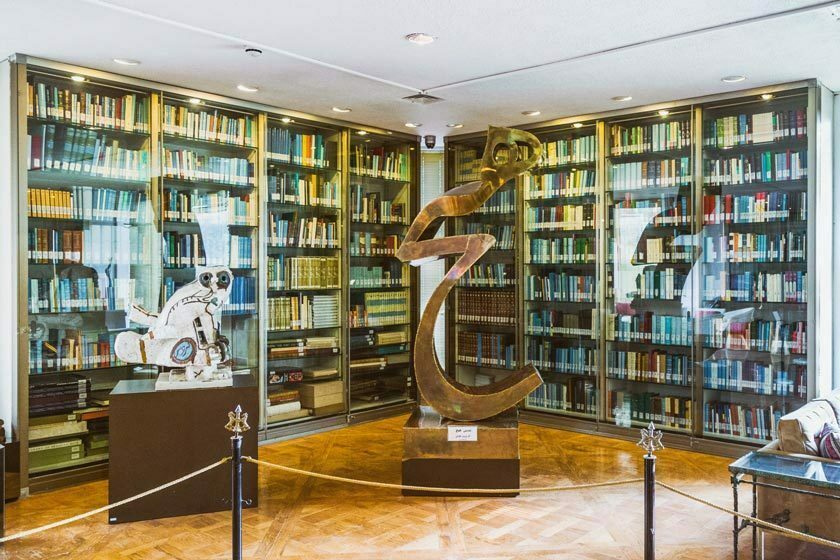
On the northeast of Niavaran complex, there is a two-floor building including a basement, altogether with an area of 770 meters, dating back to 43 years ago to be served as a private library. The interior design had been completed by Aziz Farmanfarmayan, design and composition of glass and mirrors has been done by American artist, Charles Sevigny.

The library lacks general standards of a library, since it was built as a private library. Evidence such as the piano and sound equipment shows that the place was used as a music room as well. Using elements of interior design like paintings, furniture and statues has given the atmosphere of a museum to the places.

There are about 23000 volumes of books including 16000 Persian books and some from non-Iranian authors. Excellent travelogues written by famous people traveling to Asia and Iran, collection of paintings particularly by artists of 20th century are only parts of these prosperous library.

Private-Library

Museum of Royal Family’s Vehicles

In 2011, Iranian authorities decided to make a collection of royal family vehicles in Niavaran palace. A few months later the museum, was open to visitors, following particular aims:

  • Displaying vehicles to the public
  • Organizing vehicles of the collection
  • Optimizing conservation system and protecting the heritage
  • Attracting more visitors

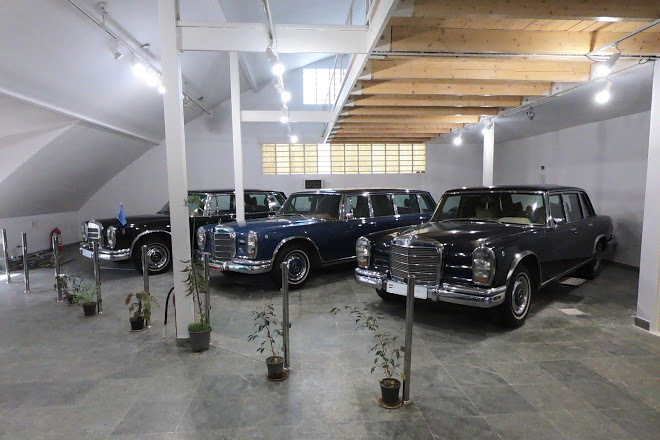
The construction allocated to vehicle museum covers an area of 200 square meters. However, being used as garage, it lacks decorative arts. Rather than being worked as a specialized museum, the focus is on conservation of royal family vehicles as a national treasure and historical storytelling.

Two Rolls Royce Phantom 5 and 6 are displayed right in the middle of the hall, surrounded by Formula racing car and eight motorcycles belonged to royal family children. Looking around, you can also see some maquettes in this gallery and some photos of the royal family with these vehicles.

Vehicles

Museum of Royal Clothes & Fabrics

The first glance at this gallery, brings to mind the harmony of Iranian clothes with beauty of nature and surrounding environment. It also presents Iranian artists’ skill in textile production.

The museum of clothes is one of the permanent treasures of the complex.

Niavaran palace Opening hours

The complex is open to visitors, Monday to Sunday from 9 am to 7 pm during spring and summer and from 8 am to 5 pm during fall and winter. To buy the ticket, visitors should arrive there an hour before the closing time.

On important national holidays, the complex is closed. So, do not forget to check before visiting.

How to arrive to Niavaran Palace

If you are looking for public transport rout, you have to get to Tajrish metro station, on Line 1, then take a cab to Niavaran square, it is a five-minute walk to the palace.

Another possible option would be “Tap30”, either from Tajrish metro station or anywhere you are in Tehran. It is quite affordable, however trying public transportation would save your money.

Niavaran palace café and restaurant

Imagine sitting in a restaurant surrounded by tall trees, only 500 meters from a historical building! If you like the peaceful atmosphere, then you are welcomed to have a drink or food in “Karzin” cafe and restaurant. However, on the weekends and holidays you should expect some crowd. The café is famous for its brunch, the brunch buffet is open until 1 PM.

Opening hours

Spring and summer: Every day from 9:00 a.m. to 18:00 p.m. except public mourning holidays

Fall and winter: Every day from 8:00 a.m. to 16:00 p.m. except public mourning holidays

Introduction

As a lovely and amazing city, Isfahan has embraced three UNESCO world heritage sites, plenty of cultural and architectural attractions and friendly hospitable local people. However, walking into Jolfa district would fascinate every visitor in a different way; it feels as if you have traveled back in time and you are in a different period of history. Let’s not forget to mention that there are 13 churches in this district right now but Vank is undoubtedly shining as the most gorgeous one. Vank Cathedral is a must-see attraction in Iran, a masterpiece representative of artistic expression of Christians in Iran and Armenian living place in 400 years ago.

History

About 400 years ago, the Armenians migrated from Azerbaijan to settle in Jolfa district of Isfahan in search of a haven, due to the Armenian genocide occurred in Yerevan during Ottoman war. Jolfa is still famous as a quiet area with European setting and architecture.

Vank is a historic church dating back to Shah Abbas the second period (1642 – 1666) having the reputation of training high rank priests in Christian world; that is why Vank is considered as one of the most noticeable churches among Armenians. Besides being an impressive Cathedral, Vank is the largest museum in Isfahan due to possessing an outstanding collection of historic documents during the last 400 years which makes it one of the most well-known Armenian centers in the world.


Vank
Vank

Architecture and Design

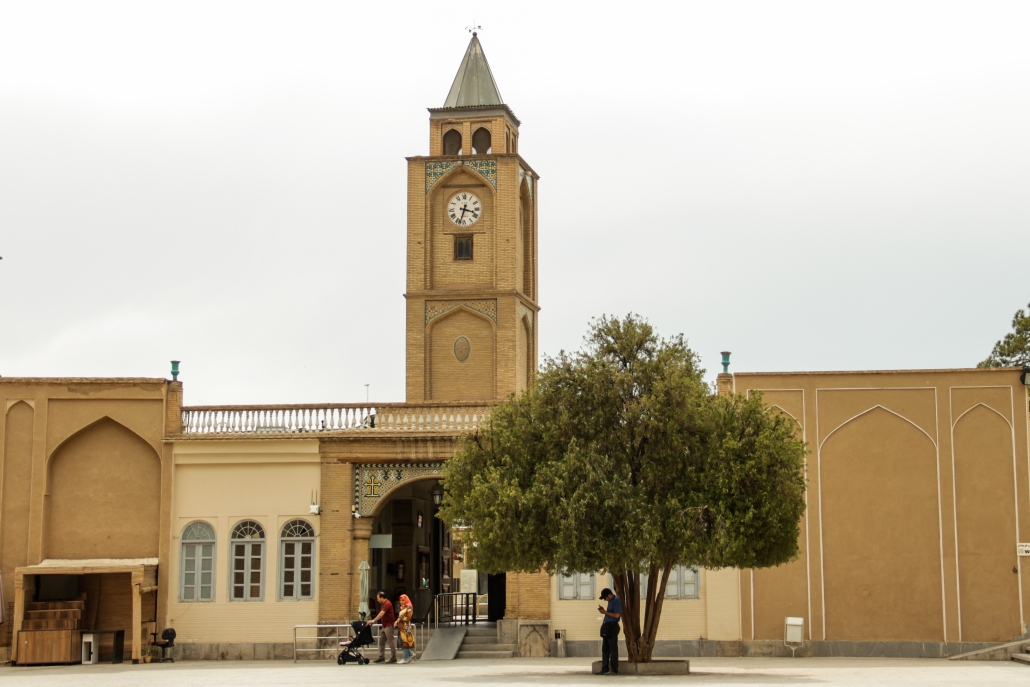
Displaying a mix of Islamic and Armenian architecture, this church covers an area of approximately 4000 square meters including the main church and its courtyard, monastery, belfry, library, museum, clock tower, Bishops’ room, community halls and tea house; considering the Vank garden and green spaces around, it is about 9000 square meters.

The height of the walls from the yard to the roof of the second floor is about 11.75 meters. Unlike many other Armenian churches in Iran which are made of stone, the main construction material in Vank Cathedral is clay.

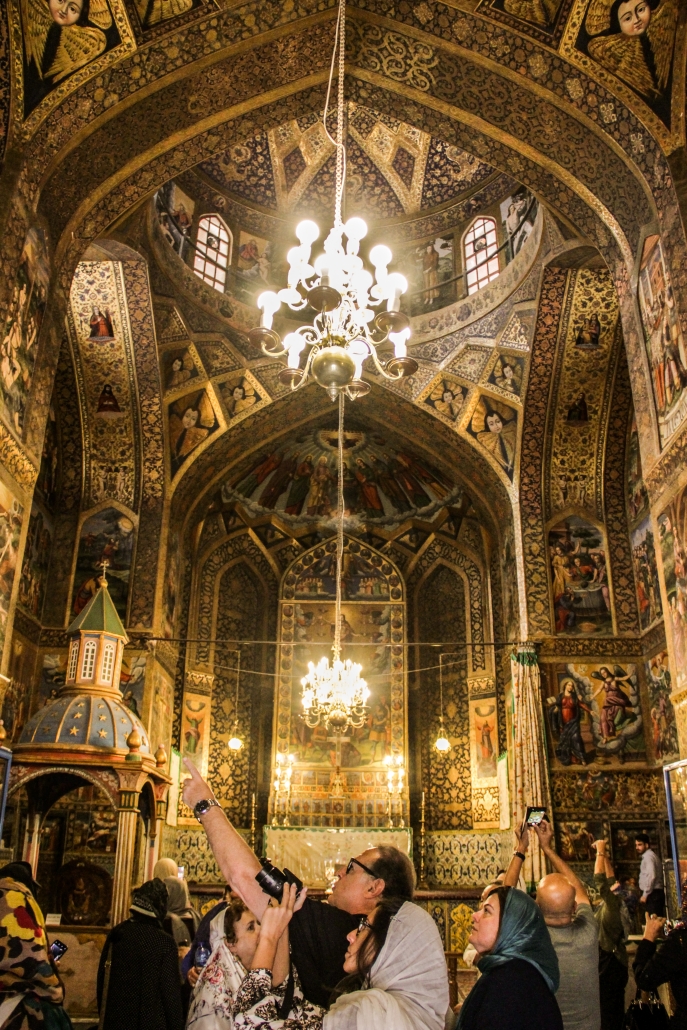
The exterior walls are covered with brick and tiles designed with winged angels can be seen everywhere while the interior walls are covered with plaster and eye-catching paintings which is the most splendid feature of this building. The magnificent artistic decorations in different parts of the church, such as inside the dome, walls and arches are mainly originated from the holy Christian book. These paintings mainly represent stories from the Holy Bible, Jesus Christ from the birth to the ascension, day of resurrection and the judgment, heaven and hell. A combination of Persian floral ornaments and Armenian national motifs are also evident on the ceilings and walls. The display of frescos on tiles with glorious gold and blue frames has created a pleasant and lovely setting inside the church. The cost of all paintings and decoration of the church was provided by “Avdic Stepanos” which are unique among Armenian churches.

Vank

Museum

Vank museum is a not to be missed place in Isfahan. One of the most significant and most  comprehensive collections of biblical manuscripts are kept and displayed here. The museum keeps 700 handwritten books, a variety of objects related to Armenian community in Isfahan such as Safavid costumes, European paintings brought back by Armenian merchants, tapestries, embroidery, and other ethnological exhibits related to Armenian culture and religion.

Visiting various collections in this museum would be one of the most interesting parts of your tour. The precious paintings related to Safavid period, painted by Armenian and European artists are unexampled. There are stunning collections of porcelain and clay dishes, collections of wooden works consisting of instruments, furniture, clock, etc. and eye-catching metal objects including gold and silver jewelries, belts, frays, etc.

The exhibition of Armenian textiles, traditional hand woven and embroidery are quite appealing to any visitor’s taste.

Vank Cathedral enjoys possessing 170 sheets of crucial historical commands, 22 of which are depicted in this museum today. Belonging to 17th to 19th century, these political orders are mostly related to the emigration of Armenians, offering religious and commercial privileges to them and tax rules for residents of Jolfa district.

And last but not least, the most highlighted object at Vank museum is a piece of hair, belonged to an 18-year-old girl on which a sentence from old testament has been written with a diamond pen in 1974. You can read the sentence through a microscope kept by the side.

Opening hours

9:00 am till 6:30 pm

Location

Vank Church alley, Jolfa District, Isfahan, Iran

Contact

(+98) 3136243471

ran e-Visa (Iran electronic visa) has launched by the Ministry of foreign Affairs – Islamic Republic of IRAN to make it easier to apply for an Iran tourist visa online.

Citizens of over 180 countries are eligible to use the Iran electronic visa. The United Kingdom, United States, Canada, Jordan, Somalia, Colombia, Afghanistan, Pakistan, Bangladesh and India are excluded.

Based on mutual agreements, citizens of some countries are exempt from applying for a visa to enter Iran. They include the citizens of the Republic of Azerbaijan, Bolivia, Turkey, Syria, Lebanon, Georgia, Armenia, Venezuela, Egypt and Malaysia.

Iran E visa (Iran electronic visa): How Does It Operate?

According to the information provided by Iran MFA, applying for an Iran e Visa is easy and takes only a few minutes. Applicants will have to go to the address www.e_visa.mfa.ir/en to make their online application.

Visa applicants must submit a completed Online Non-immigrant Visa Application for all non-immigrant visa categories, including applicants applying for Entry, Tourist, Work, Treatment, Press, Student, Family, and Investment visas.

Once the Application is submitted to Iran E visa Department, consular Officers use the information entered on the application to process the visa application and, may be combined with a personal interview, determine an applicant’s eligibility for a non-immigrant visa.

Iran Online Visa: Important Notice

  • Take care to answer all questions on the electronic visa application form accurately and completely; otherwise, you may have to reapply your application and reschedule your visa interview appointment.
  • Electronically submitting your online application is only the first step in the visa application process. Once you have electronically submitted your online visa application, you must contact the embassy or consulate at which you wish to apply to confirm whether you need to be interviewed by an officer, and to schedule an interview.
  • You can find a list of Islamic Republic of IRAN embassies and consulates on ministry of foreign affairs website. If the embassy or consulate at which you apply informs that you must have a visa interview, the visa application process cannot be completed until you appear for an interview with a consular officer.

Things that you should know before applying for Iran e-visa (Iran electronic visa):

  • Persons who may have dual nationality should announce their nationality based on the travel documents/passport that they wish to carry.
  • In case nationality printed on visa is incompatible with nationality printed on passport, visa will be null and void.
  • An applicant may not be granted Iran visa unless his/her passport is valid for at least six months.
  • Please make sure the photo you wish to upload meets all the requirements.

Ask Kalout for visa authorization letter

Online Nonimmigrant Visa Application


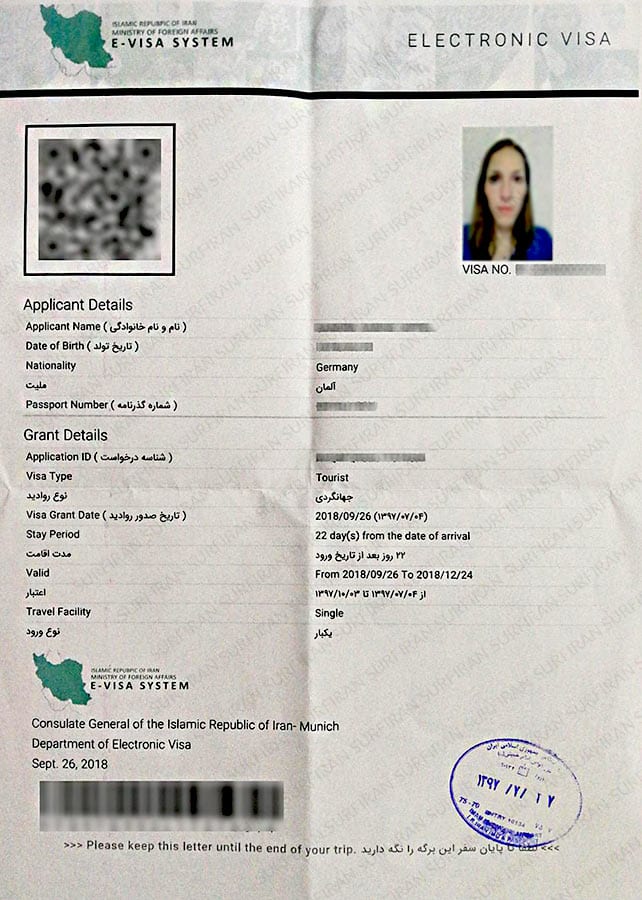
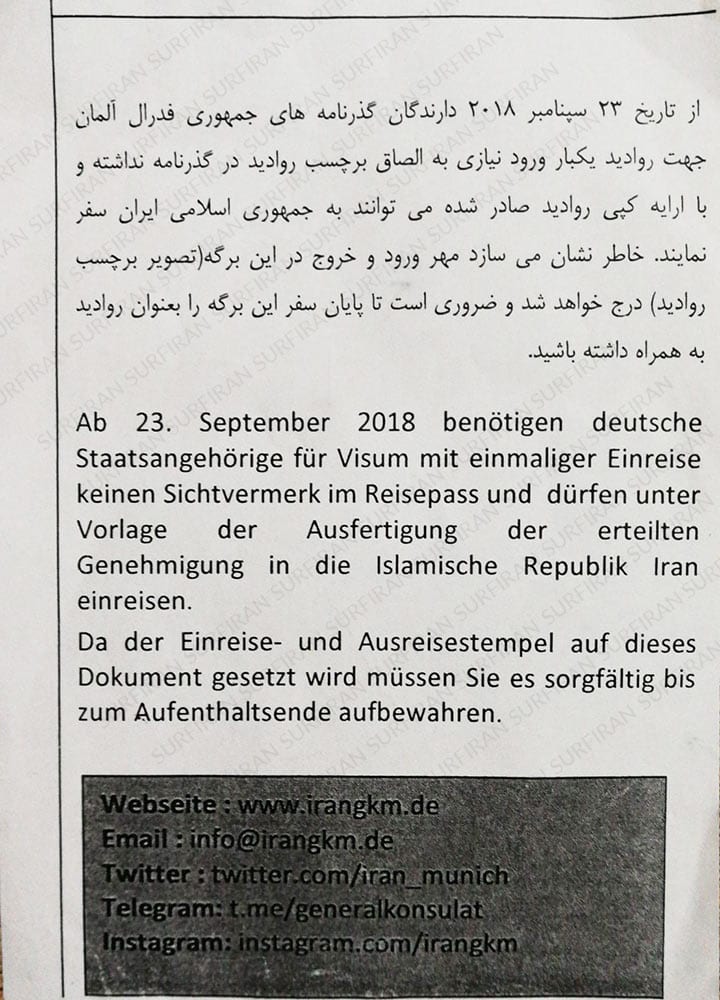
To alleviate tourists’ concerns over US sanctions on individuals visiting Iran, Passports of travellers entering Iran will not being stamped.

The initiative is a direct countermeasure to a travel restriction put in place by the US after Trump issued an order in March 2017, restricting travel to the US for those who have visited Iran, in addition to Libya, Somalia, Sudan, Syria and Yemen.


Sample iran viza

Visa authorisation letter stamped at the Tehran International Airport.


It was implemented from the first day of the second half of the Iranian year on Sept. 23, a Ministry of Foreign Affairs statement said, adding that the measure has been communicated to all representative offices of the Islamic Republic abroad as well as domestic airports.

The initiative, which was previously piloted in Iran’s offices in Doha, Muscat and across the Imam Khomeini (Tehran), Mashhad and Shiraz international airports, is part of a bigger support package to stave off the detrimental effects of US sanctions as well as the ongoing currency crisis facing the country’s tourism sector.

A note at the Iranian Embassy in Germany emphasizes that from September 23, 2018 passports of travellers entering Iran will not being stamped.


Foreign tourists from neighboring countries that have common land borders with Iran, including Iraq, Pakistan, Afghanistan, Azerbaijan, Armenia and Turkey, as well as those from the US, the UK, Canada, Jordan, Colombia, Bangladesh and Somalia, are not part of the new initiative, meaning that their passports will be stamped.


Top Tips for Traveling to Iran and Things to Know

Long history, outstanding architecture, elegant gardens, delicious foods, hospitable people, astonishing landscapes, and remarkable wildlife all represent Iran as a great destination to explore. Then, if you wish to travel with the purpose of making friends, seeing amazing beaches, enjoying magnificent architecture, feeling the mystery of deserts, and tasting delicious foods, one of the best options for you is traveling to Iran.

Contrary to the image of Iran on media displays, Iran is one of the best destinations to visit and even a month is not enough to travel around Iran and enjoy all its cultural and natural attractions. The top tips for traveling to Iran and things to know are represented here to help you get started making the best plan to travel to Iran, the country of intact nature and ancient culture.

Iran has 21 UNESCO World Heritage Sites

Iran has 21 UNESCO World Heritage Sites


1.Iran is Safe to travel

Iran is a very safe place to travel. It is one of the safest countries in the region and many travelers declare that travelling in Iran is much safer than travelling in Europe. Hostility toward foreigners is rare and local people usually welcome the tourists with warm smiles and open arms. Iran is safe for solo travelers and women only travelers as well; however, they are advised not to go to remote places by themselves or to avoid walking around late at night.


2.Iranians are friendly and hospitable

Iranians honor guests. They believe that tourists are their guests and they should host them in the best way. When you arrive in Iran, you will be welcomed by warm smiles. Some people would offer you good information about Iran and its traditions, some may ask you to have a tea together, or even they would host you at their homes and with their delicious Persian foods. Though media displays a hostile face of Iranians as people who hate the westerners and other nationalities, Iranians are very friendly and hospitable.
3.Iranians aren’t Arabs

Iranians are Persians not Arabs. Since Iranians use the Arabic alphabet, some may think that Iranians are Arabs or they understand the Arabic language, but Iranians are not Arabs and they speak Persian language or Farsi. However, Arabs as part of the population of Iran live in some parts of the country.
4.Iran is a perfect place for backpacking

Many people know Iran as a cultural destination that boasts having many tourist attractions with roots in ancient civilizations. It is also a perfect place for backpacking and tourists can add some adventurous activities to its cultural aspect. Iran has great wildlife, wonderful deserts, deep canyons, and tall waterfalls. Iran is the ultimate backpacking destination and it is among the cheap destinations for travel; therefore, you have the chance to find hostels and guesthouses in the main tourist places and get some help from its kind locals.

Iran enjoys gorgeous landscapes

Iran enjoys gorgeous landscapes


5.Traveling to Iran with babies/children

If you wish to travel to Iran with your babies/children, do not worry. The nature, food, architecture, people, and other aspects important in travel will be amazing for children as well. Moreover, there are not strict dress codes for children and they can freely wear shorts or sleeveless shirts (for girls it is for the ones under the age of 9). There are also public baby changing rooms and you will not be stressed for finding somewhere to change the baby’s diaper. Anyhow, if your child requires stroller or anything else that you will find necessary while traveling, make sure that they are accessible because some hotels or guesthouses might miss what you really need
6.Currency in Iran

Since you cannot use your credit cards in Iran, you need to bring enough cash with yourself and change it into rials (IRR) when you reach Iran. Currency in Iran is confusing. Though rial is the official currency, prices are usually mentioned in toman. 10 rials equal 1 toman. Just be aware of the difference, but do not worry, people will help you understand what they mean when they express the price of something. Iran is a cheap destination but do not forget to bring enough money so that you could enjoy visiting more tourist attractions, take part in more adventurous activities, eat the most delicious foods and drinks, and buy great souvenirs such as saffron and Persian carpets for your dear ones.
7.Mobile SIM card and Network in Iran

None of the SIM cards from other countries work in Iran, but you are offered Iranian SIM cards that let you contact your family and friends abroad and provide you network to get connected and find access to the information you search for. Then, you will have no problem for the network; however, network speed differs from one place to another and sometimes you need to be patient with its slow speed.
8.Cost of Transportation in Iran

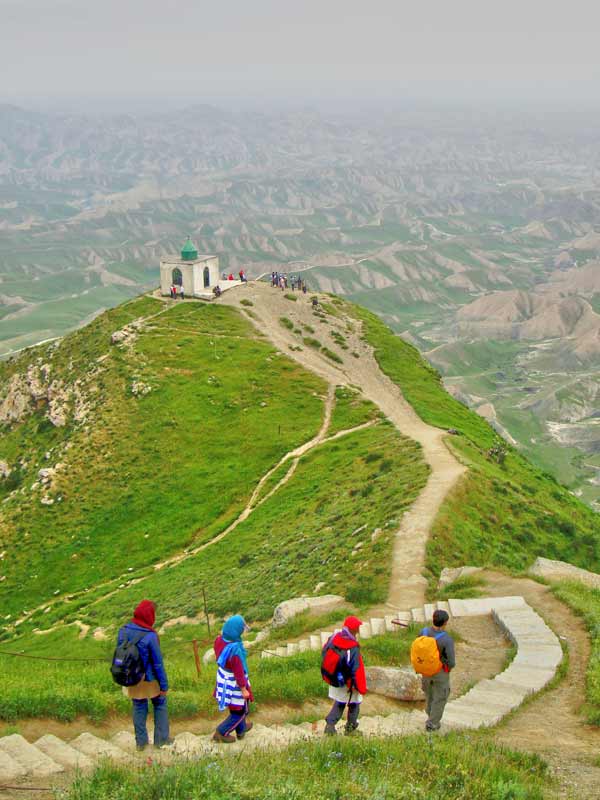
Transportation costs in Iran are low for foreign travelers. It is easy, cheap, and comfortable to travel around Iran and enjoy its scenic sceneries and historical treasures. You can travel hundreds of kilometers between major cities of Iran in air-conditioned buses only by paying a few dollars. Rail network is also spread across the country. Tehran to Gorgan railway is one of the most beautiful railways of Iran and it will amaze you with the beauty of nature you would observe through the train windows. Flights can also shuttle you from one location to another one with low prices. Within the cities, you can also take advantage of different transport options such as taxis, buses, minibuses, bicycles, and subways- in some major cities.
9.The best time to travel to Iran

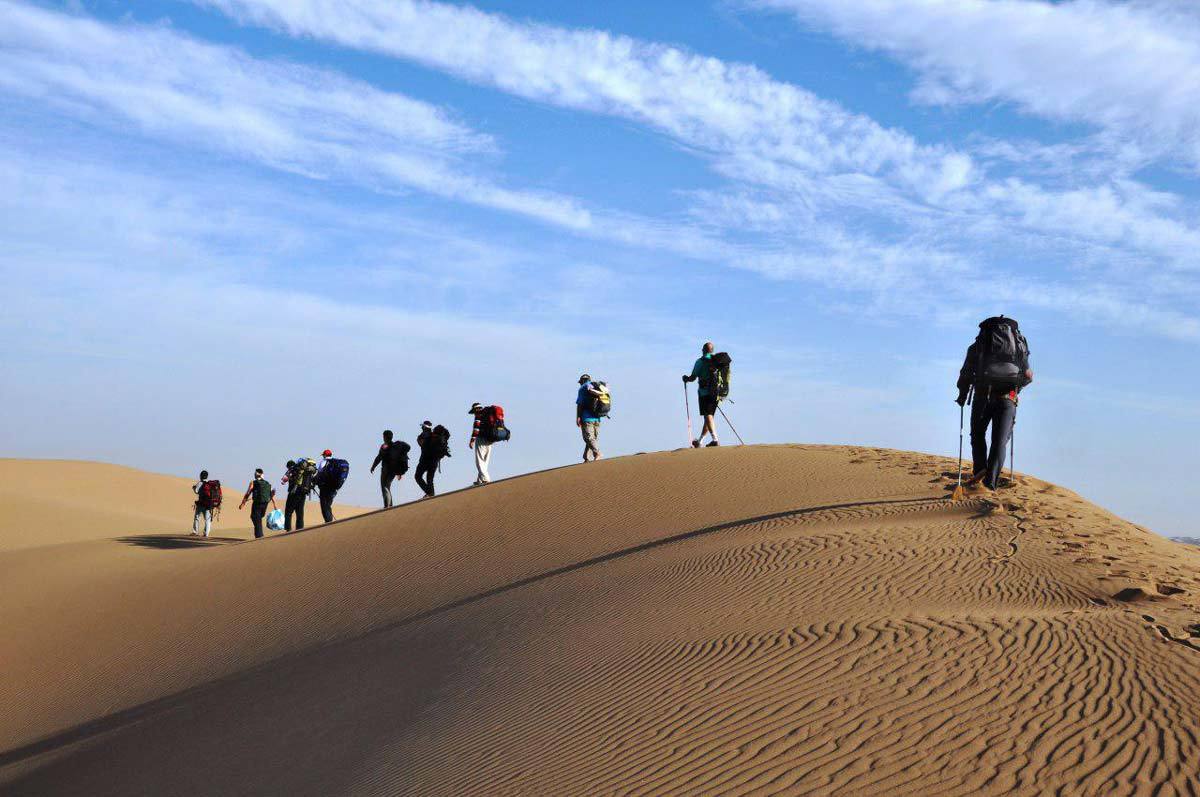
Iran embraces a vast area and it has resulted in various climate conditions. That is why Iran is known as the four-season country. It means that the time it is freezing in the north of Iran, there is a pleasant climate condition in the south of Iran, or when some people enjoy skiing in the Alborz Mountains, some may enjoy sand boarding in deserts of Iran. Therefore, you need to determine why you want to travel to Iran and what activities are the priorities for your trip. Anyhow, if you want to make the most out of your travel to Iran, the best time is in spring, from March to late May, and in autumn, from late September to late October. During these months, it is neither too hot nor too cold and you would have the chance to take advantage of both cultural activities and adventurous programs such as trekking, mountain-climbing, and sand boarding. Be aware of Nowruz holidays, however. During Nowruz, many of the tourist attractions are crowded and finding accommodation is a bit difficult, so you need to do the reservation before your travel not to get in trouble.

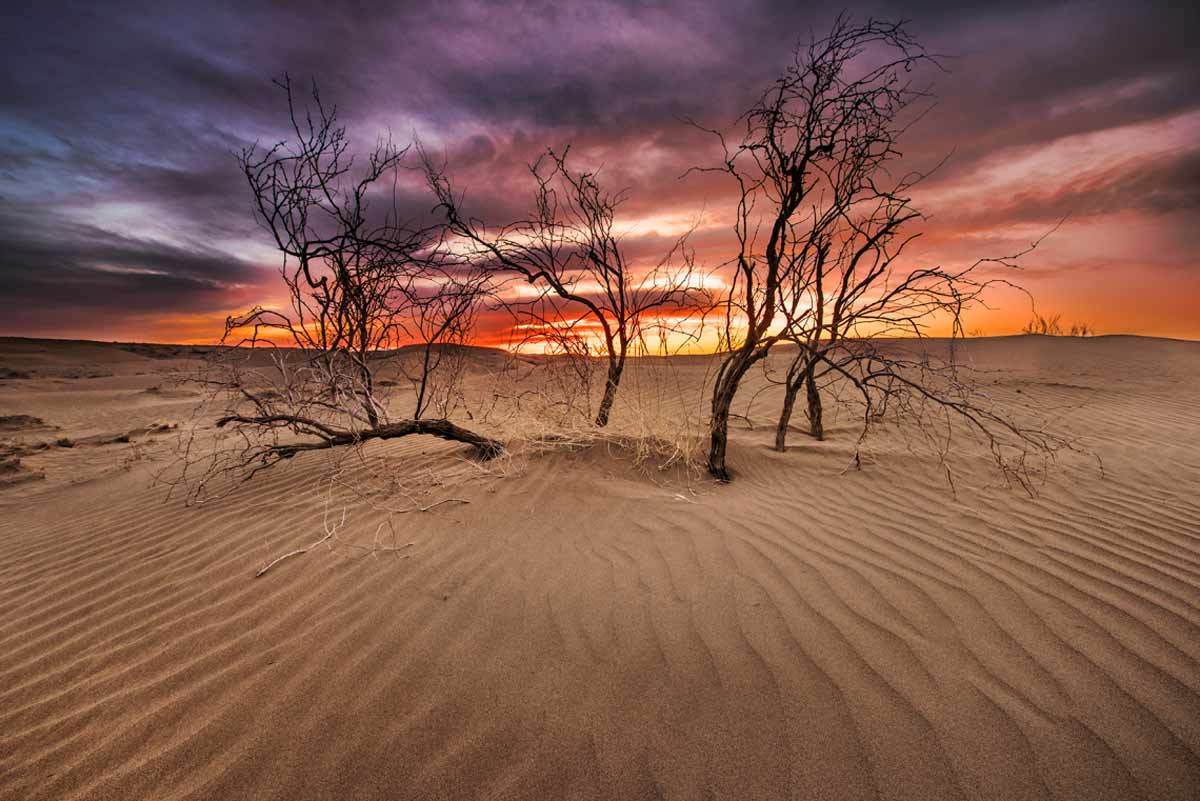
Experience trekking in deserts of Iran

Experience trekking in deserts of Iran

10.Visit bazaars in Iran

In Iran’s everyday life, bazaars have a crucial role. You can find bazaars in every small city and town. Go to bazaars and admire their architecture, go to bazaars and enjoy buying souvenirs.
11.Taste delicious Iranian foods

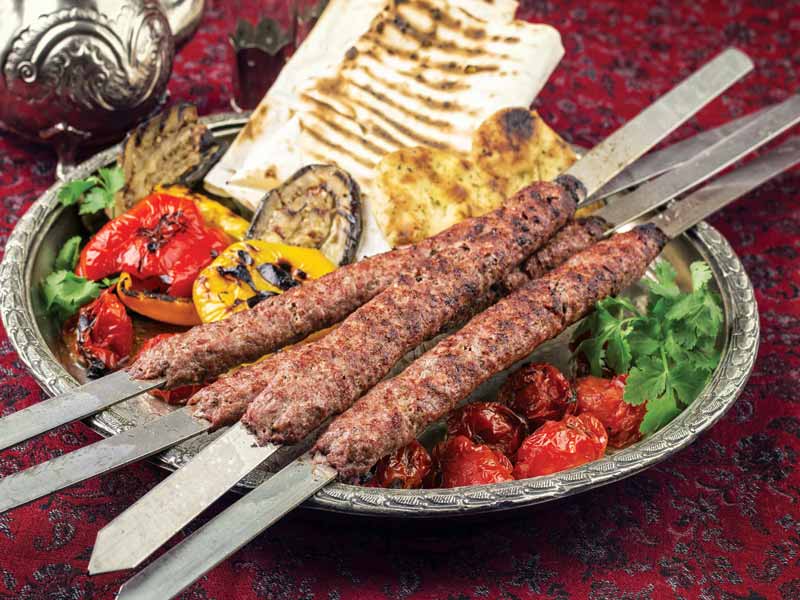
Iran is diverse in culinary. Persian foods are a mixture of most nutritious ingredients including meat, rice, vegetables, beans, and spices. Kebabs, stews, and different kinds of rice (Chelow and Polo) are among the most famous Persian dishes. In your travel to Iran, taste traditional Persian foods at restaurants or in the locals’ homes.

Taste delicious Iranian foods in your travel to Iran

Taste delicious Iranian foods in your travel to Iran

12.Say yes to Iranian toilets

You can find western toilets in some hotels and restaurants, but the majority of places do not have western toilets. Then, get prepared for squat toilets in Iran that you can find easily everywhere.
13.Know what men and women should wear in Iran

Iran is an Islamic country; then men and women are supposed to wear clothes regarding Islamic rules. One of the questions is ”what should women wear in Iran?” Women are supposed to wear headscarves and loose tunics that are usually long enough to cover their thighs and have long sleeves as well. It is also better not to wear tight trousers. Men are also supposed to avoid wearing shorts. Fortunately, the dress codes are not strict and you can soon get used to them.
14.Forget about drinking Alcohol in Iran

Drinking alcohol in Iran is forbidden. You can think positively about it. Sip some other drinks in Iran such as Sharbat e Ablimoo (Lemon Syrup), Sharbat e Khakshir, and Sharbat e Sekanjabin Khiyar. You can experience a great time with your Iranian friends who can make parties and have fun without a drop of alcohol.
15.Iranian police officers do not hassle the tourists

Police officers respect tourists. If you break rules unintentionally, they will inform you of the rules and ask you to be more careful. You might think that there are many strict rules in Iran, but the truth is that apart from dress codes for men and especially for women, as well as the forbiddance of drinking alcohol, other rules or restrictions are not strange for the foreign travelers. You could also have different hairstyles or smoke in some determined places.
16.Get Iran Visa at the Airport

Getting visa is the most difficult part of getting prepared for travel. Fortunately, Iran has made it easy for travel lovers. Visitors from approximately 180 countries have the chance to get Iran Visa on Arrival (VOA). It refers to a special class of tourist visa that you can apply for at some major airports in Iran including international airports of Tehran, Shiraz, Isfahan, Tabriz, Mashhad, and Kish Island. The visa process gets longer for tourists from US, UK, Canada, and some other countries that are not allowed to get a visa on arrival. Anyhow, it is possible for them as well to travel to Iran and discover its many beauties.

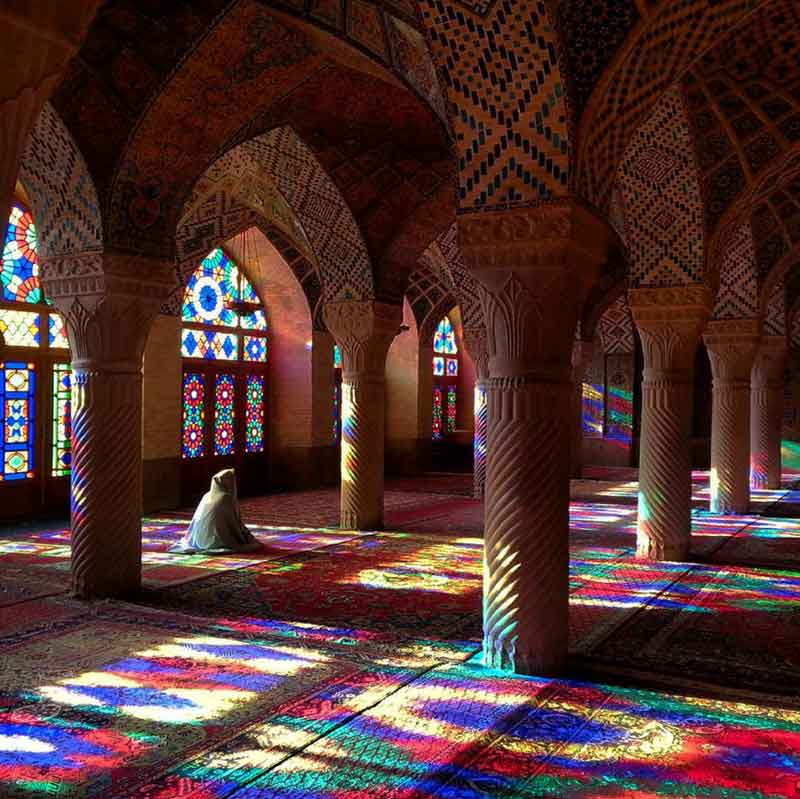
Visit the Pink mosque in Shiraz

Visit the Pink mosque in Shiraz


17.Things to See When Travelling in Iran

Since Iran covers a vast area and has had a long history and ancient civilization, it embraces many natural landscapes and cultural attractions simultaneously. Therefore, it has the most inspiring places for both culture lovers and adventure travelers from around the world to come to Iran and discover its beauties. Iran has 23 UNESCO World Heritage Sites one of which is a natural attraction. Apart from the wonderful UNESCO Sites in Iran such as Persepolis in Shiraz or Naqsh-e- Jahan square in Isfahan, there are some top tourist attractions such as Nasir al-Mulk Mosque in Shiraz, Museum of Contemporary Art in Tehran or Moghadam Museum in Tehran that you would love to visit. As an adventure lover, do not miss off-the-beaten-path activates as well. Bird watching, mountain biking, canyoneering, safari expedition, and sand boarding are among the exhilarating activities you might love to experience. Regarding the diversity of enjoyments and activities you can experience in Iran, it is better to make a list of your priorities before traveling in order to manage your time and money.

Now that you know tips for traveling to Iran and things to know before traveling, do not hesitate anymore. Add Iran to your travel bucket list of 2018 and get ready for your travel to Iran.

Thinking about Iran, you may imagine it as a vast desert without any tree where people move using camels. Thanks to western media propaganda, this is the first image most of westerner who have little information about Iran or have not travelled to Iran may have. Though this image is wrong, part of it is correct; Iran has vast deserts forming most of its central regions. So without an Iran desert tour, your trip to Iran would miss an integral part for sure.
Iran has two deserts; Dasht-e Lut, located mostly in South Khorasan, Sistan and Baluchestan and Kerman provinces, and Dasht-e Kavir, the bigger one which encompasses provinces like Tehran, Khorasan Razavi, Kerman, Yazd, and Markazi. Iran deserts cover almost 25 percents of the country’s land area.

Iran Desert

Breathtaking landscapes created by wind erosion, rich flora and fauna, salt lakes, beautiful sunny days and starry night sky, golden sand dunes, historical caravanserais, ancient villages with renovated eco-lodges and qanats will make your Iran desert tours a lifelong memory. Here we mention just some of these destinations you will definitely like in your Iran desert tours.

Varzaneh Desert

Varzaneh, named after a village south of the desert, is located 100 km east of Isfahan city. Its sand dunes resting beneath sunlight move smoothly with wind and create interesting shapes. What makes Varzaneh a good option especially for those who have not enough time to spend for a night stay in desert, is that it is one of the most accessible deserts of Iran.

Varzaneh Desert

You can easily get to Varzaneh even by your own car and spend a half day enjoying its tranquility and beauty. Then you can continue your trip or spend a night in Varzaneh city in its guest houses. However, getting to Varzaneh, our recommendation is to visit Gavkhoni Wetland and also Varzaneh City and its grand historical mosque, bridge and pigeon tower. It is also interesting to see women wearing white chadors in Varzaneh unlike the rest of Iran.

Kalout Shahdad

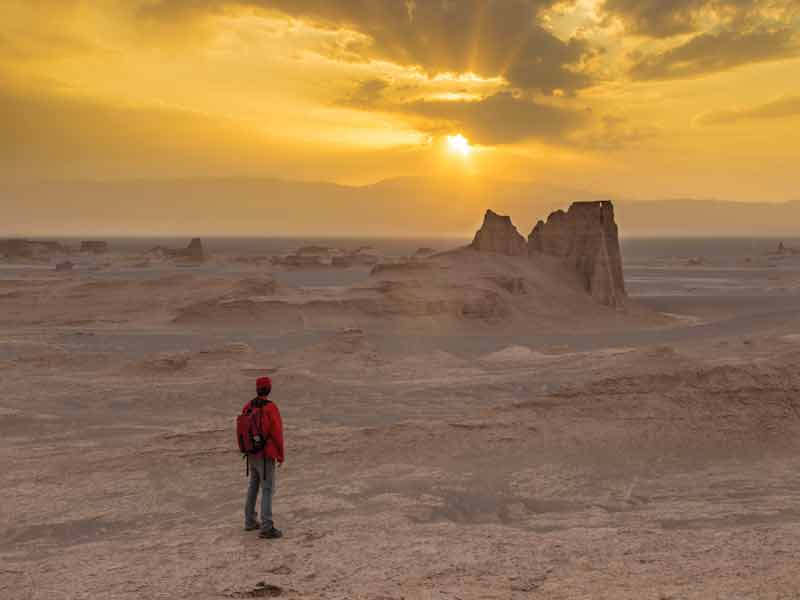
One of the most beautiful natural landscapes of Iran, Kalout Shahdad, is located in the middle of Lut Desert. Reaching to Shahdad, looking from a distance, you will see a deserted city with skyscrapers scattered around it. But they are actually duns created in thousand year by wind and natural forces. These natural structures make this desert a unique one in Iran. Travelling to Kerman, Shahdad is a must-visit but not in August as one of the hottest places on earth, Gandom Beryan, is located in Dasht-e Lut Desert near Kalout Shahdad.


Kalout Shahdad

Maranjab Desert

Maranjab Desert is a popular desert destination for Iranians. Like Varzaneh, it is located in Isfahan Province. The desert is accessible both from Tehran and Isfahan and provides you with a unique stay in a historical caravanserai located in the middle of desert. Looking at the vast desert landscape from hilltops, you may be lucky to see the wandering lake, which seems to appear in different places throughout a day. Though the desert is one of the most available ones in Iran, it is highly recommended not to drive there alone, it is better to get a tour to Maranjab desert or at least have accompanies.

Maranjab Desert


Garmeh Desert

Located in Khur Biabanak County, Isfahan Province, Garmeh is a real oasis. Garmeh Village with green palm trees, near the desert, would probably make your experience here one of the most queer ones you may have in Iran. Garmeh is known for its traditional houses hosting tourists, one of which is Ateshooni. You may be lucky to watch the house’s owner, Maziar’s musical performance during your stay here, an experience which mesmerizes visitors. If you enjoyed your stay here, you may want to go to a nearby village, Mesr and experience a totally different experience with a warm and friendly family in Barandaz lodge.


Khar Turan National Park

The last but not the least desert area we want to talk about is Khar Turan. A wildlife refuge, it is located in Semnan Province and is home to Asiatic Cheetah, an endangered specie. With historical villages like Ghale Bala and Reza Abad, what makes Khar Touran a must-see is not just its natural landscapes but the opportunity it provides especially for nature lovers to see a variety of animals. Gifted with rich flora and fauna, as a protected area and the second largest biosphere reserve on the planet, you should have permission to visit the area and see its wildlife including Asian Zebra, Caracal, Mouflons, and White Wagtail.

Depending on the time of your Iran desert tour, staying at Reza Abad Village, you may be also lucky to visit nomads and spend a night in their tents.
These are just some of Iran deserts you can enjoy during your Iran travel. Considering the fact that most of them are located in the province on the classic route, you can easily include an Iran desert tour on your itinerary.


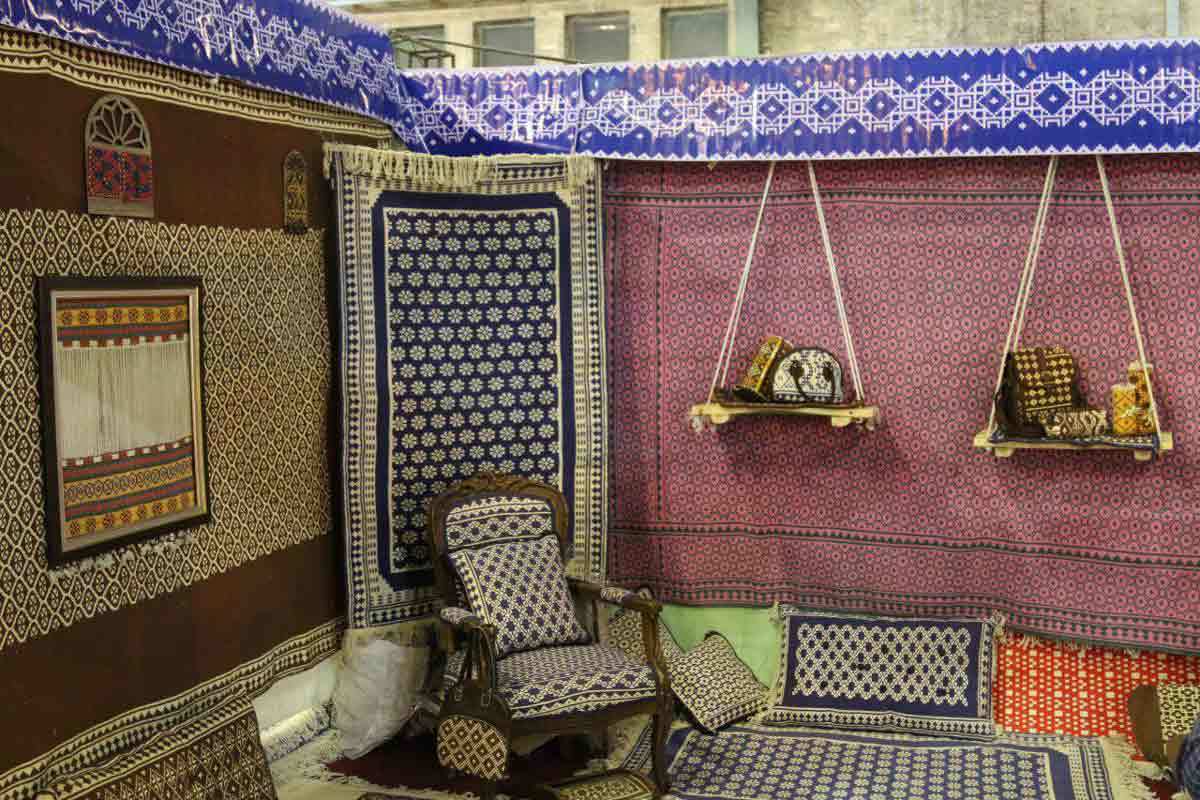
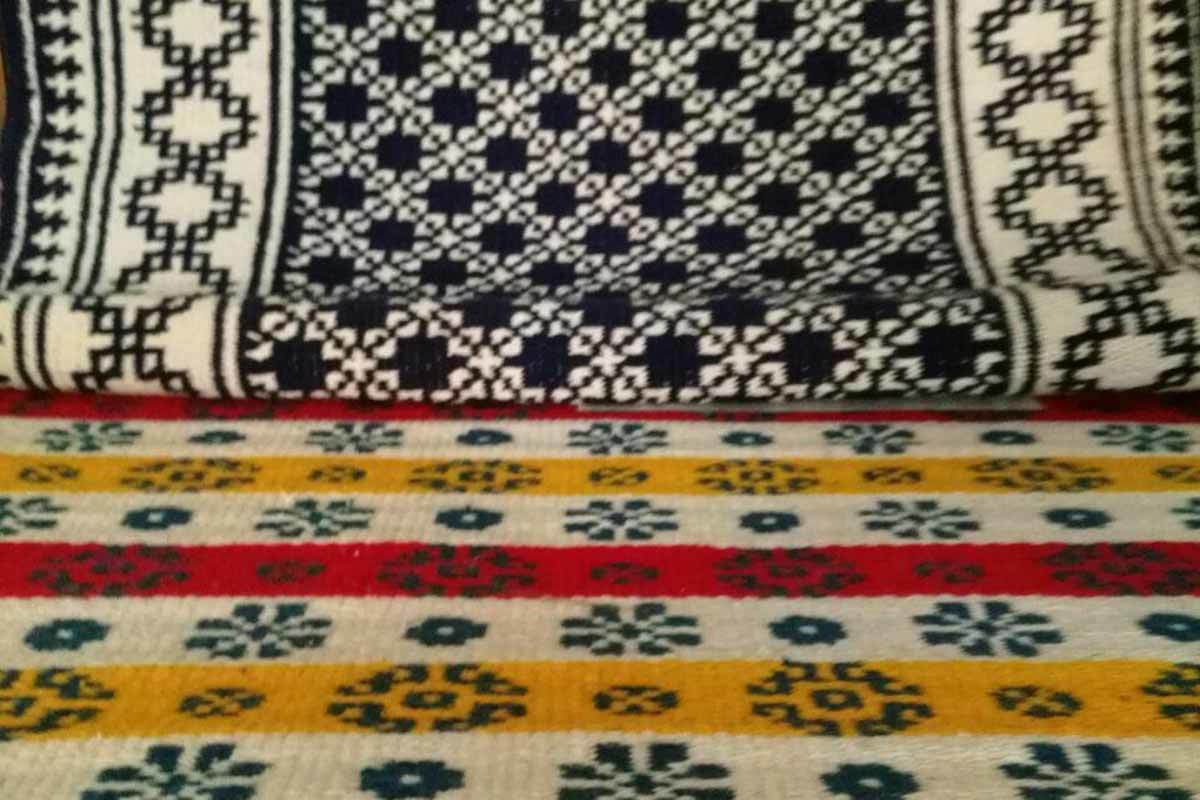
Meybod as the main center of weaving Zilu, a light Persian rug and one of the oldest handicrafts of Yazd, is being inscribed as the World City of Handicraft. The traditional Iranian carpet, Zilu, was inscribed on the list of National Treasures of Iran two years ago and the process of listing Meybod on the World List began since then.

Zilu

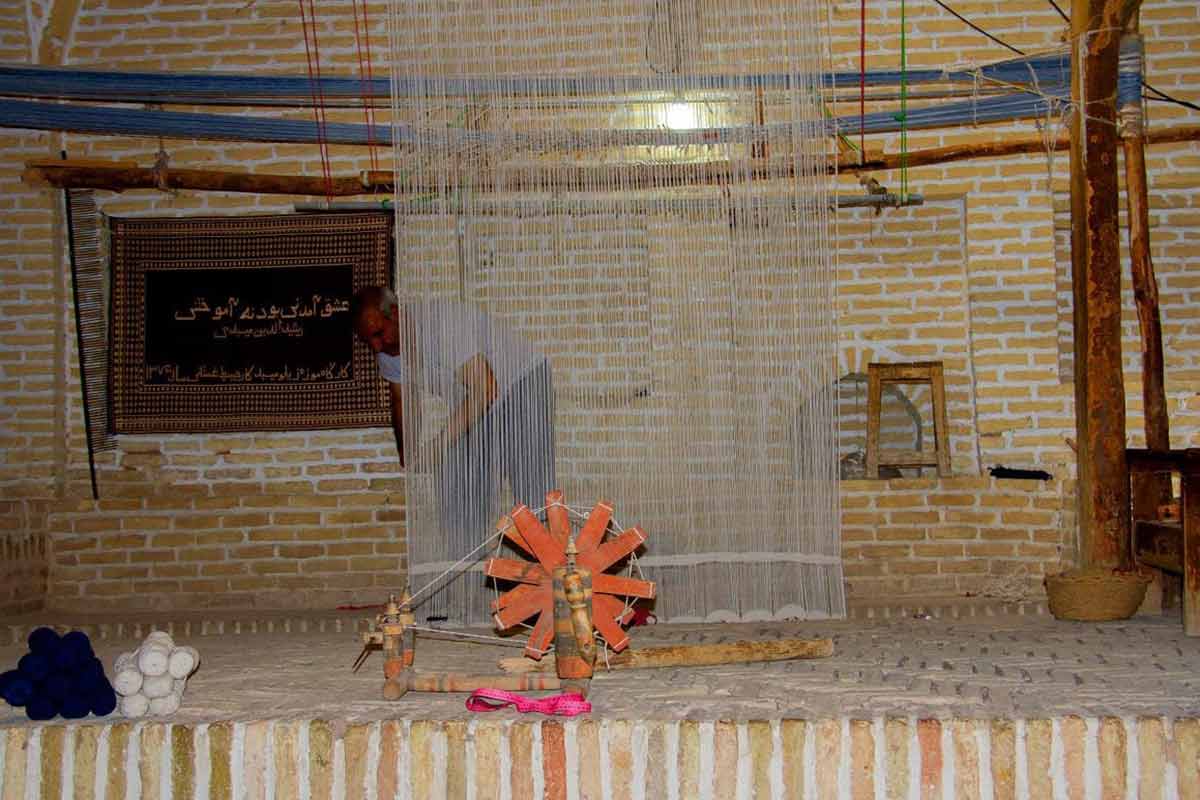
The oldest Zilu, belonging to almost 800 years ago, is being kept in Zilu Museum of Meybod. Also there are three different kinds of Zilu being produced in the city which vary in their material and colors. On the verge of being forgotten, the art of Zilu weaving, this handwoven art belonging mainly to desert areas, revived in Meybod some years ago and now more than 200 person are working in this industry in Meybod.

A group consisting of three experts from the World Crafts Council, traveled to Meybod in October 2017 and after visiting different Zilu weaving workshops, Zilu Museum of Meybod, galleries showcasing photos and documents proving the ancient history of Zilu production in the city, they left Iran confirming that the art of Zilu weaving is a widespread craft in Meybod and many people are still working in this industry.


Zilu weaving

Ghada Hijjawi Qaddumi, the head of World Craft Council in Asia Pacific added that following all the steps of Zilu production in Meybod in their visit to the city, they found out all process of preparing its prerequisites and weaving Zilu itself is being performed in the city. She also expressed their satisfaction knowing that there are workshops and classes teaching this ancient art in Meybod.

Leaving Iran indicating that the Zilu weaving art should be recognized with the world market, she added the final decision will be at the discretion of the World Crafts Council. Just one month after the Council’s representatives visiting the city, Seyed Mostafa Fatemi, deputy head of Iran Cultural Heritage, Tourism and Handicrafts of Yazd announced that the city is being listed as the World City of Zilu.

Zilu


World Crafts Council (WCC) is launching a network of creative craft cities since 2014. Iran, located in its Asia Pacific region, first appeared on the list by inscribing Tabriz as the World City of Carpet Weaving and Isfahan as the World Crafts City in 2015. Meybod would be Iran’s eighth representative on the list after Tabriz, Isfahan, Sirjan, Lalejin, Kalpourgan, Marivan, and Mashhad respectively World Cities for Carpet Weaving, Crafts, Kilims, Pottery, Handmade Pottery, Klash Footwear, and Gemstones. Monesan, deputy of Iran Cultural Heritage, Tourism and Handicrafts also declared that Abadeh and Khorashad village would be inscribed on the list for wood carving and Tobafi (towel weaving). The idea behind creating this list is to “grow a global awareness to cultural and social developments, encouraging governments to support developments of their crafts, strengthening local potentials for development of creative tourism and encourage the relation between crafts and other creative industries” as mentioned in the Council’s website.


Hamedan is a great ancient city to visit. As it is a historical and attractive place to tourists. Hamedan history dates back to 1100 BC. There are many nice landmarks that attract people from all over the world. And nature places attract tourists. The best landmark in Hamedan is Ali Sadr Cave which is worldly famous and it is one of the largest water caves worldwide. Those who are fond of historical places should visit Hamedan.


Tourist attractions of Hamedan:

  • Ali Sadr Cave – The cave is liked by many people around the world, and it has many visitors a year. It’s the biggest water cave and it is fabulous and as it is the longest cave in Iran you should go 11 kilometers into it. The cave is located on the north west of the city and it is near Ali Sadr village.
  • The tomb of Baba Taher – This place is a must visit because it’s a wonderful monument of the city, and you can enjoy the poetry environment.


  • Qorban Tower – The tower is the symbol of bravery, and the tower has defended the citizens in the wars.
  • Lion Stone – the lion statue is historical, and it dates back to 14th century and it is an ancient monument of Ecbatana and it guarded the city gate.
  • Ghanj Nameh Tourist Village – Alvand Mountain skirt will make you enjoyable moments. You can go bungee jumping and riding sleds in Ghanj Nameh village and enjoy the nice weather.

Local Products and handicrafts in Hamedan

Hamedan has always been a popular destination for tourists and the souvenirs are always provided as the handicrafts are unique and beautiful. The handicrafts are made of wood or leather. You can buy beautiful carpets too.

Delicious cuisine

Some Iranian dishes are tastier in Hamedan and they are tempting. Kebabs is special in Hamedan and you can have them in the way you want them to be cooked such as steamed, fried or grilled. Kashka Bademjan is another famous dish that you shouldn’t miss it.

Shopping centers

Shopping places and markets are always nice choices for adventurous people. There are numerous shopping places in Hamedan such as markets in Toyserkan Malayer and Nahavand. There are two kinds of markets in Hamedan; modern and historical ones. You can buy fresh local cookies such as Komaj, Shirmal and Baslogh. The most important shopping centers are the Historical Market, and the stores located in Imam Square.