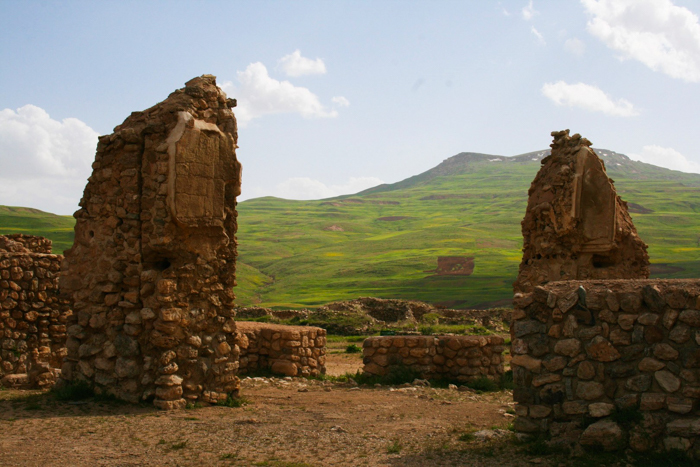
Travel to the most beautiful and greenest countryside in northern Iran
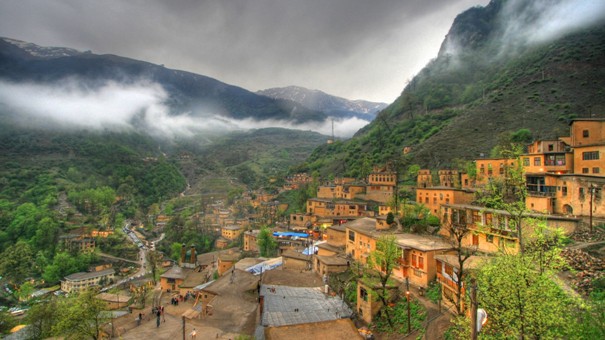
The smell of local bread, Voices of Swallows, spring blossoms, Roaring waterfalls, Massive forests, Mountains covered with flowers and plants Along with hospitable people, has created a paradise in northern Iran that attracts everyone.
A trip to northern Iran in the spring is inconspicuous.In springtime walking in the rain, among the blooms and colorful flowers, and staying under the gable roof is a beautiful and fascinating experience.Needless to explain that each season of Iran northern province has its own property.countrysides in North of Iran in addition to the greenery, with some exquisite landscapes, meadows and gorgeous forests are a beautiful collection of hundreds of small paradise and spectacular views.
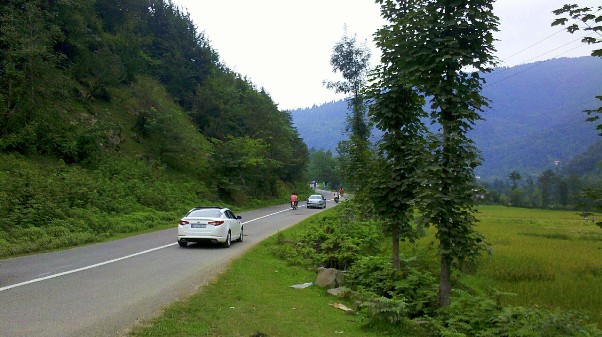
To access these tiny heavens, you should cross the mountainous and green roads.
The attractions of traveling to northern provinces of Iran can be described in several sections:
Natural features
Most parts of northern Iran are covered with forest and there are about 3,400, 000 hectares of forest in the northern slopes of the Alborz Mountains and Caspian Sea Provinces.These forests with 40 million years old and 80 tree species, are one of the most valuable forests in the world and is considered as a natural museum.
Alborz mountain range along west to east in the north of Iran, Continuing the Himalayas and Andes Mountains, has created very specific geographic features for this area.The Alborz mountain range and Damavand Peak are prominent in Iranian historical texts and legends.This mountain range is the longest in the Middle East and protect the northern parts of Iran from other parts like a huge historical wall.
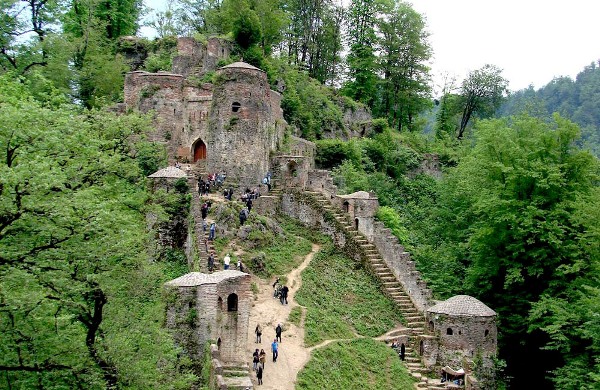
Historical & Cultural features
Historical evidence in the northern regions of Iran confirms a history of more than 10,000 years in these areas.Evidence of residency in these areas, such as castles, towers, bridges, Historic hills, as well as the objects available in the museums, themselves testify to this historical record.Most of the historical monuments in the area have been damaged over the years due to persistent humidity.But you can still see some that are still healthy.
For example:
– The Hyrcanian Golden Cup, dating from the early 1st millennium AD (800s BC). It was excavated at Kalardasht in Mazandaran.
– Marlik hill in Guilan province with 3500 years history.
– Rudkhan Castle is a military complex which had been constructed during the Sasanian era (224-651),
– Ancient hill of Gerdkooh Ghaemshahr, with 5000 years history.
– Lajim Castle, Savadkooh, with 1000 years history.
– The Great Wall of Alexander or the Red Wall also called the Red Snake.
– The Tallest Brick Tower in the World, Gonbad-e Qabus Tower was built in 996 AD.
– The World’s Highest Natural Arch, Espahbod -e- Khorshid Cave.
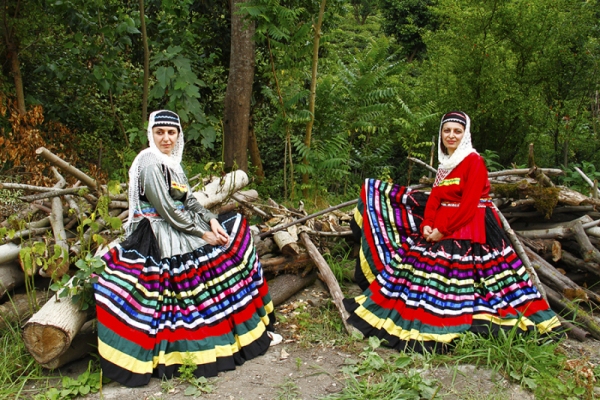
People
It has been a host of historical tribal peoples from all over the world since the past, and many migrations have been made to this area.From immigration the historic tribes until the arrival of the Poles and Russians in World War, all have caused Gilan hosts many people.These people created a special sense of security in their guests, that’s why the people of this land were famous for hospitality.
They treat their friends well, but they fought hard against the enemy.The obvious example of this feature can be found in the Gilani encounter with the Arabs and for over a century of resistance to their entry into their land.
If in the architecture of Iran’s desert areas there are narrow streets and tall walls, there are still houses with short walls in Gilan.Because the desert areas have always been exposed to the invasion of the aliens and they paid a lot of attention to security.
The most important feature of Guilan peoples that attract the tourist is
the efforts of women and men side by side to the cultivation of rice and various products.A Strong social relationships and sincere cooperation are among them.
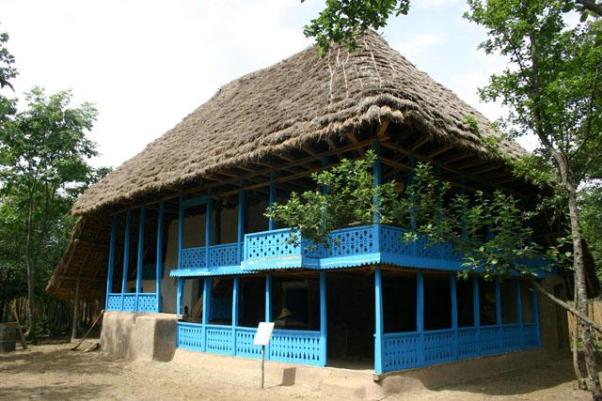
Architecture
The vernacular architecture of Mazandaran is full of
properties that are useful for new architecture.Studies in this area show that the past architecture of there is rooted in religious culture and attitude.Also   it’s beauty depend on it’s simplicity and avoiding   from extra elements.Familiarizing architectural  spaces with religious approach is a nessecity  that  can  solve  many  problems  of  new
lifestyles.The architectural style of the traditional living spaces in the houses of this region is in harmony with human dimensions.House components like stairs, Ivan, the kitchen and etc are formed by the minimum necessary in proportion to their function and avoid additional extras.
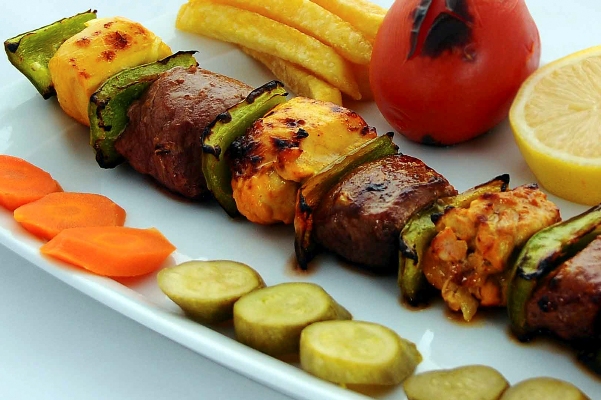
Food
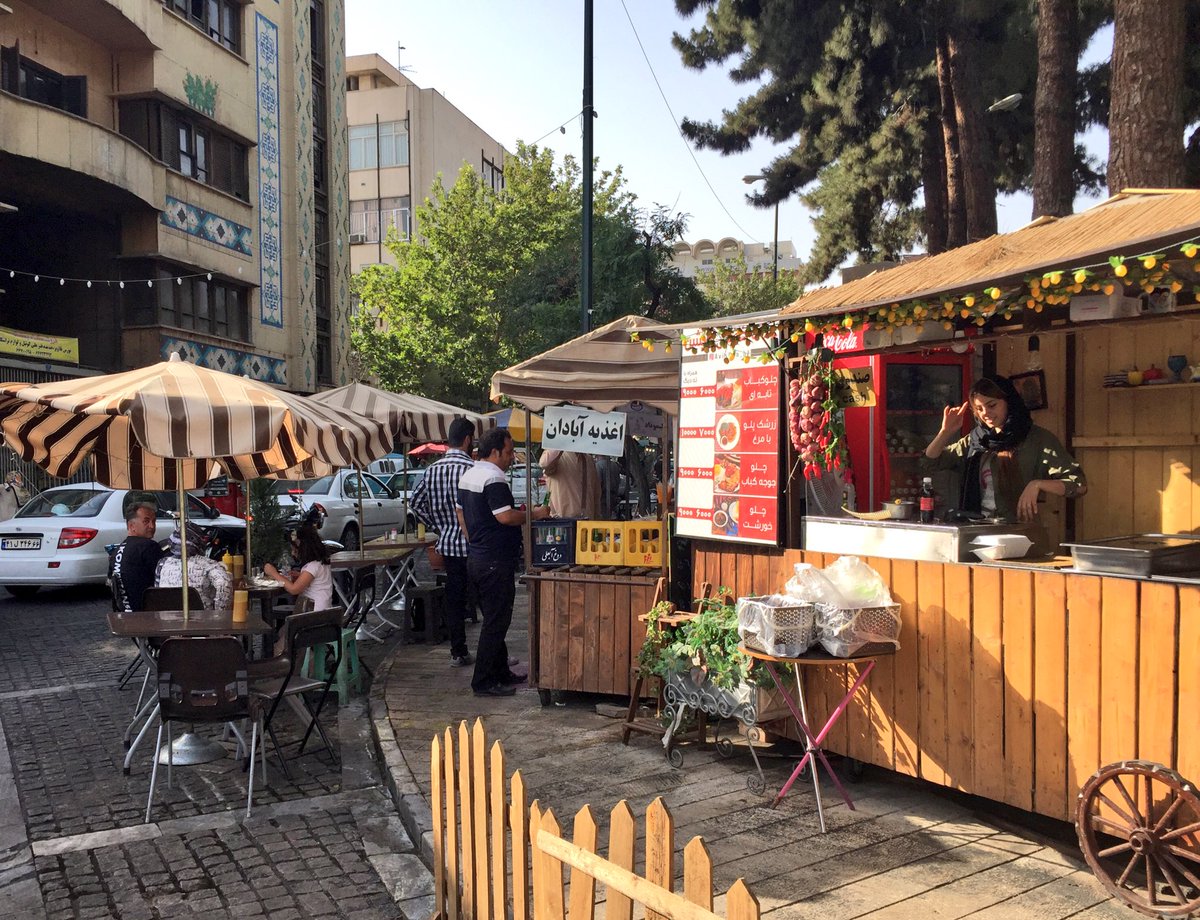
Iran is all about originality.There are local and delicious dishes throughout this land.The taste of the Iranian food in northern region of Iran always remains in the minds of tourists.Nowadays Iran Northern food is so famous that it is considered as a Foodi Tour in the tour programs.The most delicious tourist attraction of Gilan is a local cuisine that has intruded the taste of nature within it.The most delicious food with the taste of nature that will keep you on the table.Gilan is the first Iranian province for local dishes. There are more than 170 local food is Gilan.According to experts Favorable weather, good soil in Gilan, is the main reason of various local foods in Guilan.
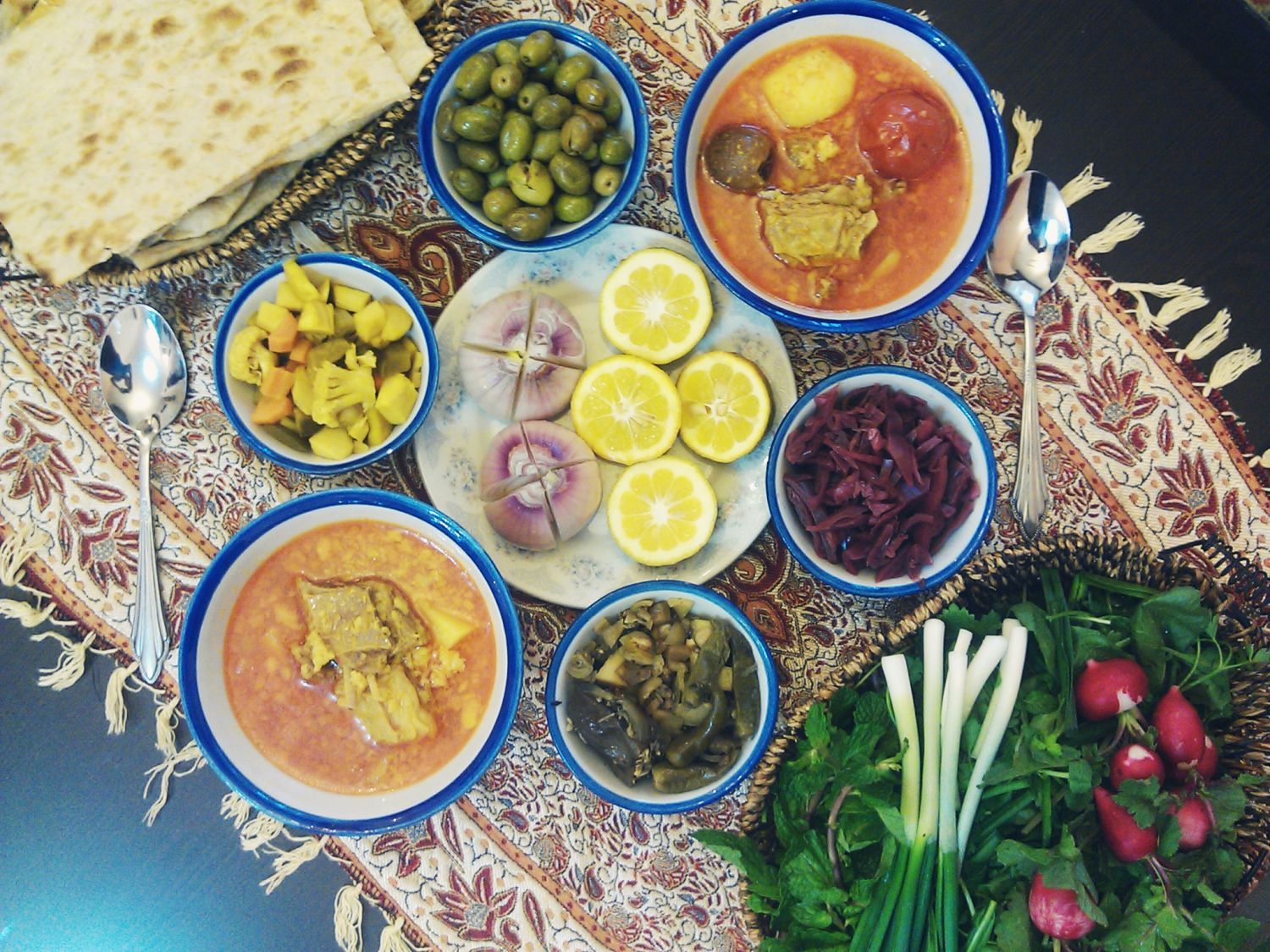
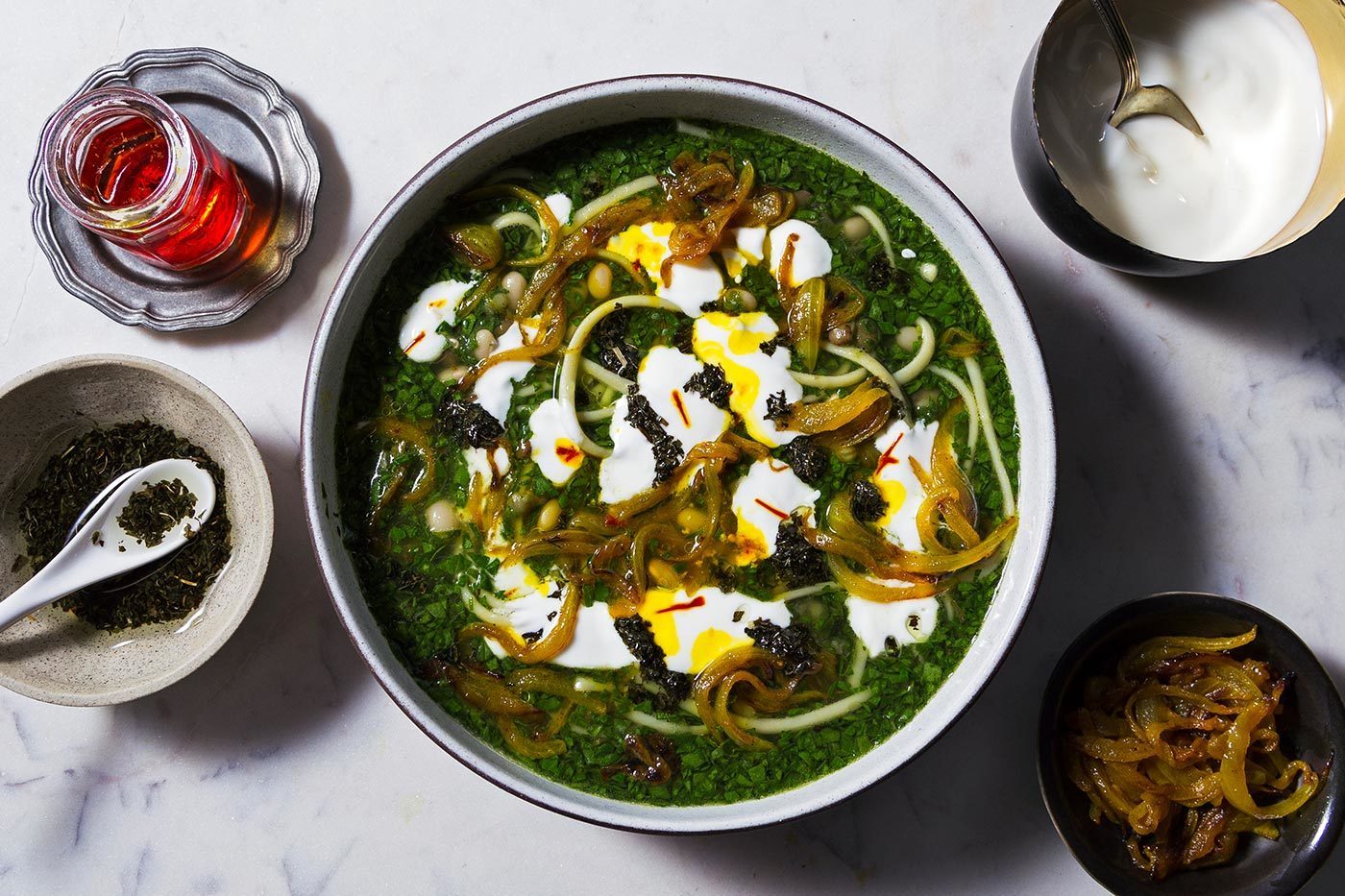
Whilst travelling around Iran you are sure to come across a stunning variety of culinary delights. From traditional stew dishes to succulent kebabs and heart warming soups, each region has something to offer. The variance in ingredients and dishes is partly owed to the diverse climates which exist across the country, resulting in only the richest of ingredients that are used for cooking. Here is a breakdown of the top 11 must-try traditional dishes for you – Noosh-e-Jan! (bon appetite).

Dizi

Also known as ‘Abgoosht’, this meat and bean broth dish dates back hundreds of years. It is essentially a stew made up of lamb and chickpeas with a tomato base. It is usually served in a stone dish called a dizi – hence the name.

dizi

Ash Reshte

Another heart warming, traditional dish which is generally served in the winter is the soup dish Ash Reshte. Hearty and delicious, this soup is made from chickpeas, beans, noodles and plenty of herbs.

Ash reshteh

Kabab

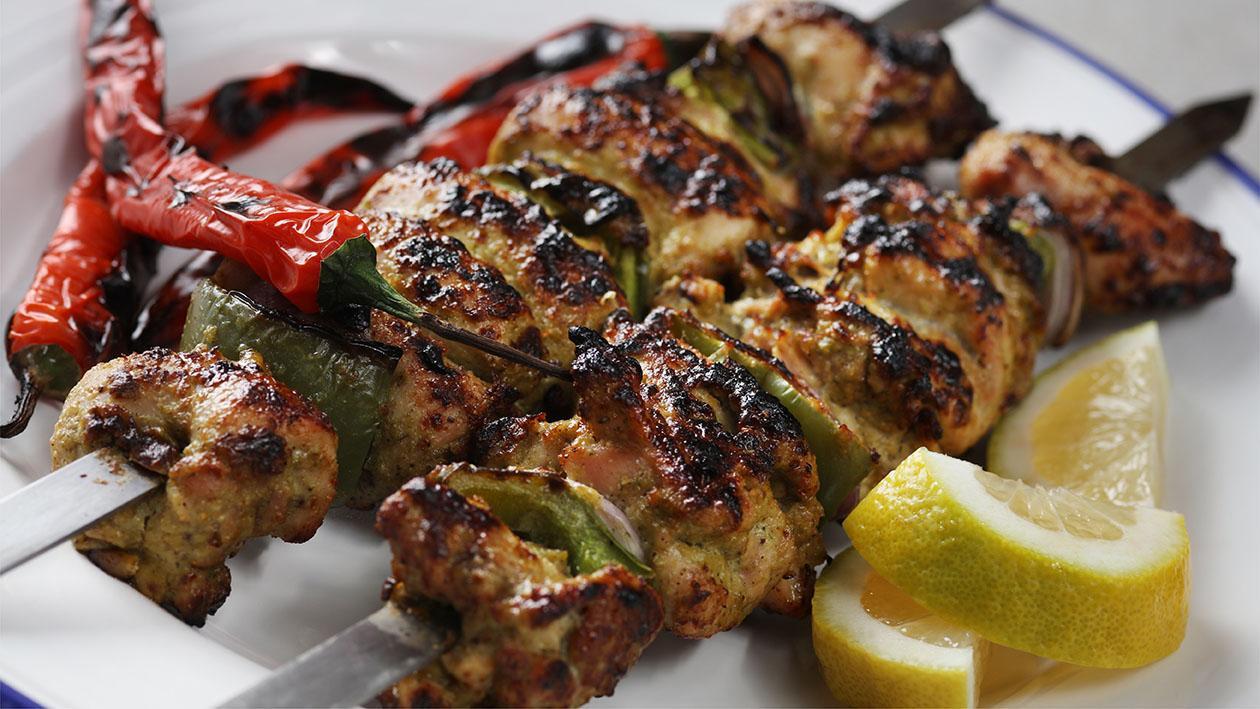
If you’re heading out for dinner in an Iranian restaurant enjoyed by locals then the chances are you will be served kebabs and rice-Iranian style. Iranian style kebabs are known for being particularly succulent and tender, and come in several varieties including koobideh, barg, chenje and bakhtiari.

Kabab

Khoresht Gheimeh

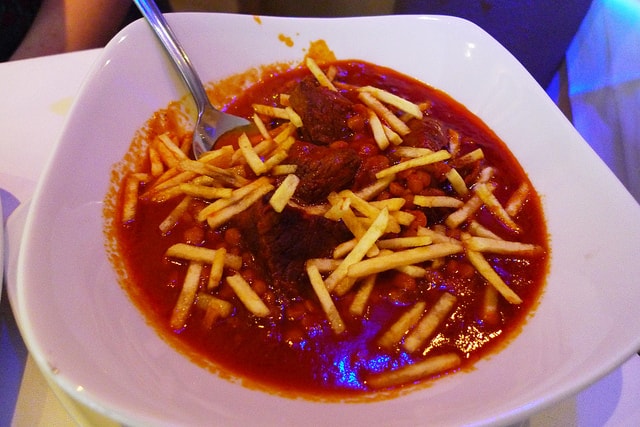
Khoresht Gheimeh is a beef and split pea stew made with dried limes and cooked in a tomato base, usually served with fried potatoes on the top. In the month of Muharram, a holy month in the Iranian calendar this dish is cooked and served on the street to those in need.

Khoresht Gheimeh

Khoresht Gheimeh

Zereshk Polo Morgh

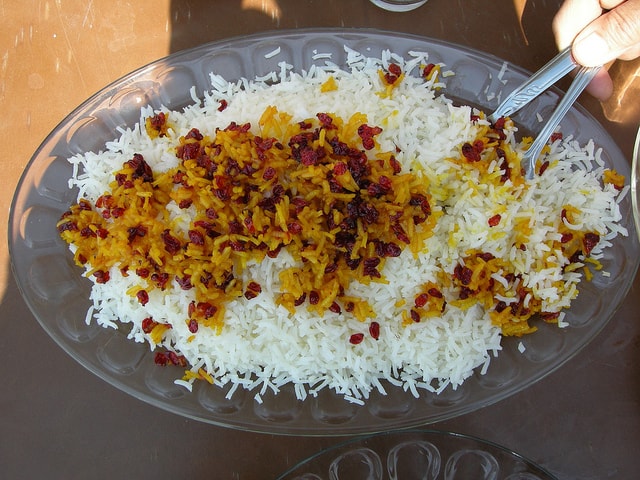
By far one of the prettiest Iranian dishes, Zereshk Polo Morgh is a rice dish usually made with saffron and barberries alongside a chicken and tomato stew. The barberries are a vibrant red and are sour to the taste, making the taste of this dish an interesting one.

Zereshk polo morgh

Zereshk polo morgh

Fesenjan

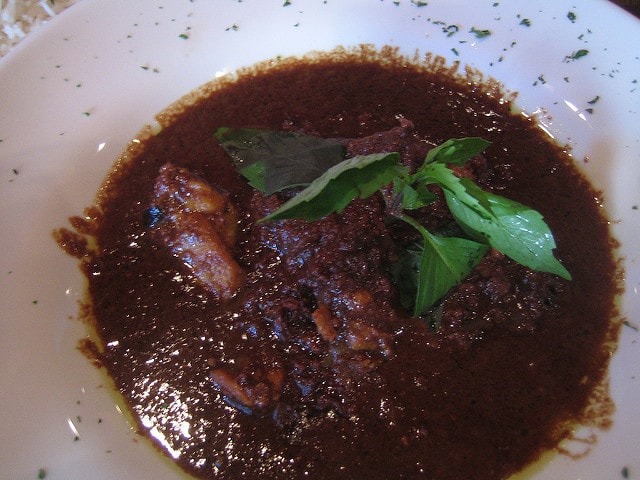
Fesenjan is an iconic dish dating back to the Achameinid Empire in 515 B.C. Made from walnuts, pomegranate paste and chicken or duck, it is common to spot it among the food often served at a wedding ceremony in Iran. At the ancient ruins of Persepolis, archaeologists discovered a tablet detailing the ingredients used to make Fesenjan, making it one of the oldest loved dishes.
Fesenjan

Fesenjan

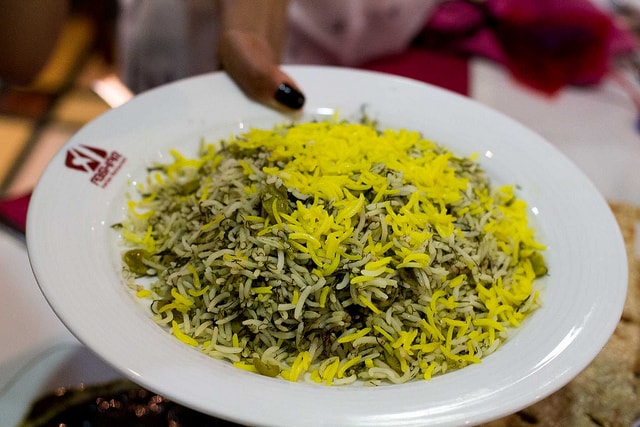
Baghali polo

This rice dish is made with saffron, fava beans and green dill, and is usually served with lamb. A favourite in spring time, this is one of the most popular rice dishes in the country.

Baghali polo

Baghali polo

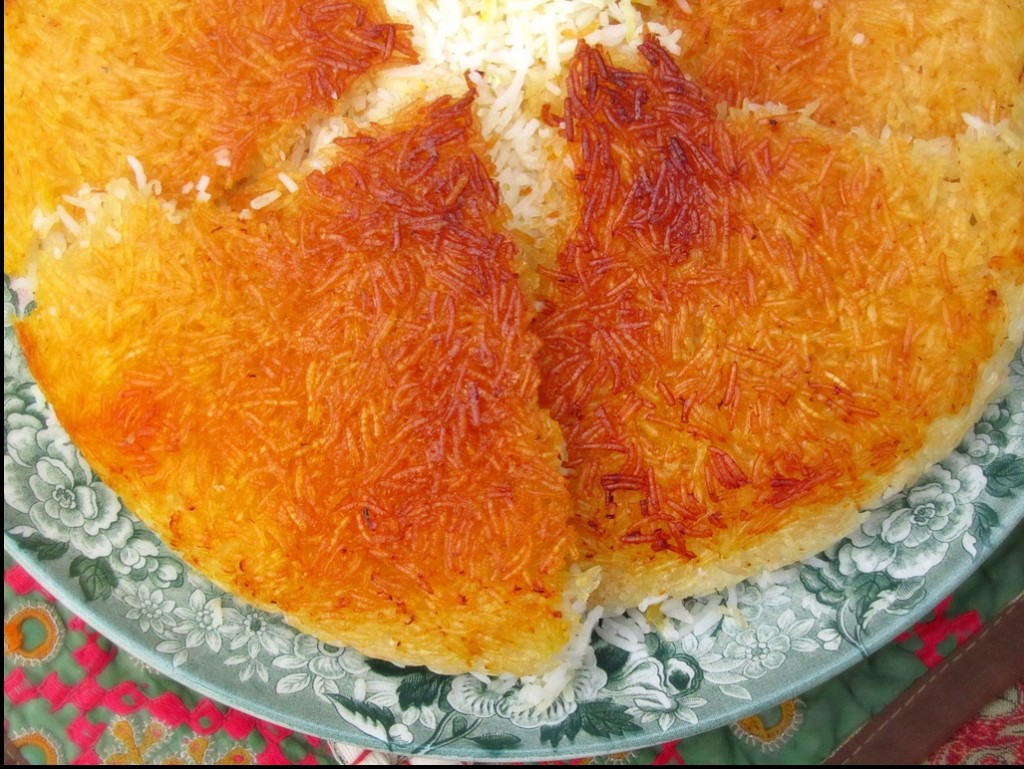
Tahdig

Tahdig is the golden crispy layer found at the bottom of the rice pot. It’s normally eaten as a side dish however there is never enough of it and tahdig often finds itself in the middle of most family rows!

tahdig

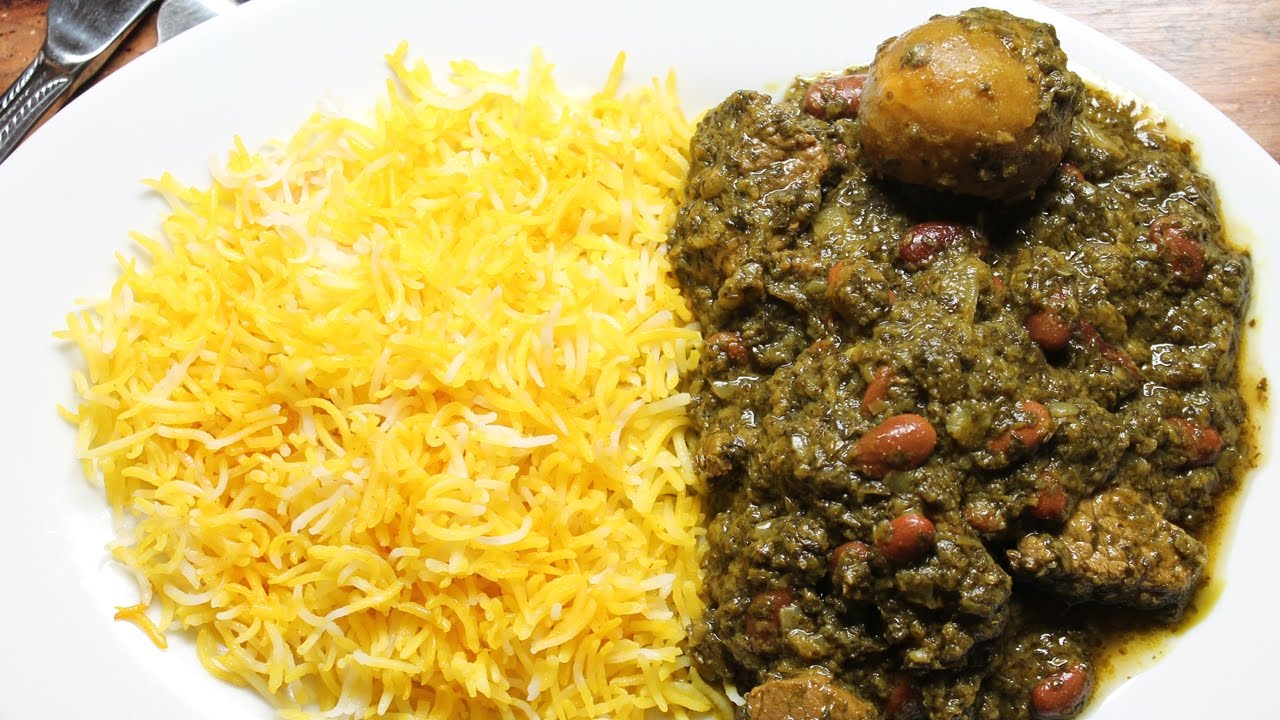
Ghormeh Sabzi

Made from lots of herbs, kidney beans and lamb, this dish is typically served with rice and is another very popular and must-try dish in Iran.
Ghormeh Sabzi

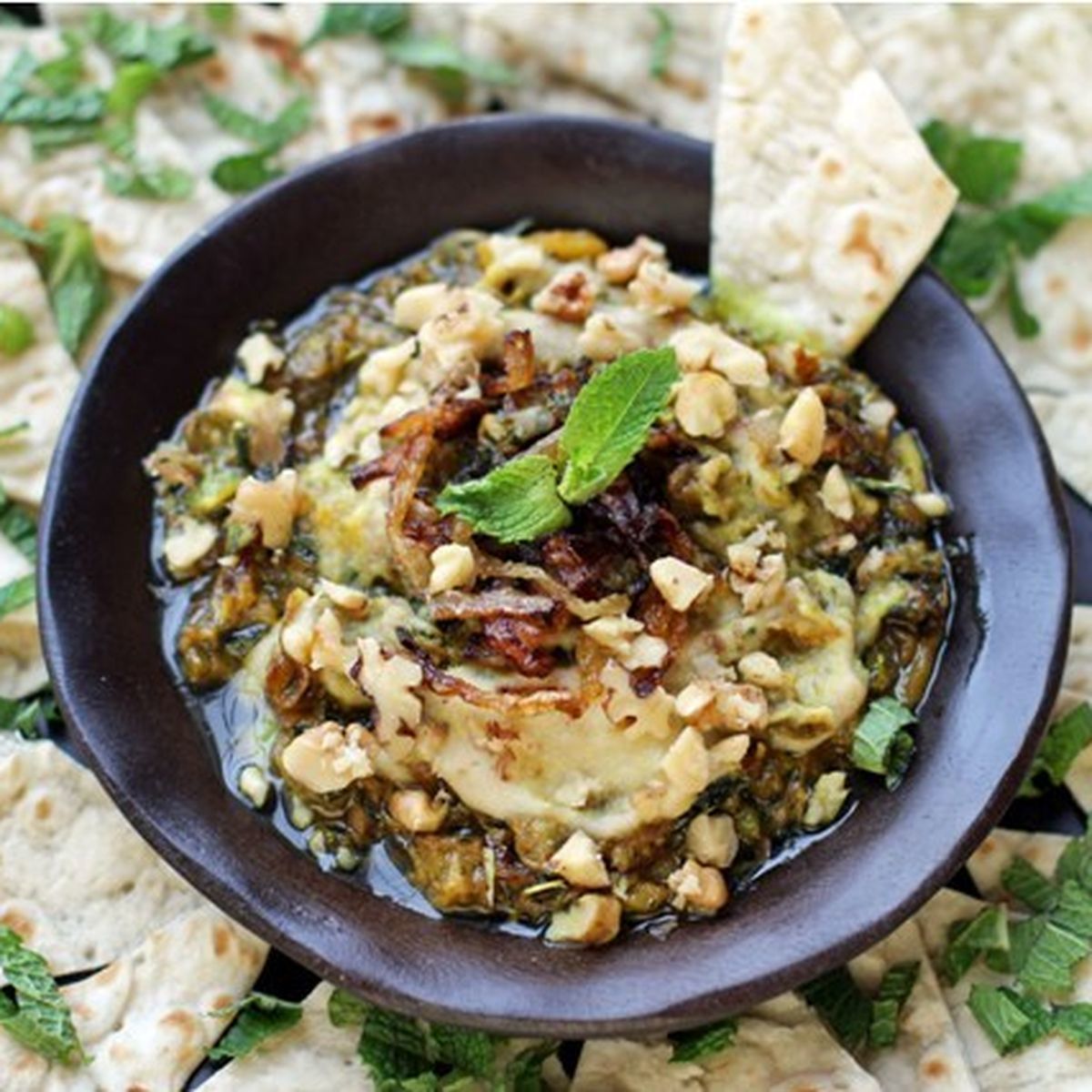
Kashke Bademjan

Usually eaten as a dip or side dish, Kashke Bademjan is made up of smoked aubergines and ‘Kashk‘ – a yoghurt whey used commonly in Iranian cooking. This dish is usually served with a delicious Iranian bread known as Lavash.
Kashke Bademjan

Saffron Ice-Cream and Faloode

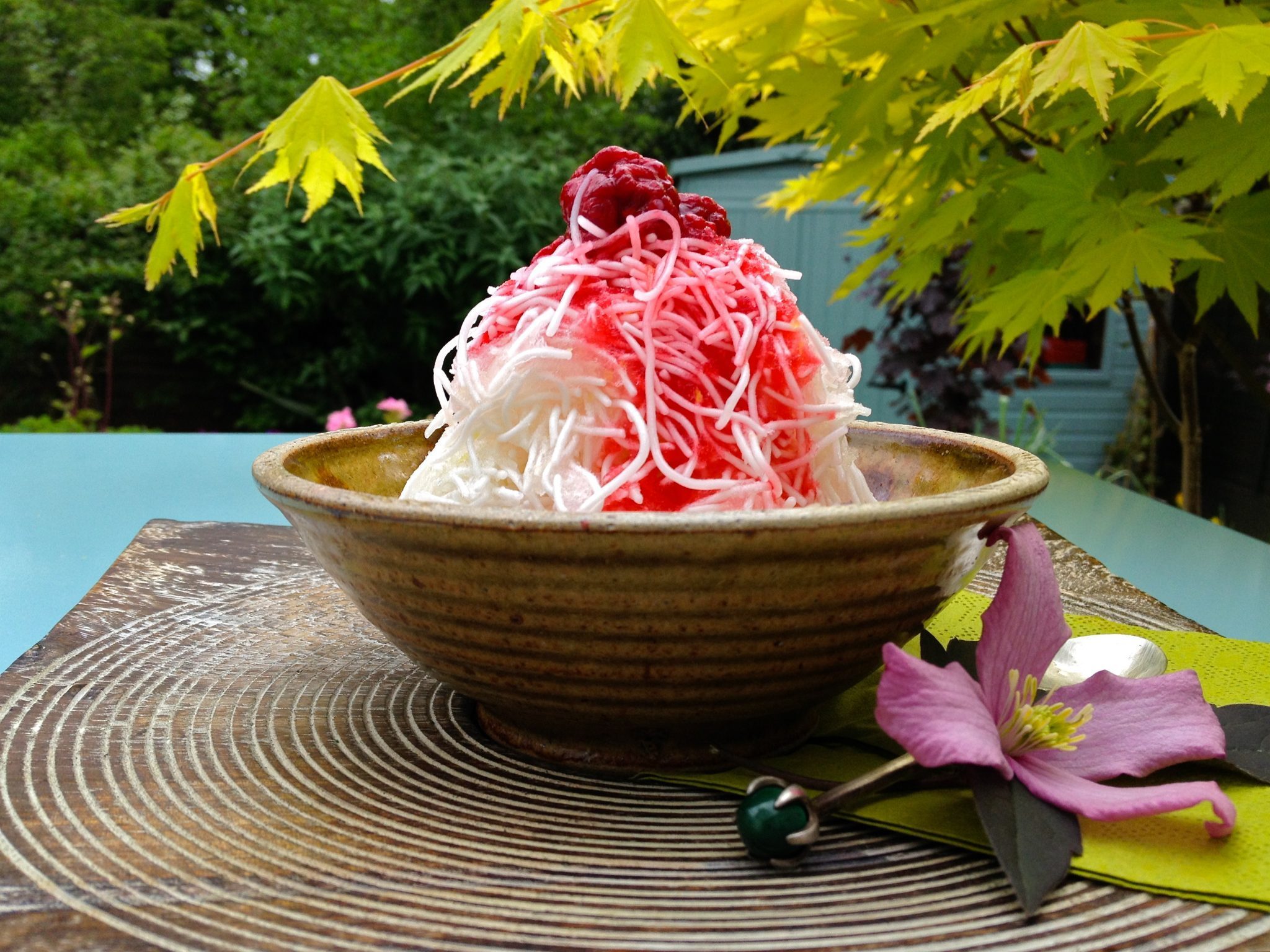
One dessert dish worth trying out is Iranian saffron ice-cream and faloode. Faloode is also a cold dessert, consisting of rice noodles mixed in semi frozen rose water and sugar syrup, similar to a sorbet. Both of these can be found at ice cream shops around Iran and make a delightful afternoon snack in the hotter months of the year.

Faloode

As you would expect from one of the oldest continuous civilisations in the world, Iran and Iranians have created many ingenious and revolutionary things and concepts we now take for granted. From the postal service to the refrigerator, here are 10 inventions you probably didn’t know were Iranian.

Human Rights

The Cyrus Cylinder has been historically recognised as the the world’s first universal charter of human rights. Created in 534 BCE, the Cyrus Cylinder is constructed out of clay and inscribed in Akkadian cuneiform script, and predates the Magna Carta by one millennium. It was discovered in Babylon in 1879, and is now kept in the British Museum in London.

The Postal Service

‘Chapar Khane’ is a Persian term for the first postal service system used during in the Achaemenid Empire. It was created by Cyrus the Great and later developed further by Darius the Great as a method of communication throughout the Persian lands. The system comprised of a series of stations along a 2,500 m highway throughout the empire, where the ‘Chapars’ would ride horseback, delivering post from one part of the kingdom to another.

The refrigerator

In 400 BCE, the ancient Persians created the world’s first ever refrigerator. The Persian word for fridge – Yakhchal – translates as ice pit, which is very much how the modern day fridge started out. The original structure had a domed shape somewhat like a small mountain, and it was used to store mainly ice but also sometimes food items.

Algebra

Muhammad ibn Musa al-Khwarazmi was a Persian scholar (750-850 AD) in Baghdad. His work spanned the fields of mathematics, astronomy and geography during the Abbasid caliphate. Today, he is best known for the method through which he taught algebra as an independent science. For this reason, he is hailed as the founding father of algebra.

Sulphuric acid

Zakariya Razi (865-925 AD) was a pioneering Iranian scholar who discovered alcohol and sulphuric acid. Nowadays, sulphuric acid has a wide range of uses and applications, including as drain cleaner, as an electrolyte in lead-acid batteries and in various other clothing products.

Chess

Although there is some dispute as to whether the game of chess originated from India or Persia, the earliest mentions of chess in writing can be found within Iranian literature. The oldest surviving chess pieces came from the Persian lands, thus reinforcing the belief that chess originated in Persia.

The guitar

The earliest version of the modern day guitar exists in the form of the tar or lut – a wooden instrument on which strings were plucked to produce music.

Important discoveries in modern medicine

Ibn Sina or Abu Ali Sina is known more commonly in the Western world as Aveccina. He is considered to be one of the most significant physicians, astronomers and thinkers of the Islamic Golden Age (8th-13th centuries). After qualifying as a physician at the young age of 18, he went on to produce his most famous works – ‘The Book of Healing’, and ‘The Canon of Medicine’, an encyclopaedia of medicine.

The first monotheistic religion

Zoroastrianism is considered to be the world’s oldest monotheistic religion, founded by the prophet Zarathustra over 3,500 years ago in the city of Yazd, which is now in Iran. Estimates suggest there are around 190,000 Zoroastrians worldwide today.

Qanat (water irrigation)

The qanat was a water management system used in irrigation, which dates back to the pre-Achameinid era. The oldest known qanat is in the city of Gonabad in Iran, which after 2,700 years still succeeds in providing drinking and agricultural water to people today.

The must-see places of Tehran no visitors should miss!

Si-e Tir Street

Unbeknownst to even many locals, a synagogue, church, and Zoroastrian fire temple sit together harmoniously on the cobblestone Si-e Tir street. Haim Synagogue hosted Polish Jewish refugees during the Second World War, and as this number increased, a second Ashkenazi synagogue was built adjacent to it. Holy Mary Church is across the street from Adrian Fire Temple whose flame was brought from the temple in Yazd. Be careful as you walk in this area as it gets more crowded the farther north you walk, and motorcycles are merciless, often creeping up behind you on the sidewalk!

Si-e Tir Street

Jomeh Bazaar

Every weekend, Parvaneh Mall’s multi-storey parking garage converts to a Friday bazaar and should be experienced even if you aren’t in the market for buying anything. The first few floors are a treasure trove of antiques with everything from home décor to vintage photos, records, and gramophones. As you ascend, you’ll find unique handmade products by local artists and art gallery paintings being sold at a fraction of the retail price. Go early to avoid the crowds and to have the most choice.

Jomhuri Avenue between Ferdowsi Ave. and Shirvani Alley

Deh Vanak

The peaceful Vanak Village sits just north of bustling Vanak Square. One of Tehran’s oldest neighbourhoods, this area was once known for its grand gardens, but the charm nowadays lies in its narrow alleys (some just 90 cm wide), wooden doors, and sun-dried walls. The Iranian Garden is modelled after the typical Persian gardens and is especially picturesque when it’s drowning in colourful tulips. Vanak Zurkhaneh, a gym of traditional Persian martial arts inscribed as a UNESCO Intangible Cultural Heritage, and Saint Minas Armenian Apostolic Church are other sites to visit in this area.

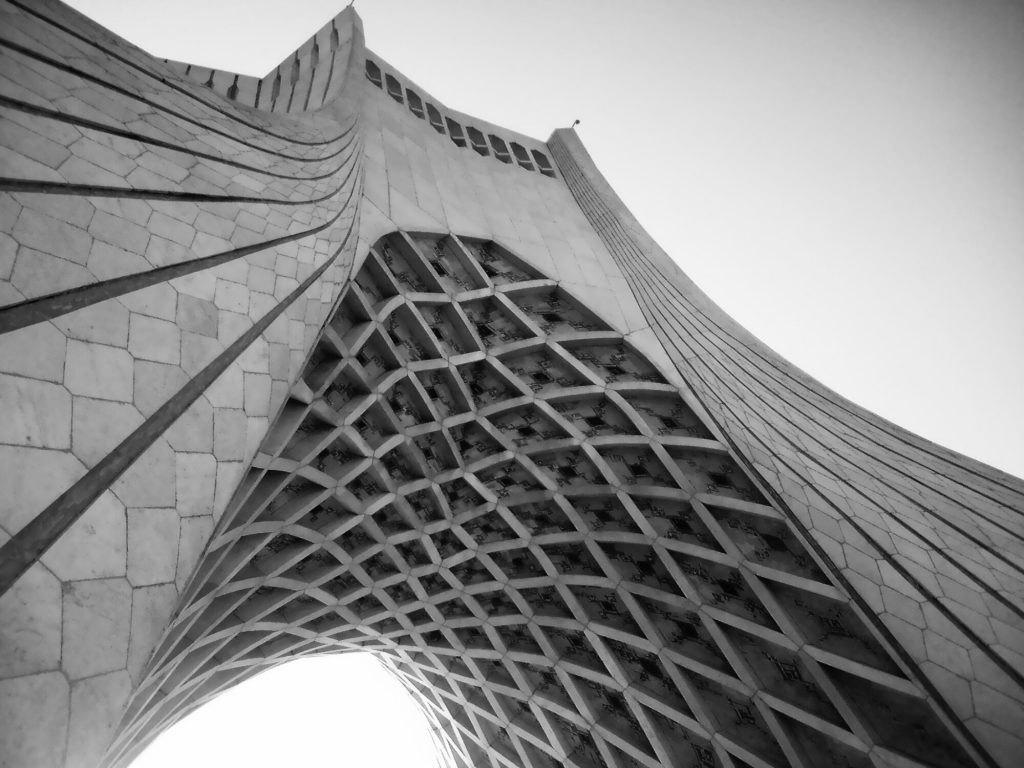
azadi

ranian Garden, Saberi St., Tehran

Negarestan Garden

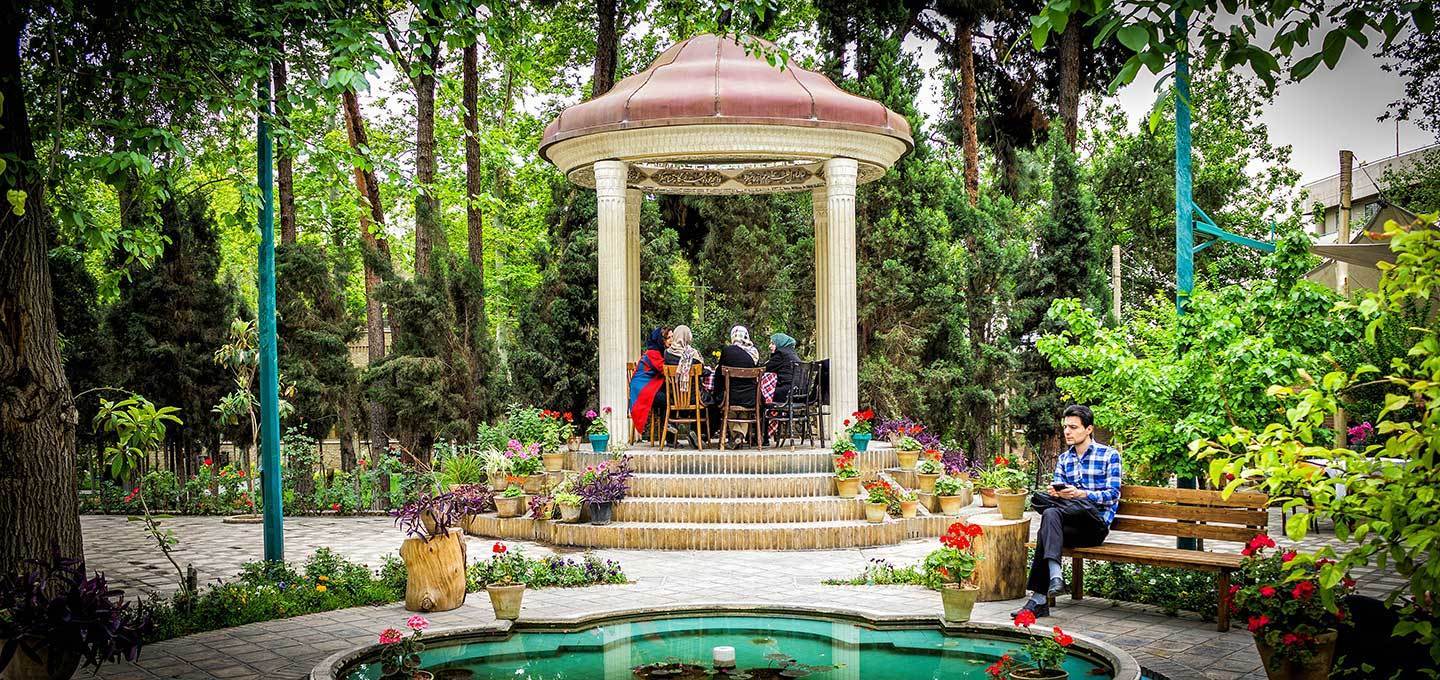
In the chaos of downtown Tehran, you may be surprised to find this oasis of serenity. Built as a summer retreat during the Qajar era, Negarestan Palace was later converted to Iran’s first modern university where the famed lexicographer Dehkhoda wrote the comprehensive Persian dictionary. This palace currently acts as a museum, housing some of painter Kamal ol-Molk’s masterpieces. The outdoor cafe in this lovely setting has, needless to say, become extremely popular with locals, and if you’re lucky, you may even get the table under the Hafezieh, a structure modelled after Hafez’s mausoleum in Shiraz.

Negarestan Garden

Negarestan Garden, Tehran

Masoudieh Palace

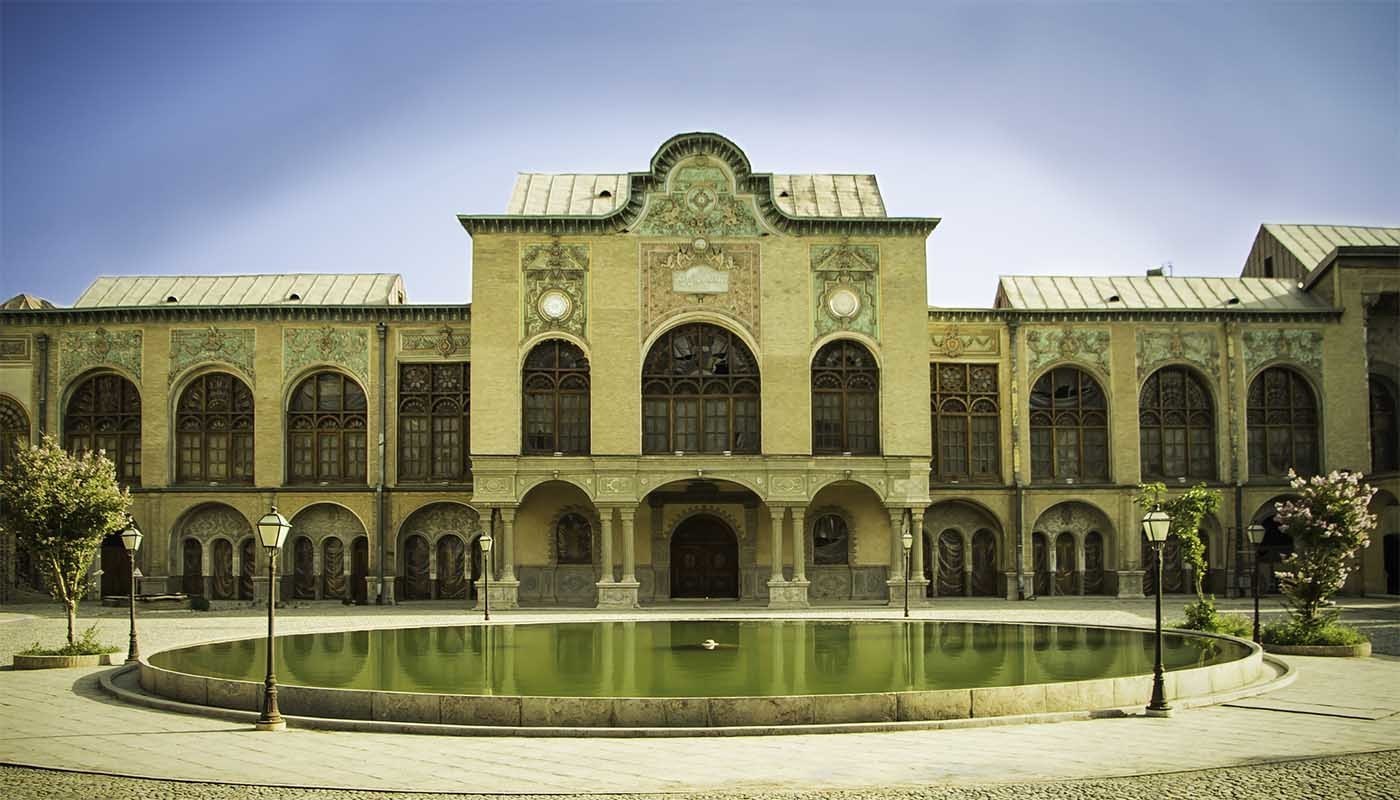
One of the most beautiful historical buildings of the Qajar dynasty is Masoudieh Palace. Aside from its historical significance dating back to 1879, this palace allows visitors to fully experience its culture and history in the cosy cafe, with its traditional architecture and stained-glass windows and whose servers are local theatre actors. A walk around the gardens and fountains will complete the outing to this unforgettable palace.

Masoudieh Palace

Masoudieh Palace, Mellat St., Tehran

Zahir od-Dowleh Cemetery

North of Tajrish Square off Darband Street is the quiet Zahir od-Dowleh Cemetery where Iran’s most prominent artists and cultural figures have been laid to rest. Known as the cemetery of poets and musicians, among the most famous names here are musician Gholamhossein Darvish Khan, 19th century poet Iraj Mirza, and the 20th century poet best known for her feminist point of view, Forough Farrokhzad. The sound of chirping birds under the canopy of trees provide a serene setting where Iranians still come to pay their respects.

Zahir od-Dowleh Cemetery, Darband, Tehran

Moghadam Museum

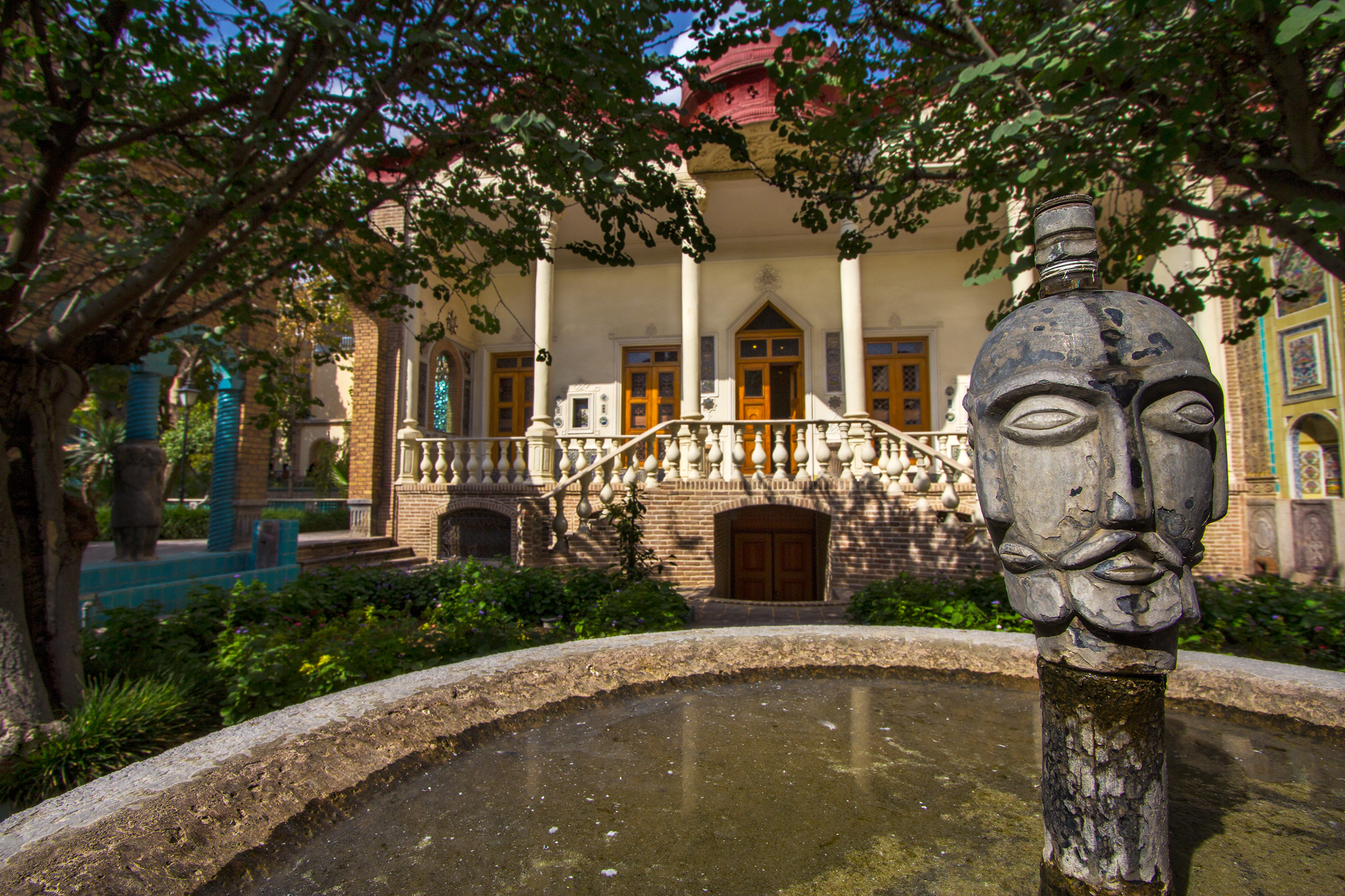
This majestic house once belonged to the artist son of Tehran’s mayor during the Qajar dynasty. Along with a private and public wing, it has some the most exquisite tiles throughout the house. The museum displays some of Moghadam’s art and other objects he acquired during his travels. Enough can’t be said about the surrounding gardens as they completely remove visitors from the hubbub of the city centre and offer a tranquil respite.

Moghadam Museum

Moghadam Museum, Emam Khomeyni St., Tehran

ASP Towers

Completed in the mid-70s, these residential towers once housed some well-known Iranian figures. Though the towers aren’t particular noteworthy themselves these days, the ground floor is littered with trendy cafes and restaurants and is therefore a popular hangout with the young Tehrani crowd. Homemade Iranian cooking at the cozy Mahtab Cafe and delicious Asian noodles and sushi at Wasabi are just some of the eateries all nestled within these towers. A stop at Aknoon Gallery is a must to check out the modern-meets-traditional Persian art, fashion, and jewellery.

ASP Towers, Tehran

Naser Khosrow Street

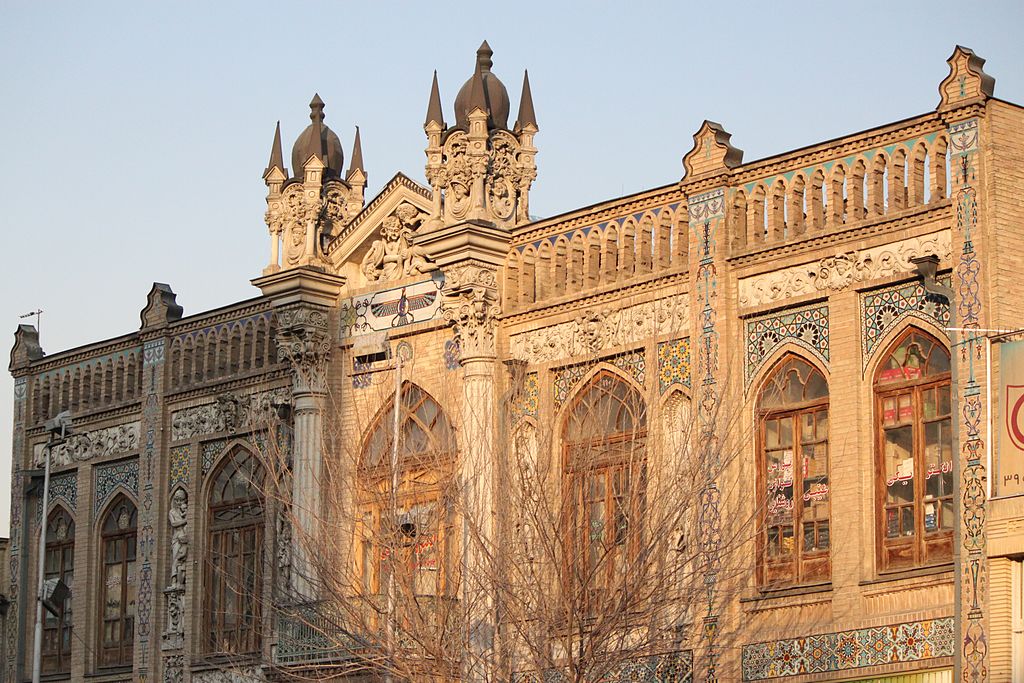
The oldest street in Tehran, Naser Khosrow has some of the most iconic landmarks. Delve into the past by first passing Darolfonoon School, Iran’s first modern school founded by Amir Kabir, a prime minister of Iran, in 1851. Further along, the gothic architecture of Saraye Roshan, one of the first commercial centres, is sure to stand out as unusual in Iran. The twin towers of Shams-ol-Emareh peek out from behind the buildings, and right across the street is Marvi Alley Bazaar with its plentiful shops, boutiques, and delicious street food.

Naser Khosrow Street

Read more

Travel to Iran without Isfahan is not complete

According to tourists who visited Iran and Isfahan, it is one of the most beautiful and most visited cities in Iran. It seems that there’s something in Isfahan that makes the city so likable.As it’s got some of the highlights of a trip to Iran, the absolute majority of tour operators plan the itineraries in a way that Esfehan is the first or the last stop before leaving Iran.
These special features of Isfahan can be divided into several categories.

Natural scenery

Zayande Rood

The most important and most significant natural effect in Isfahan is Zayandeh Rood River
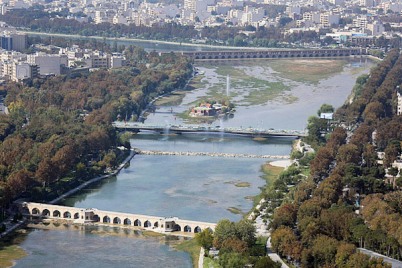
A river with historic and beautiful bridges that give the city a dazzling effect.This 400 km long river in the provinces of Chaharmahal Bakhtiari and Isfahan, besides the special effects of nature, has provided a great deal of sports facilities for tourists.At the side of this river in addition to the farms and the lush forests have created areas for rafting and recreational sports.There are parks on both banks of the river for kilometers and this lets the people from Isfahan and environs to spend some time relaxing in the shade of the trees, stroll with friends and family and revitalize themselves and enjoy their time.Some of the royal gardens of Safavids (16th to 18th centuries) were irrigated this way.Zayandehrood’s historic bridges like the 33 bridges and khaju have provided a beautiful and deceptive effect to the river.Zayandehrood’s historic bridges like the 33 bridges and khaju have provided a beautiful and deceptive effect to the river.Walking along these bridges is one of the attractions of tourists.

City Planning of Esfehan

Chaharbagh Street

A lot can be said about the city planning of this beautiful city.
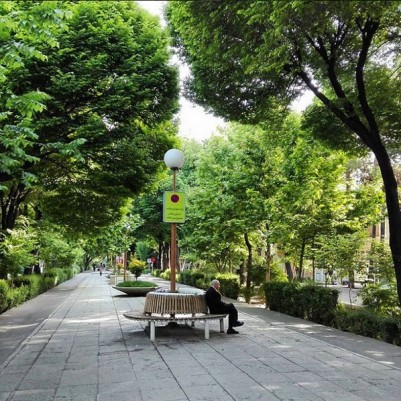
First of all, it’s green.You see several fully-shaded streets in different parts of the city as well as pedestrians, especially on Chaharbagh Street, one of the most beautiful streets of Isfahan.There’s such a broad shaded space in the middle of the street that city hall has placed benches for the people to sit down and relax.
As I mentioned before, there are parks along the river on both banks of the north and south. You can go jogging, walking, etc. for hours.
You can go on a picnic and hire a boat and go peddling.There are also good highway system and overpasses and underpasses that helps you make your inner city trips shorter and more comfortable.

Historical Monuments of Esfahan
Isfahan is known to “Half of the world or museum city “This slogan of Isfahan represents an abundance of Historical monuments
Cultural and Artistic in this historic city.The Iranian architecture of every historical period has its own charm, but as far as structural techniques, tiling and decoration are concerned, there are no other ancient monuments in Iran that could match the buildings of Esfehan.
Undoubtedly, Naghsh-e-Jahan or Imam Square is at the center of these fantastic arts.The early 17th century square with its magnificent monuments and colored shops all around created a unique setting that you will not see anywhere else in Iran.This unparalleled collection includes the Royal Palace, Jame Mosque,
Royal mosque and market collection as well as other royal palaces around the square that have all contributed to making this place an unforgettable one.
There are other mosques such as the ancient Esfehan Friday mosque which are astonishing and worth visiting.
You should add to this unique collection the churches, old houses, the Zoroastrian fire temples, as well as the historical minarets of Isfahan.
So add a free day at end of your schedule for these historic monuments.

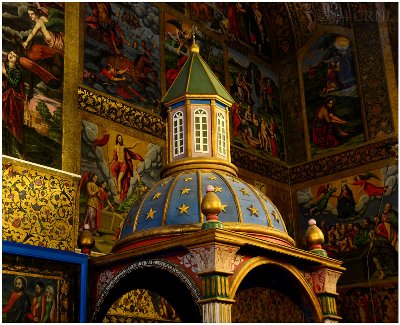
Vank Cathedral

Handicrafts of Esfehan and Its Artists
In most parts of Esfahan, and in particular in Imam Square, you can shop, art galleries and workshops of handicrafts where you can see the actual artists and craftsmen who are creating beautiful works of art.Large collections of artistic works, carpets, miniature paintings, etc. make Esfehan the city for shopping during your stay in Iran.
These artists will welcome you in their colorful stores and you can visit these valuable artworks.These people are keeping this Iranian art alive by following the traditional styles of centuries of miniature painting in Iran.

Armenian Quarter of  Jolfa
Armenians have long been living in Iran and their history has been linked to Iran’s culture and civilization.Many regions of Azerbaijan and other cities of Iran have long been the home of Armenians.The existence of various historical churches in Iranian cities reflects the history of these people in Iran.
The Armenians of Isfahan from the time of Shah Abbas(17th century) settled in the southern part of the Zayandeh River.Jolfa is the quarter worth visiting for both its fascinating churches as well as culture. In this part of the city, you can get acquainted with the Armenian climate of Isfahan.You can find all the special Armenian elements, such as the hotel’s café restaurant and their stores, you can enjoy spending time in and having something to drink.Coffee is part of Armenian culture. So, if you want good in an interesting atmosphere, Jolfa is the place.

Isfahan and Tourists

People
The last section is about hospitable local people of Isfahan, who are so proud of their city and happy to welcome foreign travelers.This city is not only for tourists but also for Iranians themselves as one of the destinations of tourism
Every year in different seasons of the year, like the New Year, Noruz, Iranian New Year, as well as summer holidays, millions of Iranian travelers visit Isfahan and explore its beauty.So, the local people have got the reason to feel proud of their legacy.
Esfehan, because of what you have read so far, is where people have been very exposed to tourists. Tourism has brought business and employment to the city. The local population is happy to see tourists and is useful to them.
In general, if there is a reason why some travelers come back to visit Iran again and again, they are kind, generous and hospitable people. You must see it to appreciate it.

5 Special Offer for Autumn Cruise

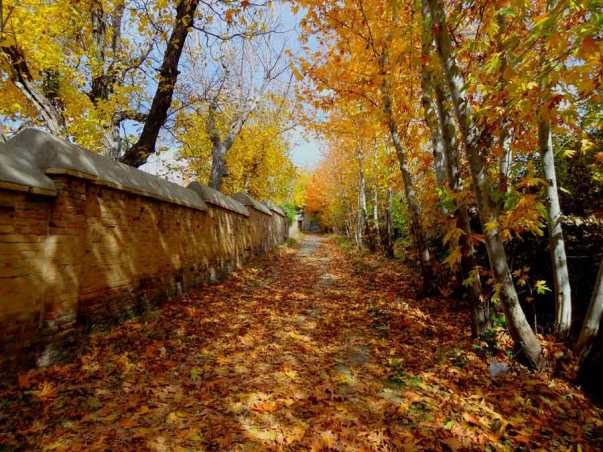
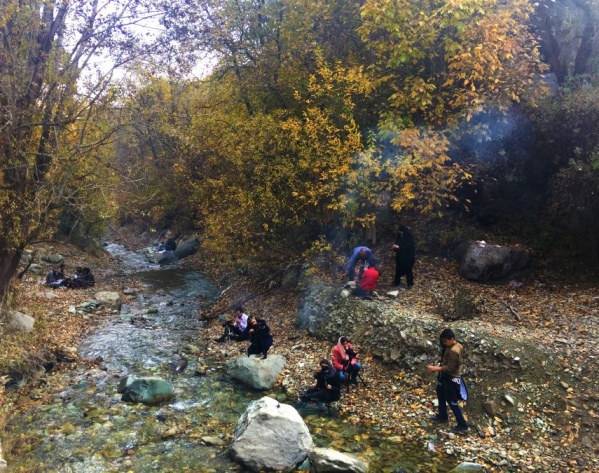
The journey will not end only in the summer and its long days.The new season of travel to new areas begins with the coming of autumn.Pleasant weather,the smell of rain and colorful trees has prepared the best season for nature lovers.
Iran is a four-season country and due this particular feature you can visit some part of Iran in different seasons.
Traveling in Iran is not limited to spring or autumn.At any time, a part of this beautiful country prepares a special trip location for you.Autumn in Iran has different choices for you.The deserts provide the best trip for you in this season. Simultaneously,the northern forests of Iran are waiting for desert travelers with millions of colors.

We have 5 special offers for your autumn trip that you will have a memorable and colorful autumn tour in Iran.

Desert tourism
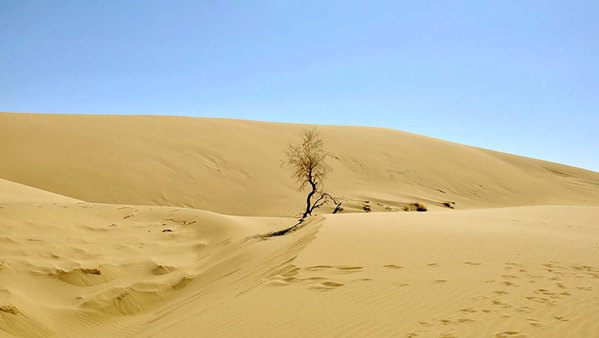
Autumn is the best season for lovers of the desert.In this season, the extreme heat of the desert and the cold of the nights are both tolerable.Since Iran is a desert country, then you will have different choices to travel to one of the beautiful deserts of Iran.
Maranjab desert near Tehran will have the best and the closest access to you.In addition, in this desert area you can visit all the features of the Iranian desert region in a small area as like as Sandy hills,SaltLake,Sandy roads,
The Silk Road,Desert Wildlife and other features of the desert areas.Also, the most important feature of this region is the implementation of the tour program as a one-day excursion program.
Our second suggestion for your desert program is the 2-day tour of Kashan and Abouzidabad Desert.Spend one day in Kashan and the other day in the desert of Abu Zaidabad.This area is just 30 minutes from Kashan.
In order to enjoy other desert areas in Iran, you need some medium-term plans that Iranian agencies will help you.

Nayband; Tabas
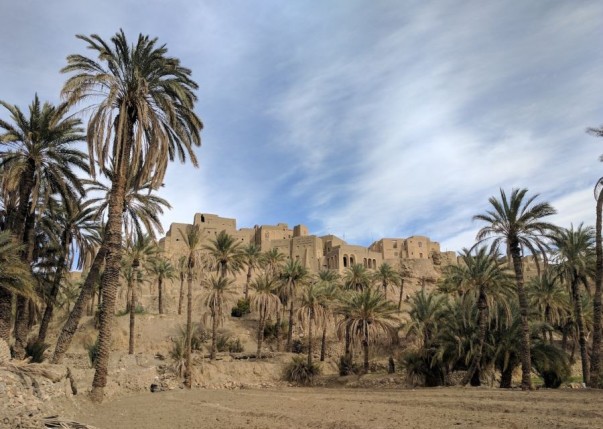
Another landmark of Iran in the fall is the village of Nayband.This desert village is known the Masooleh of Desert.Nayband is located 225 km south of Tabas and adjacent to the Lut desert.Nayband is one of the unique examples of staircase architecture that has been formed in the Lut Desert.In this type of architecture there is a dense set of houses in which the roofs of the houses are used as their upper yard.This architecture has created a solid correlation among the inhabitants of this region.
One of the most prominent and spectacular views of this area is seeing the sky at night with millions of stars.

Forestry; from Naharkhoran Forest to Londvil Forest
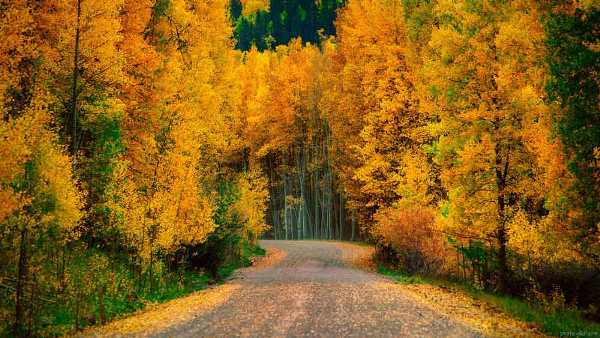
Autumn is the best season for walking in the Forest.Trees with thousands of colors and the smell of wet soil are autumn beauty that makes walking in the woods more enjoyable.3 Northern provinces of Iran with dense forests and tall trees will have unforgettable autumn landscapes.For the Trekking Trees in the Autumn make travel to one of these beautiful areas:
Naharkhoran Forest,Gorgan Province.
Asalem to Khalkhal Road,Gilan Province.
Alimestan Forest,Amol,Mazandarn Forest.
LondvilForest,Astara,Gilan Province.
Chamestan Road,Mazandaran Province.

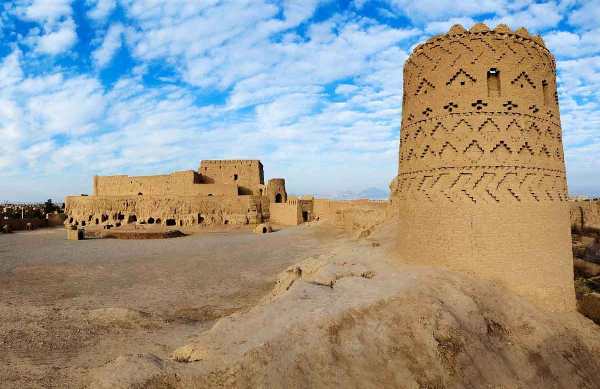
Meybod,Yazd
This small town is located on the edge of the Yazd desert with 45 km distance from Yazd.You can experience four seasons of the year at this time.Spring mornings, summer heat noon, autumn sunset, winter nights and nights, are the autumn gifts for this city.Simultaneously, you can see the beauty of the desert and the old monuments of this city.
Some of these sights are:
Old Carevanseray,PostOffice,StoreWater,OldMosque,Pigeon Tower and Pottery workshops.

Tehran, Ahar Village
Tehran and its surroundings are also beautiful in autumn.You can enjoy the beauty of this great city by staying in Tehran
The villages around Tehran with beautiful forest areas will have nice scenery from autumn.
You can also enjoy these beauties by walking in the parks of Tehran or in the streets.The streets that are covered with long tree as Vali-e-Asr street.

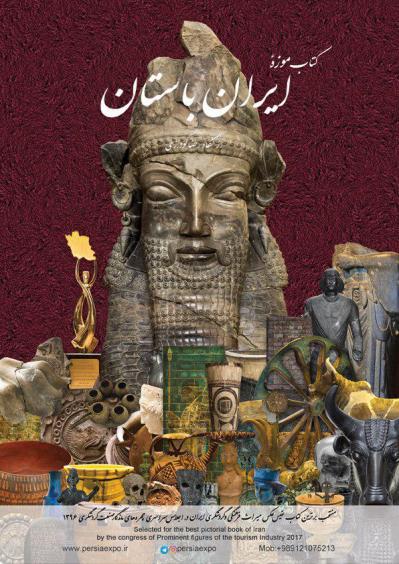
Iran Bastan museum pictorial book (National museum of Iran), Selected for the best pictorial book of Iran by the Congress of Prominent figures of the tourism industry 2017.

Iran Bastan Museum (National museum)Through Reza Goudarzi’s lens.
(Selected for the best pictorial book of Iran by the Congress of Prominent figures of the tourism industry 2017 in the National library of Iran)

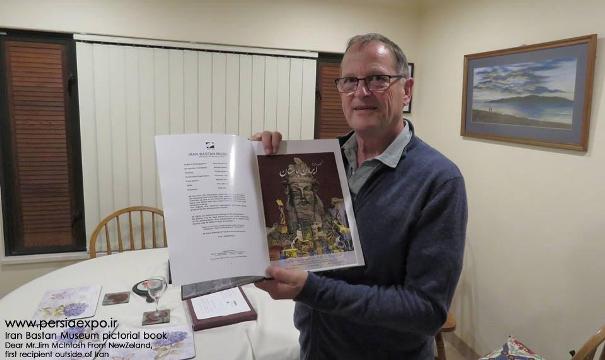
Mr. JIm mcIntosh from NewZeland, first recipient of the book outside of Iran.

All around the world museums are one of the most interesting places for tourists. However, there are so many different museums to visit with so many different objects in the museums that tourist never have enough time to waiting, look, read and save the informations and take photos. Some of the areas in the museums are missed or even forgotten to be looked at.

With museum tours, the tour guides tend to skip around to different areas or tend to rush to provide all the visitors with a small tour. They also want to make sure all the museums are visited before time runs out.

However, having a pictorial book of the museums with information on the items of museum can make your trip more enjoyable.  You can also share a part of Iran’s history with beautiful photos of monuments and natural sites. If you ever want to go back and revisit your trip, all you have to do is open the book and see the wonderful places you have visited.
National museums of Iran consist of Iran Bastan museum (Ancient Iran museum) and Islamic Museum. These complexes are the largest and most important museums in Iran.
The “Iran Bastan Museum Through Reza Goudarzi’s Lens” was published by Reza Goudarzi’s after Nowruz of 1396. It includes 152 pages of high glossy photos. The hard cover book is 24-34 centimeters thick with over 400 photos of items in the museum and 20 landscape shots of monumental places. The book includes both English and Persian language.
You can find the photos of the items and well as a short history of each era. The book include the Paleolithic, the Neolithic, the Bronza & Elamite age, the Iron age, the Achaemenids, the Seleucids, the Parthians and the Sasanids periods.
From the photos in the book you can point out the Statute of Darius, Human Headed Capital (Lamassu), the Audience Hall Scene (from Persepolis), Archer on Glazzed Bricks, Bronze Statue of a Parthian Nobelman, Salt man, Stucco & Musaics of Sasanids, Bones & tools from the Paleolithic and the Neolithic period, Pottery beakers of Susa, the Bull statue of Tchogha Zanbil, The first document navigation from Chogha Mish, Elamite Tablets, the First Animation of the world from Shahr-e-Sukhteh. You can also find objects from historical sites such as Jiroft, Shahdad and Sialk.

The 20 landscape photos (Full pages) in the book include monumental places such as Persepolis & Pasargadae (Pars), Bisotun (Kermanshah), Tapeh Sialk  (Kashan), Engravings of Naqsh-e-Rostam (Pars), The tower of silence of Zoroastrain (Yazd), Anahita temple (Bishapur), Sar-e-Yazd castle (Yazd), Takht-e-Soleyman (Takab city), Khorhe (Markazi province), Narin castle (Meybod), Anahita temple (Kangavar), Tappeh Hasanlu (Naqadeh), Ziggurat Chogha Zanbil (Khuzestan) and Shekarchian cave (Bisotun).

We hope this book will be as exciting and absorbing as the museum itself for those who will wish to learn about the Iranian culture and history.

This book is a great item to gift to family and friends or even something to show at home. To check out sample pages of this book please contact us or visit the following links:
www.persiaexpo.ir
www.instagram.com/persiaexpo

iran-esfahan-imam-detail-geoex

iran-esfahan-imam-detail-geoex

Everyone says you’ll be surprised by Iran (except for those who say, you’re nuts for going — and they’d probably be the most surprised of all). So I went in expecting to be surprised, but I still wasn’t prepared.

I was surprised by the red poppies bursting out all over the landscape, the snowcapped mountains where I’d expected desert, and the national commitment to mystical poetry and song. The most profound surprise of all was the genuine warmth of the people. From Tehran to Tabriz to the smallest village in the desert, people went out of their way to express appreciation at our visit. In Yazd, a restaurant owner went so far as to place an American flag on our table and blast “The Star-Spangled Banner” from the speakers, causing the other patrons to rise from their seats out of respect. Now, that’s surprising.

Below are a few of my favorite memories:

The palace was a pleasant surprise — an equivalent place in Europe would be overrun with tourists and selfie sticks. Instead, it was magnificently quiet; you could hear the babble in the fountains and the chattering of parrots overhead.

iran-jess-silber-geoex

iran-jess-silber-geoex

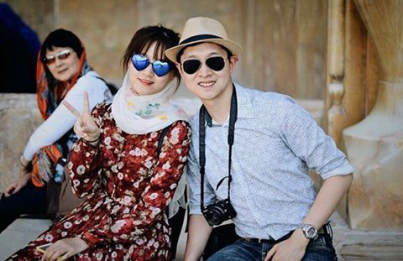
I had my picture taken by a young Iranian couple who were also strolling around Golestan, being tourists themselves. They were thrilled to see a group of Americans touring their capital.

One thing that surprised me about Iranian cities was the fun public art. I expected to see lots of sober portraits of the Supreme Leaders, Khomeini and Khamenei, and yes, I did see those. But I didn’t expect colorful murals and whimsical sculptures, and I saw lots of those, too. I think the picture above is actually an advertisement, but it’s a nice reminder of how Iranian cities can be joyful places, not just somber ones.

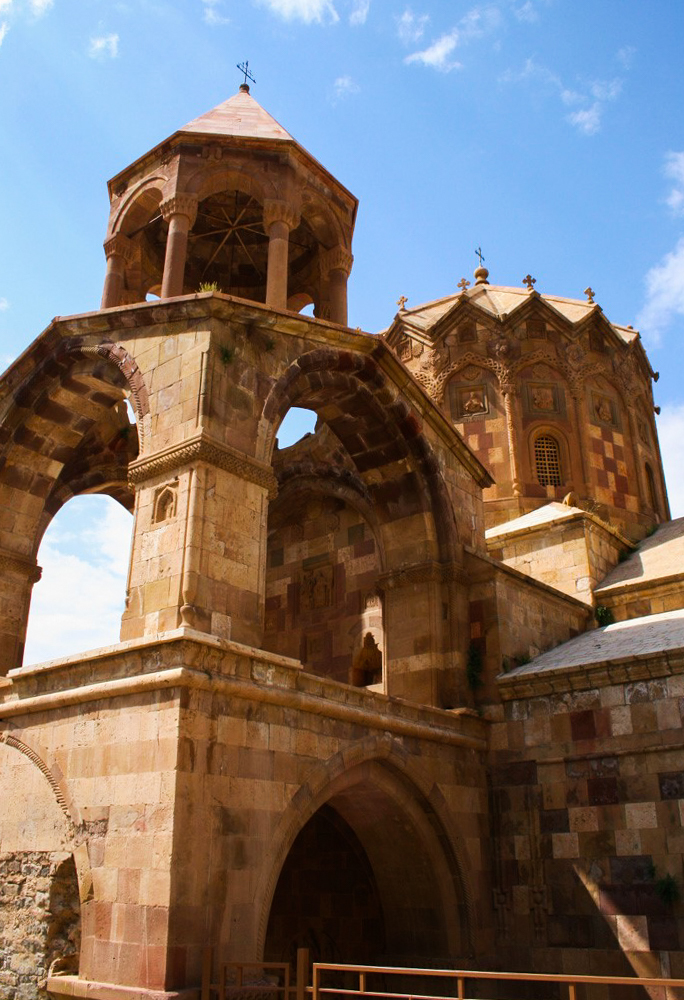
On Iran's rural border with Azerbaijan, set within a canyon and reachable only by a steep walk, the centuries-old St. Stephanos Church feels like it's in a different world from cosmopolitan Tehran.

On Iran’s rural border with Azerbaijan, set within a canyon and reachable only by a steep walk, the centuries-old St. Stephanos Church feels like it’s in a different world from cosmopolitan Tehran.

Iran’s Islamic architecture is dazzling, no surprise there. But there are other religions in Iran, and exploring sites sacred to Christianity, Zoroastrianism, and Judaism was a surprise highlight. Saint Stephanos Church is a long drive from the closest major city; perched just across the border with Azerbaijan, it holds court in a canyon of red rock that feels like one of the archives of time.

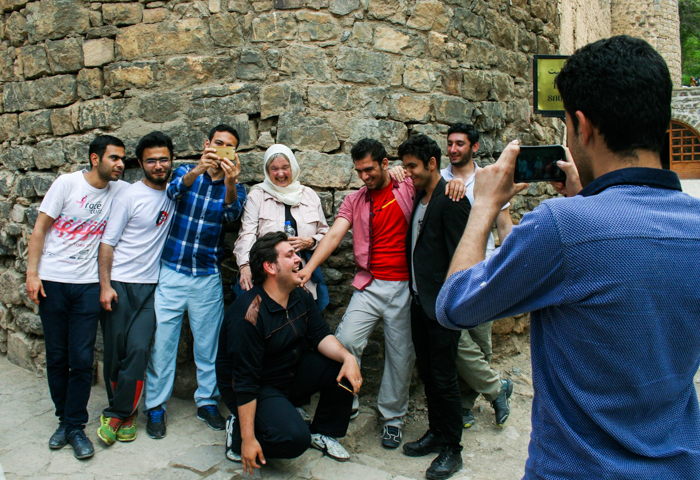
The Iranians that we met on the "Treasures of Persia" trip were always eager to have their picture taken with us. Same goes for this group of guys who ran into us at St. Stephanos Church.

The Iranians that we met on the “Treasures of Persia” trip were always eager to have their picture taken with us. Same goes for this group of guys who ran into us at St. Stephanos Church.

We visited Saint Stephanos on a weekend, and it was busy. At each corner and courtyard of the church complex, we were approached by people who wanted to welcome us and chat with us — or take their photo with us. Kathie is pictured here with a group of gentlemen who wanted to immortalize the visit.

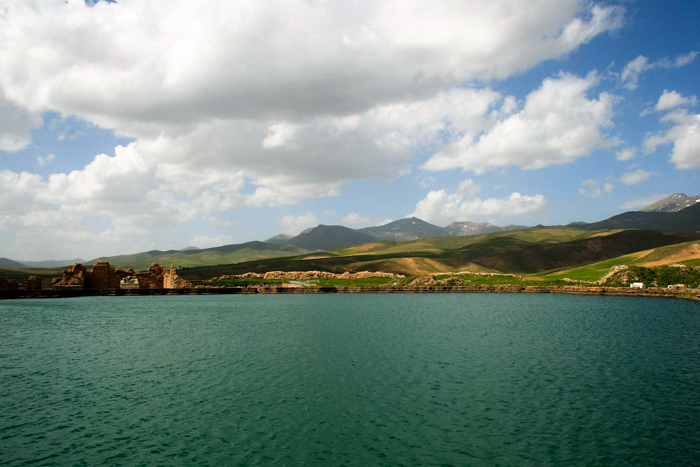
A spring fills this volcanic crater at Takht-e Suleiman, Iran - it's easy to see why it was considered a sacred site to different civilizations throughout Iranian history.

A spring fills this volcanic crater at Takht-e Suleiman, Iran – it’s easy to see why it was considered a sacred site to different civilizations throughout Iranian history.

At first I was a bit skeptical as we walked up to Takht-e Suleiman, a windy mountaintop UNESCO World Heritage Site. We’d driven hours through mountain landscapes to get there, and as you approach, you can’t see much except the crumbs of ruins. But the opaque, blue-green pool in the center of the site, formed in a volcanic crater, brought into focus how magnificent and spiritual it was. “One of the most sacred places in Iran,” our trip leader, Sylvie, said, and it was pretty easy to see why.

As with so many other places in northern Iran, we pretty much had the whole site of Takht-e Suleiman — all of its chambers, tunnels and temples — to ourselves to ponder and explore. Here, our national guide, Peyman, is explaining the Zoroastrian fire temple that once burned here.

The atmospheric ruins of Takht-e Suleiman, a sacred site in rural Iran.

The atmospheric ruins of Takht-e Suleiman, a sacred site in rural Iran.

There was just one other group of tourists visiting the ruins at Takht-e Suleiman that day, an older couple strolling with a young man. The woman asked me to take a photo with her. After the young man had taken the picture, the woman squeezed both of my hands in hers and kissed both of my cheeks. I don’t think anyone has ever been so happy to take a picture with me in any other country I’ve visited.

Military service is compulsory for most young men in Iran. These two soldiers serve their time as guards at the crumbling Anahita temple, a pre-Islamic ruin in the town of Kangavar, dedicated to the Zoroastrian goddess of water.

An Iranian woman in Kangavar offered warm bread to some members of our group. At first we declined, trying to adhere to the Iranian custom of taarof, which governs etiquette, but as you can see, eventually the aroma of warm bread overcame us.

Persepolis! Ancient cities haven’t always been my thing — in the Roman Forum I was preoccupied by the scrawny cats begging between the columns — but this site is magnificent from the very first approach. The city was a ceremonial capital for the Achaemenid kings, built on these tremendous stones that heave it toward the sky like an altar, and decorated with astonishing carvings and reliefs. It was more recently famous for being the site of the last Shah’s final big party in 1971, which lavishly celebrated 2,500 years of Persian civilization and provoked the outrage of then-exiled Khomeini.

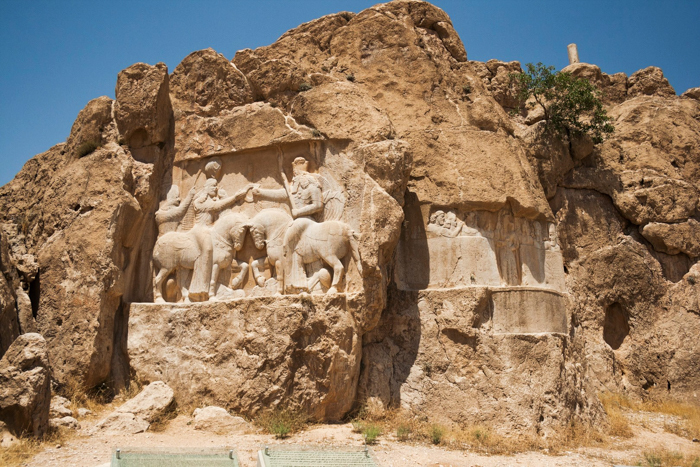
This third-century relief at Naqsh-e Rustam, just a few miles from Persepolis, depicts the beginning of an empire: Ardashir, the first Sassanid king, is receiving a ring of kingship from the Zoroastrian deity Ahuramazda. The empire only ended four centuries later with the arrival of Islam in Iran.

This third-century relief at Naqsh-e Rustam, just a few miles from Persepolis, depicts the beginning of an empire: Ardashir, the first Sassanid king, is receiving a ring of kingship from the Zoroastrian deity Ahuramazda. The empire only ended four centuries later with the arrival of Islam in Iran.

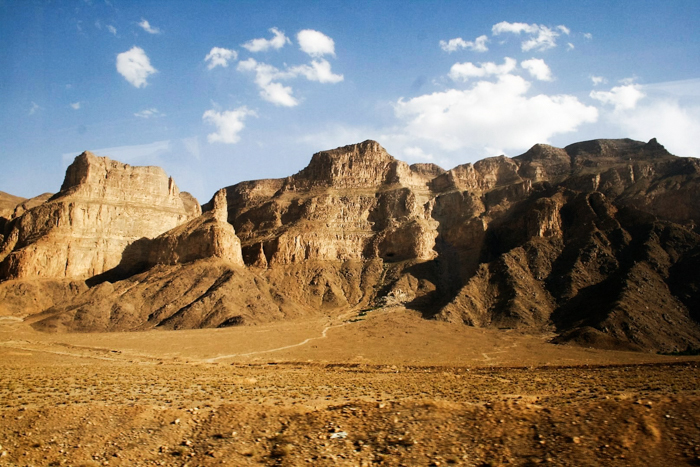
The highway from Shiraz to Yazd follows historical trade routes, passing the same desert mountains as the camel caravans of previous centuries.

The highway from Shiraz to Yazd follows historical trade routes, passing the same desert mountains as the camel caravans of previous centuries.

The highway from Shiraz to Yazd follows historic trade routes, passing the same desert mountains as the camel caravans of previous centuries.

I’m posing here with a gentleman who has greeted travelers to the Towers in Silence, a Zoroastrian ruin on the outskirts of Yazd, for years — maybe decades. “Over the years I’ve come here, he’s gone through three different donkeys,” our guide explained, “but it’s always the same man.”

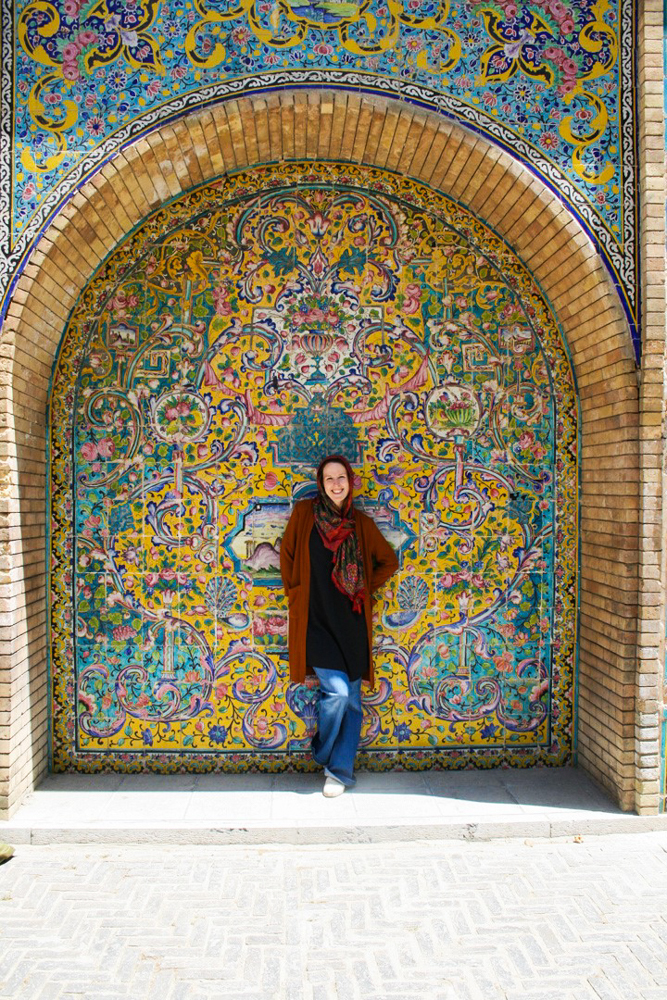
Kathie admires the tile work and calligraphy at the Friday Mosque in Yazd.

Only 20 columns support the ceiling of the Chehel Sotun, or Forty Column Palace. The other 20 are created by the reflection in the pool at the entrance to the palace.

Only 20 columns support the ceiling of the Chehel Sotun, or Forty Column Palace. The other 20 are created by the reflection in the pool at the entrance to the palace.

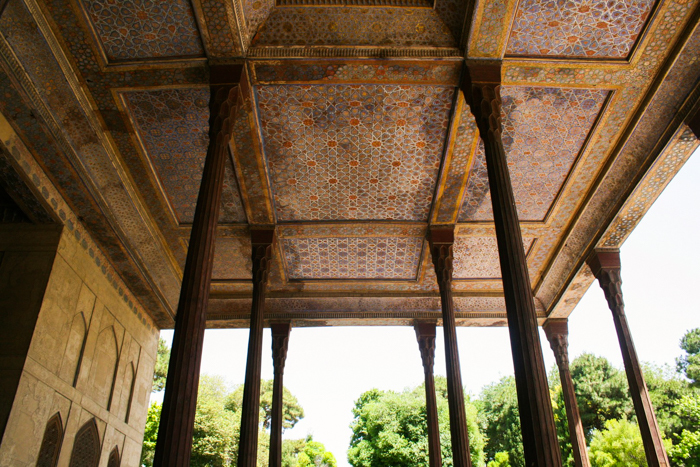
Only 20 columns support the ceiling of the Forty-Column Palace. The other 20 are created by the reflection in the pool at the entrance to the palace.

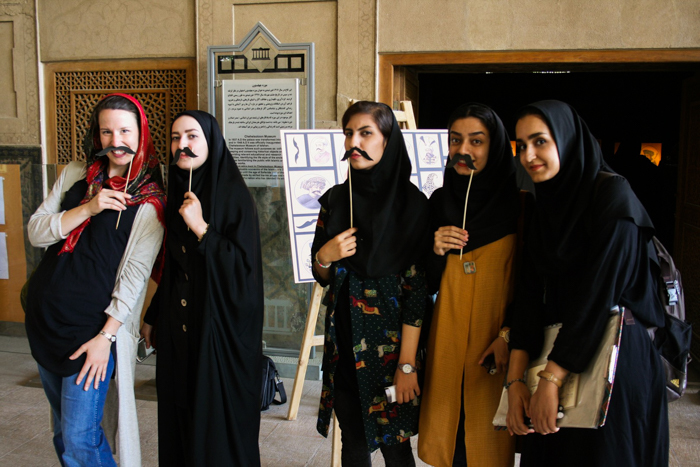
Esfahan's Forty-Column Palace has an impressive variety of mustaches depicted in the artwork on its walls. On the day we visited, they honored their mustache heritage with a make-your-own-Persian-'stache station.

Esfahan’s Forty-Column Palace has an impressive variety of mustaches depicted in the artwork on its walls. On the day we visited, they honored their mustache heritage with a make-your-own-Persian-‘stache station.

The Forty-Column Palace might have only had 20 columns. What it had in excess was mustaches depicted in its artwork and frescoes — an impressive variety. On the day our group visited, the palace happened to have a temporary exhibit dedicated to this mustache heritage, including a “make your own historical Persian mustache” station that we took full advantage of.

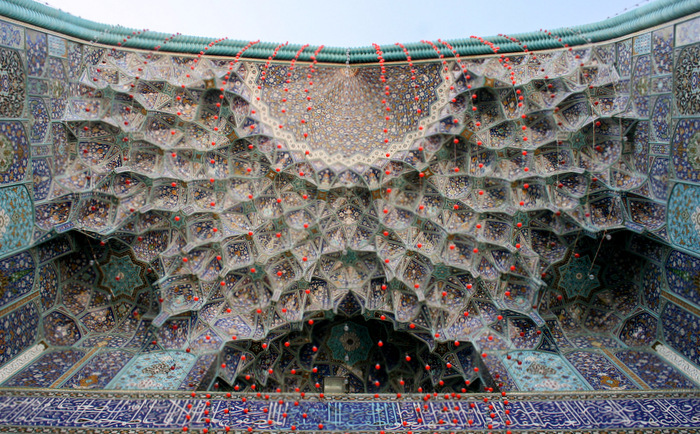
The exterior of the Imam Mosque, in Esfahan, is covered in ornamental red bulbs to honor the birthday of the Hidden Imam, a Messianic leader believed by some Shia to be living in secrecy among the people.

Lots of people have written about the beauty of the Sheikh Lotfallah Mosque in Esfahan. I am happy to confirm that they were all correct. It’s a masterpiece. The mosque was built in the 17th century as a private mosque for the women of the Shah’s family. The pious women were invisible while at prayer thanks to a long, curving hallway that twists away from the entrance doors.

As our trip wound to a close, we stopped in the village of Abyaneh, in the Karkas Mountains north of Esfahan. It’s beloved for its historic red-brick houses and its fruit leather (it tastes better than it sounds).

An Iranian surgeon and entrepreneur says the country should prepare the grounds for attracting medical tourists who would like to receive VIP services.

Behnam Shakibaie, the founder of microscopic dental surgery in Iran, says VIP services should also be offered to travellers.

“It shouldn’t always be the case that tourists come to Iran for treatment because medical services are cheap here; rather, we should prepare the ground for attracting patients who would like to receive VIP services,” he noted, according to a Farsi report by the Mehr News Agency.

Speaking in a recent conference on medical tourism in Tehran, Shakibaie said the VIP Medical Tourism Plan focuses on VIPs.

He said there are individuals in the world who want the best specialists to give them medical services regardless of the costs.

“The necessary infrastructure should be provided for such tourists,” he said.

He said the stage should be set for attracting travellers demanding VIP medical services.

Meanwhile, Tourism activist Jalil Tabatabai says Iran has great potential to render medical services to foreign travellers and can be a good destination for patients from other countries.

He said most foreign travellers who need medical services have been coming to Iran with tourist visas, which enable them to stay in the country for a long time.

Tabatabai urged organizations in charge to work more professionally and make the necessary arrangements and plans to attract more foreign travellers demanding medical treatment.

He said one of the areas in which Iran offers services is the treatment of infertility.

“Given the high quality and good services in the country in the field of treating infertility, the nationals of Persian Gulf littoral states and Lebanon are keen to come to Iran for treatment,” he noted.

He said most of the travellers coming to Iran demand services in the areas of treating eye diseases, infertility, heart surgery, and plastic surgery.

Official statistics show that the number of tourists from Iraq and the Persian Gulf littoral states visiting Iran has decreased in 2016 and 2017, while that of European and American visitors to the country has witnessed a remarkable growth since August 2015.

Although, compared to last year’s figure, the overall number of foreign tourists to Iran has reduced 6.9 percent in the current Iranian year (started mid-March 2017), statistics indicate that the decrease pertains to the number of visitors from the Persian Gulf littoral states, and not that of the European and American ones.

According to a Farsi report by ISNA, the director-general of Iran’s Office for Planning and Supporting Expansion of Tourism Industry, Abdolreza Mohajeri-Nejad, said over 1.14 million foreign tourists travelled to Iran during March 21-June 21, 2017.

This comes as, in the same period last year, the figure stood at more than 1.18 million, up by 6.9 percent, he added.

Mohajeri-Nejad said the decline in the number of tourists from the Persian Gulf littoral states and Iraq is the main reason for the drop in the average number of foreign visitors to the country during the three-month period.

“The number of visitors from these states to Iran was subject to a 9-percent decrease, year-on-year, in the said timespan, under the impact of the country’s weakened ties with the Persian Gulf littoral states – following the attacks on Saudi Arabia’s Embassy and diplomatic mission in Tehran and Mashhad (eastern Iran) in early 2016 – insecurities in the regional states and unfavorable economic condition in Iraq and Syria.”

The downward trend has continued in the past two years, he added.

Mohajeri-Nejad said from March 2016 to March 2017, the average total number of foreign tourists to Iran (over 4.91 million) was also 5.2 percent less than that of the same 12-month period ending mid-March 2016.

However, he said, despite the decrease in the number of tourists from regional countries to Iran during the 15-month period to June 21, 2017, that of European and American visitors to the country has grown 56.6 percent in the same duration.

“The increase has occurred as a result of the going into effect of the Joint Comprehensive Plan of Action (JCPOA) [signed in July 2015 between Tehran and the P5+1].”

Mohajeri-Nejad added from August 2015 to March 2017, a total of 478,826 tourists from western states, particularly Europe, travelled to Iran. This is while, prior to the signing of the JCPOA, from December 2013 to June 2015, the figure stood at 35,852, he said.

He expressed the hope that in case the upward trend in the number of European and American tourists to Iran would continue, the country will definitely manage to achieve the targets stipulated in Iran’s Vision 2025.

As per the Vision 2025, Iran’s annual income from tourism sector is required to reach $25 billion (20 billion tourists per year) in eight years from now. To achieve the target, the country needs to be a destination for 5.1 percent of the total global number of tourists per annum.