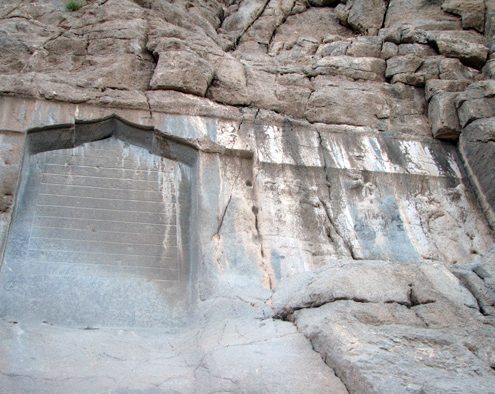
A closer view of Achaemenian inscription & relief at Bisotun

A closer view of Achaemenian inscription & relief at Bisotun

This ancient archeological site is one of the most outstanding historic  attractions of Iran. It has got its name from a relatively perpendicular mount by the same name where it is located. A prehistoric cave called “hunter’s cave” indicates this place has been a human shelter since 40,000 years ago. The ancient trade route between the Mesopotamian and Iranian merchants used to pass by a valley in front of this mount. There are some remnants of Medes, Achaemenians, Sassanians, Ilkhanids and Safavids here that were created several centuries later. I’m going to introduce them at this post:

Bas Relief & Inscription of Darius the Great

After the death of Cyrus the Great, the founder of Persian Empire and Achaemenian dynasty, there was a chaotic situation across the empire about who was his son to ascend the throne. At such crucial time, a few people falsely introduced themselves as Cambyses, his son. When Darius I and other Achaemenian nobles realized the pretenders’ plots, they decided to stop them, save the country and bring law and order back to the nation. Therefore, in a period of approximately less than 2 years, he suppressed these liars and ordered the truth to be written on parchment and potsherd to be distributed everywhere and carved on the face of the mount Bisotun.

This large cuneiform inscription carved on mount Bisotun is the world’s largest inscription ordered by Darius the Great to be inscribed at this site. It explains what the true identity of these people were, where they had come from, who they had pretended to be and how they were arrested. The bas relief also illustrates the story in a scene in which 9 rebels are tied to one another in a row and a magus, the priest, called Gaumata under Darius’ foot.

The decipherment of Bisotun inscription largely contributed to the understanding of cuneiform as well as understanding of ancient civilizations. In this sense, it can be compared to Rosseta Stone in Egypt.

Other Historic Monuments in Bisotun Area

The most significant monuments and historic remnants are:

  • Hunters’ cave: a cave from Neandertals’ time, app 40,000 years ago,
  • Median remnants: a fortress going back to 8th/7th century B.C on the slope of the mount near the inscription, a Median terrace below the relief of Darius most probably for the worship of an image,
  • Achaemenians’ remnants: a royal road built at the time of Darius the Great extended from Susa to Sardis passing by this area,
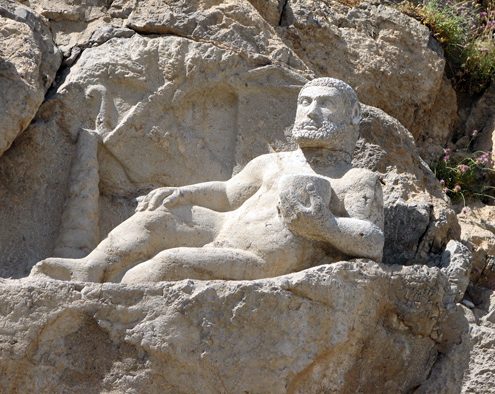
  • Seleucid  remnants: a statue of Herakles with a curly hair lying in front of an olive tree,


Statue of Herakles Recumbent at Bisotun

Statue of Herakles Recumbent at Bisotun

  • Parthian remnants: it includes the remnants of Parthian town, bas relief of Gotarzes II and bas relief of Mithridates II, a site of worship, relief of king Balash, etc,
Mithridates relief & Zanganeh Endowment Inscription at Bisotun

Mithridates relief & Zanganeh Endowment Inscription at Bisotun


Mithridates relief & Zanganeh Endowment Inscription at Bisotun
  • Sassanian remnants: Behistun Palace, which is said to be Palace of Khosrau II, carved stones, Farhad Tarash (a rectangular area of the foothill cut perpendicularly most probably to form some bas relief, but not completed).
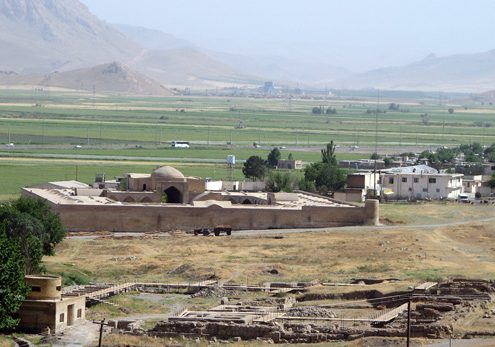
  • lkhanid caravansery: the rocks, bricks and mortars in form of semi-standing walls and vaults down the slope from the mount and close to the inscription.
  • Safavid remnants: a caravansary still standing in the area at a walking distance from the inscriptions, inscription of Sheikh Ali khan Zangeneh, which is a text endowment.


A general view of the remnants of Ilkhanids & Safavids’ caravansaries

A general view of the remnants of Ilkhanids & Safavids’ caravansaries


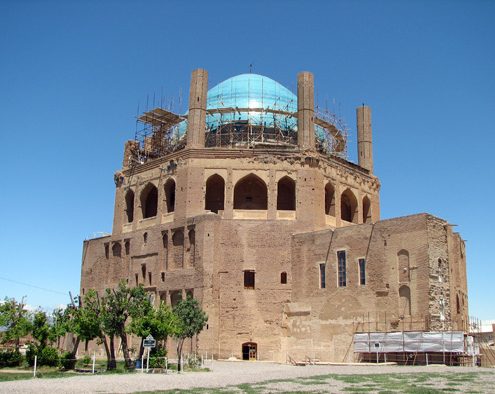
A General view of Soltaniyeh mausoleum

A General view of Soltaniyeh mausoleum

The ancient town of Soltaniyeh is located approximately 40 km west of Zanjan on the old road of Zanjan-Qazvin. Driving from any direction, you can redirect a bit into the present town of Soltaniyeh and pay a short visit to a fantastic World Heritage Site, Soltaniyeh Mausoleum. This town thrived under Oljayto, the Mongol king of Ilkhanid dynasty in Iran (14th century) and turned into the capital city of Iran.

He decided to build this burial structure in early 14th century because of his religious interest in Imam Ali, the first Shiite Imam as well as the rest of the Shiites’ imams. Eventually, he communicated with the religious leaders of Najaf and Karbala, today’s Iraqi cities, and got informed that exhumation weren’t allowed in Islam. According to many researchers, as he wasn’t allowed to bring back the bones of all the Imams to this mausoleum, he was the person who was finally buried there. Of course, some other researchers disagree with this assumption.

Historical Background

Although settlement had started in this area since first millennium, it was at the time of king Arghun of Ilkhanid dynasty around the end of 13th century that decision was made to further develop this area. He constructed a summer residence there due to the rich pasture for horses. Then, his son, king Ghazan came up with a decision to build a city there, of which little information is handed over to us. Later, his son, Oljayto, the first Ilkhanid king who converted to Islam, enlarged the city and called it Soltaniyeh, meaning imperial.

The ancient city was continuously inhabited until 16 and 17 century and together with Tabriz, Soltaniyeh turned into one of the main stops on Asia-Europe trade route. Several caravansaries were built along such routes. Some of them are close to this city which was a major stop on this well-known route.

The Monument of Soltaniyeh Dome

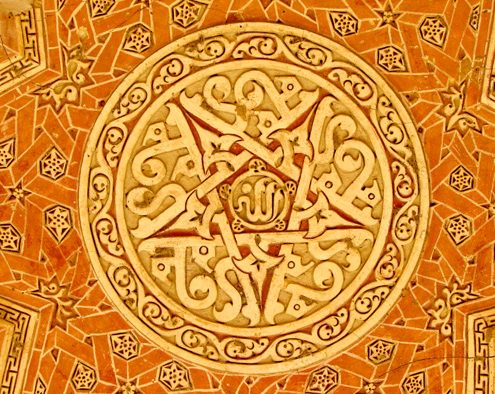
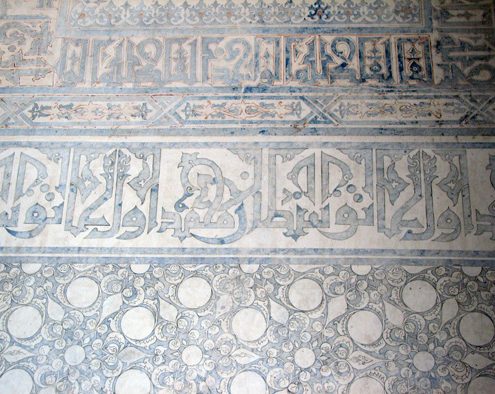
Inscription decoration at the ceiling under the Soltaniyeh dome

Inscription decoration at the ceiling under the Soltaniyeh dome

Soltaniyeh Dome, a highlighted accomplishment of Iranian architecture, is among the top three huge historic buildings in the world. The other two structures are Santa Maria Cathedral in Florence, Italy and Ayasofya Mosque in Istanbul, Turkey.

What distinguishes Soltaniyeh mausoleum, known as Soltanieh dome by many, is the substantial success of Iranian architects of that time. Building this burial structure, they had proved their achievement in innovative engineering creating spatial proportions, architectural forms and eye-catching decorative patterns using ground-breaking techniques at their time.

At the south west of the ancient city, a royal citadel was built with surrounding walls and watch towers with a moat around it filled with water to make sure it’s well-protected. The mausoleum was also built inside this royal citadel section. The construction continued for almost 10 years and resulted in an architectural masterpiece in central and western Asia.

There were three main sections in this mausoleum: The domed chamber, cellar and Torbat Khaneh. Most of the decoration have been applied to the inner part of the structure of the domed chamber. The cellar, the entrance of which is situated inside the domed chamber, is supposed to have accommodated the grave of the person(s) for whom the mausoleum is built. And Torbat Khaneh (meaning the house of holy earth), refers to the section attached to the domed chamber and originally allocated to the corpses of Shiite Imams.

Structure of Soltaniyeh Mausoleum

Islamic art if form of painted inscription of Koranic verses, holy names, etc.

Islamic art if form of painted inscription of Koranic verses, holy names, etc.


Obviously, like many other examples of Islamic architecture of 13 and 14 centuries, bricks and mortars have been the main construction materials used to build the monument. It’s built on a rectangular plan together with the spaces around the domed chamber. The space allocated to the domed chamber is in octagonal shape. Symmetry has been firmly observed in the construction. There are several ideas about the main and other entrances to this Mausoleum. Seemingly, there must have been three doors leading visitors to the inner part of the building. The floors have been treated with alabaster stone creating a clear white surface.

The double-shell dome is approximately 50 meters high with a diameter of approximately 25 meters. This indicates how heavy it is – 200 tons! Various sections of the structure have been joined to one another using dented wooden beams made from pine trees saturated with particular kinds of oil to make sure they could reduce the structure’s tension. The incredible fact about the structure is that its foundation is maximum 90 centimeters deep into the ground, not more. It has resisted against more than 300 earthquakes so far suffering some damages, but it still stands there with its entire splendor.

Plaster work decoration of the balcony under the dome at Soltaniyeh

Plaster work decoration of the balcony under the dome at Soltaniyeh

On top of the octagonal structure, what you see from outside is a series of eight minarets standing at the corners of this 8-corner structure. The blue dome is shining inside the space surrounded by these minarets. You won’t see much decoration on the façade of the structure from outside. As a matter of fact, you will notice the magnificence of the monument when you visit inside the building.

Decorations inside Soltaniyeh Dome

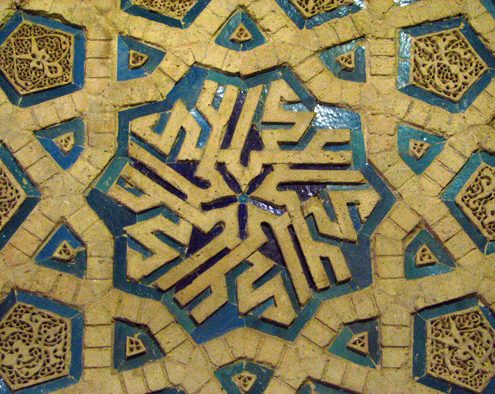
Inscription by plain & glazed bricks inside Soltaniyeh mausoleum

Inscription by plain & glazed bricks inside Soltaniyeh mausoleum


The Islamic arts used at this monument are of various forms. The decorative elements applied in Soltaniyeh Mausoleum are:

  • Brick decorations
  • Plasterwork decorations
  • Inscriptions
  • Tile works
  • Painted decorations
  • Stone decorations
  • Wooden decorations

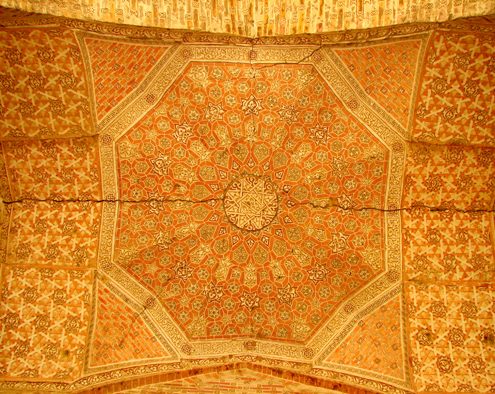
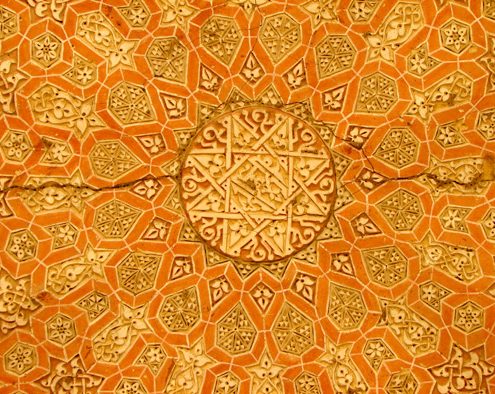
The interior walls have been largely decorated by plaster and glazed bricks. The fascinating inscriptions and motifs have been made with plasterwork. The ceiling of the balcony just under the dome, which can be seen from outside, has got unique orange-color plaster works in form of geometric and plants patterns and inscriptions.

Orange-color decoration of Soltaniyeh balcony under its dome

Orange-color decoration of Soltaniyeh balcony under its dome


There are religious inscriptions uniquely worked out in small and large sizes and particular scripts of kufic and Thuluth. Sometimes plaster has been used for this art and sometimes glazed bricks. The study of the content of these inscriptions indicates the political-religious developments of Oljayto’s ruling period.


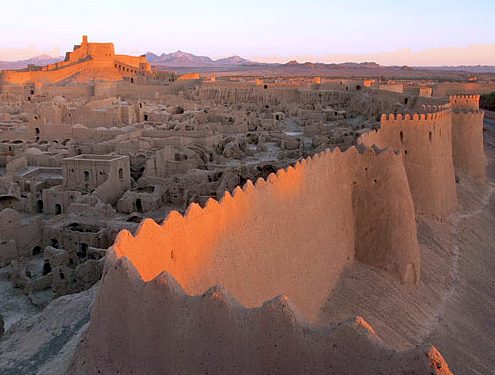
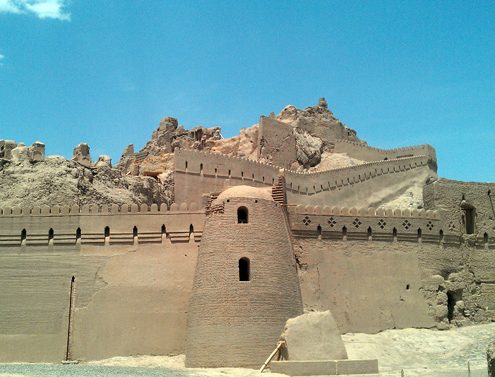
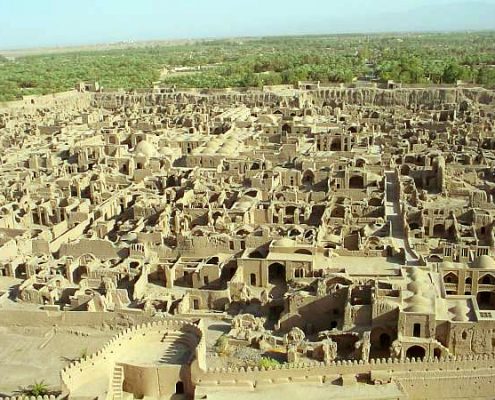
The ancient city of Bam and its protective walls

The ancient city of Bam and its protective walls


The ancient city of Bam, a world heritage site registered in UNESCO’s list, has emerged at least at the time of Achaemenians (6th to 4th centuries). The flourishing time of Bam traces back to 7th to 11th centuries when it was at the crossroad of ancient trade routes. This city started to be inhabited since Achaemenian period until around 200 years ago. After that, it was used as military station for soldiers until approximately 80 years ago.

The creation of the ancient city of Bam was indebted mainly to the ancient underground water supplement system of Iran called Kariz (qanat in Arabic). This system has been continuing the provision of water for this city till now.

Whereabouts of Ancient City of Bam

It has been located between the Southern part of Kavir-e-Lut, Southern desert pit of Iran and the Northern part of Barez local mountain range, South East of Iran. The importance of Bam has been due to its geographical location in a broader scale, in connection to the centers of commerce in Western Asia during antiquity.

Originally, like any other communities at or inside deserts, the city was surrounded by protective walls and its governor was living within another walled section, a citadel, inside the walled town. The entire walled city of Bam was 200,000 square meters. Desert towns feel safer this way and can grow much more confidently. The surrounding wall is as long as 1810 meters and its height varies from 15 to 18 meters. There seems to have been 38 watch towers along this wall and a deep moat outside the city’s walls, which was filled with water at the times of danger.

Apart from the walled town and its citadel being the central focus of this valley, the cultural landscape of Bam is connected to a series of forts and citadels now destroyed. Today you may see a fortress of 7th century called Qale Dokhtar at the North of Bam and a couple of shrines dated back to 11th and 12th centuries – Emamzadeh Asiri and Emamzadeh Zeyd mausoleums.

Various Parts of Ancient City of Bam

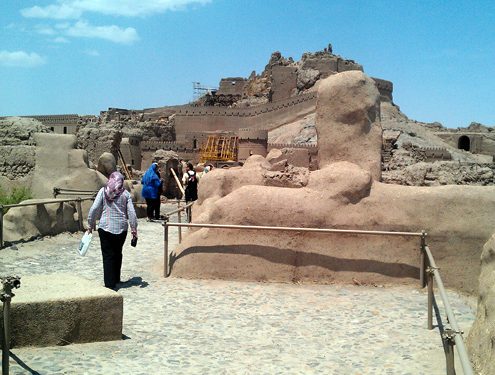
Tourists visiting the ancient city of Bam after earthquake

Tourists visiting the ancient city of Bam after earthquake


What makes the ancient city of Bam unique in regards to its construction is the vernacular technique applied there: Traditionally, the architects have used mud layers (Chineh), sun-dried mud bricks (khesht), and vaulted and domed structures. This is the best example of desert architecture that you will find in several parts of Iran around the deserts. No matter which part of the city we visit, we will see the same style and technique applied to the structures.

The ancient walled city of Bam consists of 2 main sections for the governor (citadel) and common people. The Governor’s section, built on top of a rock higher than the rest of the city, includes royal stable, garrison and governor’s house. The common people’s section, spreads out from the foot of the governor’s section to the city walls in a relatively flat area, has got all including what a city required: 528 residential houses, main bazaar, Meydan (Tekieh), Friday mosque, Mirza Naeem School, Zurkhaneh (traditional sport club), Malek-o-Tojar House (a merchant house), caravansary, public bathhouse (hammam), Jews’ Sabat (rest area) and a noble’s house.

Some of the most important structures are:

Bazaar: it’s 115 meters long accommodating 42 shops in it. It used to offer silk and cotton fabrics to the traders traveling on the spice route, a sub-branch of silk route.

Friday Mosque: It was built on the site of a former temple, a Zoroastrians’ fire temple, with four eyvans (porticoes), later changed to three.

Zurkhaneh: The tradition of building such clubs dates back to ancient times in Iran when this sport was exercised.

Mirza Na’eim School: it’s a beautifully built structure consisting of two sections of interior (living quarter for the teacher) and exterior (studying quarter for the students).

What separates the common people’s section from the governor’s is the government’s reinforced gate. There are two rooms attached to this gate when you enter with their upper floors for the guards. After you cross this gate, you will see a different section. First you go to the left where the royal stable is located. You turn right and go through a garrison where the governor’s soldiers and guards were stationed. A corridor on the right side leads you to a steep slope which goes up first toward the commander’s house on the right and eventually leads to the top, house of governor.

Governor’s Section at the Ancient City of Bam

Governor’s Section at the Ancient City of Bam


The main part of this section is where the Bam’s governor used to live:

House of Governor: it consists of summer eyvan, winter eyvan and open space. There’s a building called four-season mansion. It could be used during all seasons as the name implies. It was a three-storey building. On top of all, there’s a watch tower square in base, which used to be circular and changed shape under Qajars after some destruction. Behind all parts of the governor’s section, there’s a private bath.

Water Supplement System at Bam

Apart from the Kariz system that brought water from Barez Mountains to the vicinity of the walled town and was transferred inside the walled city of Bam through a U-shaped pipe, many houses had their own wells. There was a deeper well half way to the top at the garrison and one well, the deepest, next to the private bath of the governor. Some water canals are on the surface for the irrigation of the trees.

Water supplement helps the irrigation of palm trees

Water supplement helps the irrigation of palm trees

Bam’s Present Condition

Outside the walled city, as the time passed by, the population grew and the security is the region was supported, some new houses were built and people started relocating to those houses. The centers of business moved outside and main places for religious ceremonies went outside the city walls. There are several palm tree areas and many trees along the streets shaping a garden city out there. Gradually, the walled city was evacuated and the new city of Bam was formed.
Some started looting the ancient city for the antiques, some for its fired bricks and some for the old soil to be used for their gardens. All these contributed to the tear and wear of the ancient walled city of Bam.

The 2003 earthquake largely devastated the new city and the ancient city of Bam. The newly restored city has kept its city planning and the ancient monuments’ restoration is underway. Fortunately, the foundations of several walls were still standing after the earthquake. This made the restoration job move convenient.

The city is undergoing more restoration these days, but it’s worth some exploration. Even before the earthquake when several world travelers visited the city, it wasn’t complete and intact. When you go to the ancient city of Bam, you see more or less what could be seen before 2003’s natural disaster.

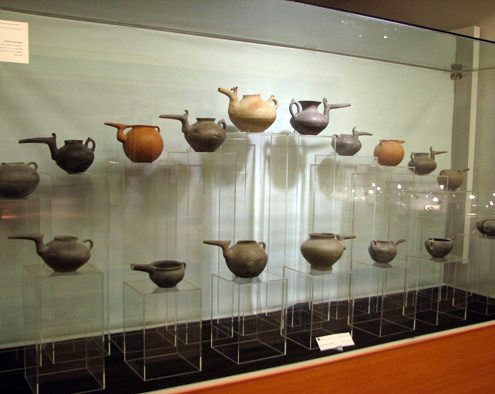
This is the post I’d promised you to write about. The Iranian objects returned from Belgium, known as Khorvin artifacts, are now displayed at Tehran’s Archaeological Museum. This temporary exhibition is showcasing all the objects returned home from Belgium after almost a century. The photos you see at this post are all taken at this exhibition.

Several monochrome potteries unearthed in Khorvin

Several monochrome potteries unearthed in Khorvin


Here, first I introduce the ancient site of Khorvin OR Khorwin:

The Site of Khorvin & Its Findings

At approximately 80 km North West of Tehran, at the North of Karaj-Qazvin highway, there’s an area with two well-known historic mounds of “Ganj Tappeh” and “Siah Tappeh”. In 1949, Archaeological Center of Iran found out that particular type of ancient artifacts are being bought and sold among people. The center discovered these two historic mounds and carried out a series of excavations in elliptical graves. The findings were 228 objects that were transferred to the National Museum of Iran (the same as Archeological Museum of Iran) to be safeguarded there.

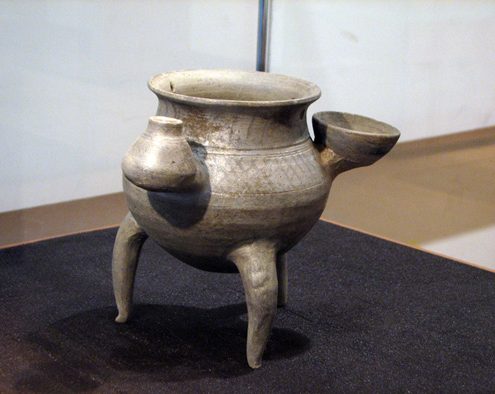
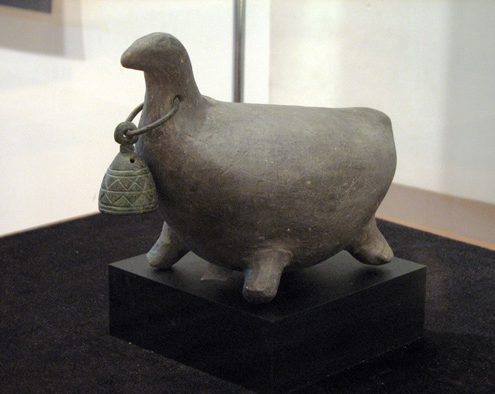
The burial rituals of the communities living there included various grave goods like pottery vessels, clay figurines as well as stone and bronze objects. In addition, they had ornamented these dead bodies with personal adornments like necklaces, diadems, earrings, bracelets, pins and pendants. Among the potteries unearthed, the majority was gray potteries without painted motifs and few plain red potteries were also discovered that looked like some other ones found in Tehran’s big plain.

A three-legged gray pottery from Khorvin

A three-legged gray pottery from Khorvin

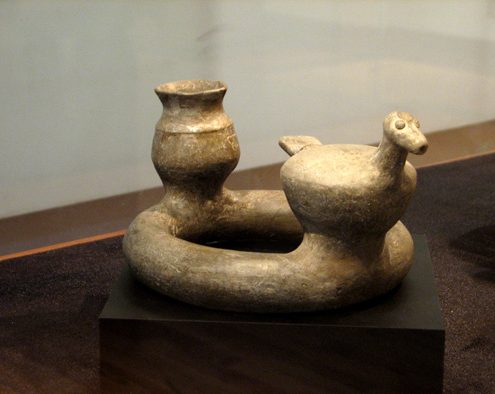
A zoomorphic pottery from Khorvin

A zoomorphic pottery from Khorvin

A monochromic stylized pottery from Khorvin

A monochromic stylized pottery from Khorvin


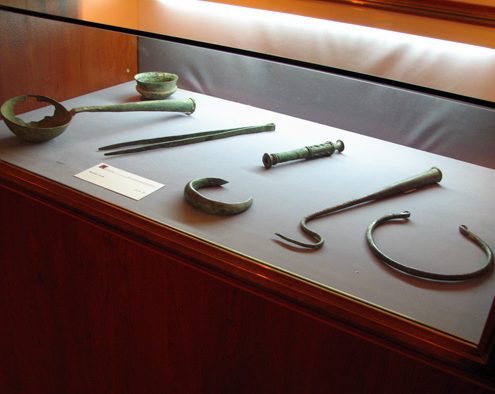
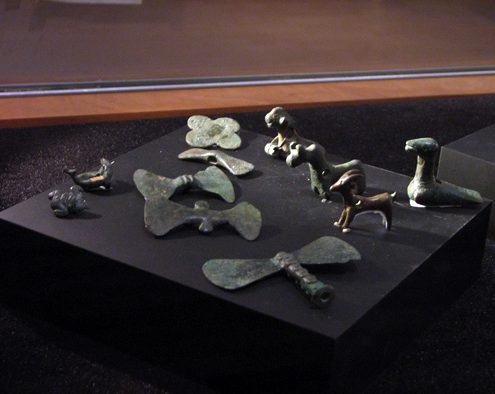
There are numerous bronze objects discovered in Khorvin site. However, the items made of copper and iron are rare. A large number of bronze objects of Khorvin are agricultural tools as well as weapons like dagger, spears, axes, maces and arrowheads. In addition, some objects are human figurines which have been interpreted as representations of warriors.

Some bronze objects (tools) from Khorvin

Some bronze objects (tools) from Khorvin

Importance of Khorvin Objects in Archaeology & Ancient Sociology

The Iron Age lasted almost a millennium, from mid-2nd to mid-1st millennium and came after Bronze Age. Archaeological theories discuss that gray potteries were introduced in Iranian craftsmanship since Aryan migration started in Iran (approximately at the same time of the Iron Age). Khorvin findings support this idea too. The resemblance of the findings from North, North West and North East of Iran as well as these items to the findings of a large number of the other historic mounds found at other parts of Iran provide reliable documents for the Aryans’ migration story to the Iranian Plateau.

Iron & bronze tools and figurines from Khorvin

Iron & bronze tools and figurines from Khorvin


Moreover, these returned items from Belgium maintain the important role of the communities, living at the Northern and Southern foothills of the Alborz mountain range, in major cultural developments. The Southern foothill of the Alborz, where Khorvin is situated, has always been fertile with local economies thriving. Several small rivers could have been tapped as best water resources for agriculture and animal husbandry. Therefore, the inhabitants of these communities were more focused on producing food and improving living conditions than warfare. Interestingly enough, it’s been found out that the number of the weaponries in Khorvin objects was less than other sites in other regions of Iran.

The widespread usage of iron items in Iranian Plateau during the 9th century BC are convincing witnesses to the social, political and economic changes. The construction of particular public buildings and temples during this era is also indicative of such major developments.

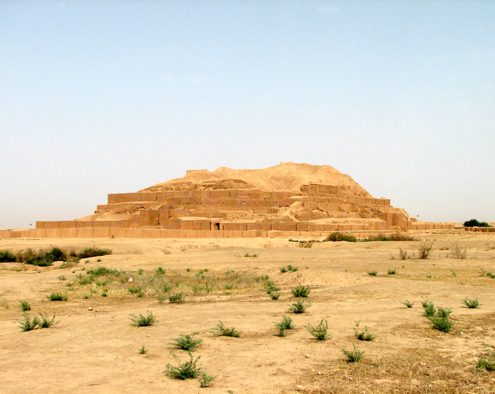
General view of Tchogha Zanbil Elamite Temple

General view of Tchogha Zanbil Elamite Temple


The name Tchogha Zanbil isn’t a very understandable word in Persian either. Tchogha Means “hill” in Lurish language of Bakhtiary tribes in Iran. Zanbil means “basket” in Persian. Tchogha Zanbil means a hill that looks like a basket! This is how people referred to this historical mound before it was noticed and excavated by professor Girshman, the French Archaeologist, between 1951 and 1962.

Why Was Tchogha Zanbil Built?

This temple was built by an Elamite king called “Untash Napirisha” in approximately 1275 BC around 35 km South of the ancient city of Susa. Tchogha Zanbil is a temple of gods. It is believed that originally it had been decided to accommodate 22 gods, but right after the death of Untash Napirisha, the construction of temples discontinued and the successors never continued what had been initially started. Today there are only 12 temples for eleven lesser important gods and one main god called “Inshushinak”, the god of Shush (Susa).

King Untash Napirisha built a town and named it after himself to challenge Susa that used to be the main center of Elamites for a long time. At the center of this walled town, he built Tchogha Zanbil to honor gods and accomplish a new style of temple construction.

The Structure of Tchogha Zanbil Ziggurat Temple

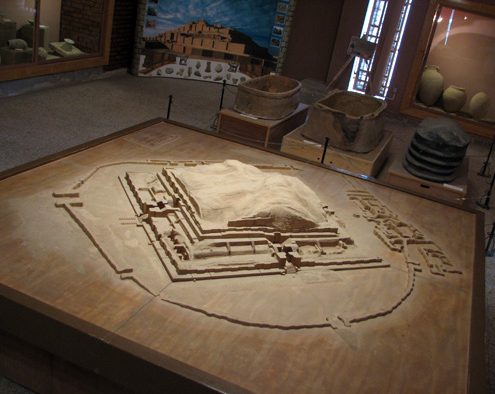
Model of Tchogha Zanbil Ziggurat Temple and its surrounding

Model of Tchogha Zanbil Ziggurat Temple and its surrounding


The ancient town of Untash Napirisha was surrounded by a wall approximately 4 km long. The temple was located in the middle of this town surrounded by two walls around it separating the temple from the town. You see one separating wall at the picture above as well as some other buildings between this wall and the other wall, which isn’t present at this picture. Also, there were several gates along these walls.

The main temple of Tchogha Zanbil is an example of Iranian architecture in pre-Islam era. It’s in form of a ziggurat, but unlike the Mesopotamian ziggurats, each level has not been built on top of the previous one. The temple was erected in two stages:

  1. First, a series of rooms were constructed around a central courtyard, and
  2. Then, new upper floors were built from the ground floor to the top.

Four floors have been unearthed by Girshman. Based on the height of each floor, he assumes a fifth floor (a chamber) must have been there, the actual temple, called “kukunnum“. Considering such 5th floor there on top, the ziggurat’s height must have been 52 meters. Today only 25 meters of this structure is standing there yet giving such an awesome appearance to the temple.

The pavement around the temple are all treated by fired bricks extended from the structure to the first surrounding wall. The inner walls of the structure have been built with mud-bricks and the exterior walls with fired bricks.

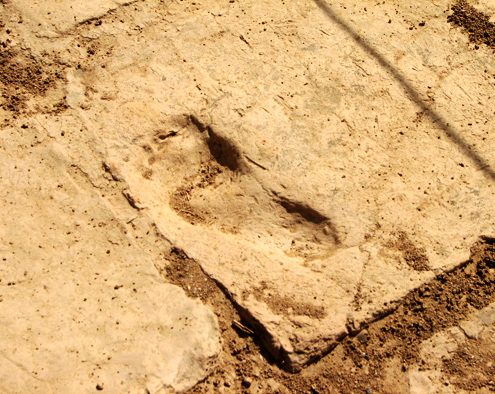
+3000 years old original footprint on the pavements of Tchogha Zanbil Temple

+3000 years old original footprint on the pavements of Tchogha Zanbil Temple

Particular Features of Tchogha Zanbil

At the top of each entrance gate, located in the middle of each wing of this approximately square-based structure, there’s a vault made of bricks. This is the oldest example of vaults in ancient Iran. Later under Achaemenians, palaces had flat ceilings. Only under Sassanians, 1600 years later, vaults and arches became popular again.

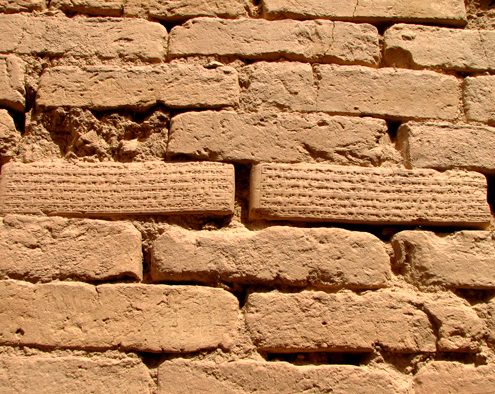
In certain rows of the exterior walls, in one line, a lot of bricks are inscribed by cuneiform inscriptions ordered by Untash Napirasha dedicating the ziggurat temple of Tchogha Zanbil to the “god of Susa”, Inshushinak.

Bricks inscribed by cuneiform Script

Bricks inscribed by cuneiform Script


Unlike Susa and Kabnak (Haft Tappeh) ancient towns, where each tomb accommodated several corpses, here at Al Untash Napirisha, each tomb had only one skeleton and the rest of the bodies had been cremated. It’s not known why they were treated like that.

The doors of temples and palaces of the town were all made of wood decorated with glass tubes to be translucent. At one of the rooms of the temple, some black and some white tubes have been found that were used to decorate Tchogha Zanbil ziggurat, palaces, temples, palaces and even surrounding walls. This indicates Iranians were familiar with glass-making techniques around 33oo years ago.

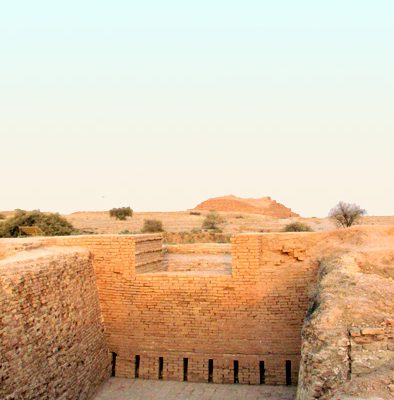
At the North West of the temple, there’s a reservoir of water in which water was purified to be drinkable. It’s said that Untash Napirisha had brought water from some 50 km away from the town to be purified at this place. There were 9 conduits to lead the clean water to a small pool at a higher level so that people could fetch clean water there for consumption. According to another assumption, it was used to drain the rainwater from the surrounding buildings.

Water Treatment Structure at the North of Tchogha Zanbil Temple

Water Treatment Structure at the North of Tchogha Zanbil Temple

Arts & Architecture at Tchogha Zanbil

For embellishment, glazed bricks, gypsum plaster works, vaulting, and some architectural ornament of faience and glass were largely made use of . Professor Girshman has discovered some ancient artifacts categorized as Elamite arts. Cylindrical seals, potteries, metal objects, clay-made figurines, and several other decorative pieces are some of such discoveries.

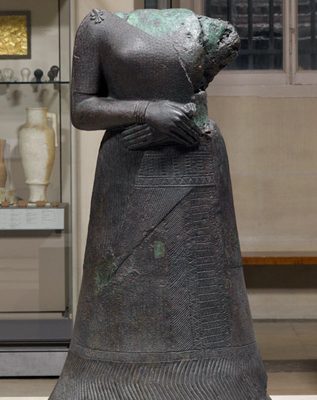
According to the evidences, ancient Iranians have been specialized in making sculptures. A bronze-made sculpture of Napir Asu (around 1800 kg), the wife of King Untash Napirisha, has been made by the same people, Elamites. It’s in Louvre museum now.

Bronze Sculpture of Queen Napirasu

Bronze Sculpture of Queen Napirasu

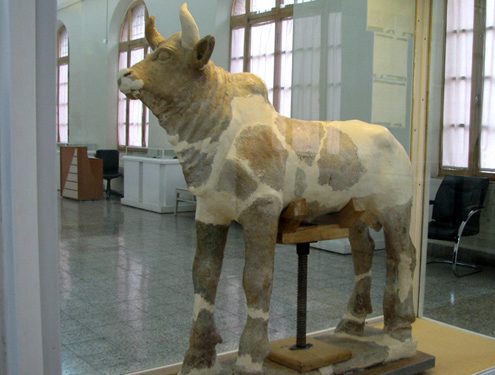
There were clay made bulls protecting the ziggurat’s temple entrances. One of them with cuneiform inscription on the back of the animal has been restored by the excavator’s wife.

Clay-made bull from Tchogha Zanbil temple

Clay-made bull from Tchogha Zanbil temple


Snakes were the motifs symbolizing protection against evil forces. They were used at the jar caps. Also, snake motifs were found at the entrance gates and doors in form of glass tubes for protection. The motif of two mating snakes were Elamite symbols of fertility that were later used in other civilizations as well.

How It Was Destroyed

After Untash Napirisha’s death, Tchogha Zanbil temples remained a center of worshiping various gods for religious pilgrims and burial ground until around 1000 BC, when it was destructed by the Assyrian king Ashur Banipal. Assyrians believe this destruction led to the abandonment of the site at 646 BC, but according to the evidences discovered in one of the temples, Tchogha Zanbil and its surrounding structures were entirely abandoned at around 1000 BC. The city wasn’t rebuilt again.


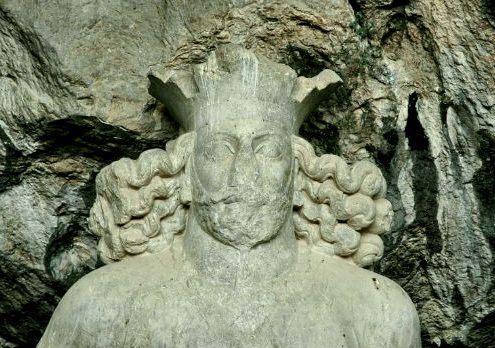
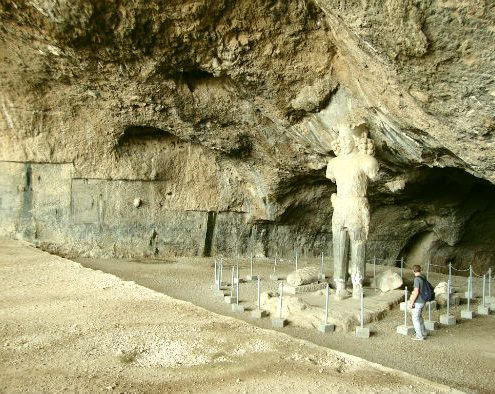
Shapur Statue inside Shapur Cave

Shapur Statue inside Shapur Cave

This cave is located on the heights overlooking Chogan Valley, about 6 km from the ancient city of Bishapur in the south of Iran. Shiraz is one of the cities from where you can start your trip to get there.

Now imagine you’re up there. What appears in front of your eyes is a huge statue standing in front of you not far ahead. He’s Shapur I, the second king of the Sassanid Empire. Yes, it’s really surprising to see such a huge statue in a cave at the top of a mountain. But it’s not the only thing that can surprise you.

Sculptures and rock reliefs have formed an outstanding part of Sassanid art. Although such carvings benefited less popularity at those times as compared to the other ancient periods, they’ve done the best in depicting some significant figures and events.

What You Need to Get to Shapur Cave

  • Because of the steppe climate in this region, you’ll need cotton clothes in light colors if you want to be there in spring or summer. But if your trip is in fall or winter, you’ll need warm clothes. The annual precipitation is very low in this region but to be assured of your comfort, have a raincoat with yourself.
  • You’ll need suitable and comfortable footwear because you have to go up the carved stairs with about 230 treads to get to the entrance of the cave. Or you can hike the steep slope of the mount if you wish. It can be challenging but you don’t need to be a professional mountain climber.
  • Have a bottle of water with yourself. There’s no access to drinking water in the cave. It takes about an hour and a half to get there. It’s rather a long way and makes you tired and thirsty.

Now It’s Time to See the Real Surprise

Shapur Statue inside Shapur Cave

Shapur Statue inside Shapur Cave

So, to see the real surprise, you have to reach a cave which is located at a height of about 800 meters above the mountain foot. The entrance of the cave is about 30 meters wide and 15 meters high, and its length is about 450 meters from the entrance to the end. It’s called Shapur cave because the enormous statue of Shapur I is there.

Yes, this remarkable manifestation of Sassanid art is so impressive. The height of this statue is about 7 meters and the shoulders are more than 2 meters wide. It’s carved out of a stalagmite in this limestone cave and dates back to about 17 centuries ago. It’s the only sculpture this large remaining from the ancient times in Iran.

Shapur I was one of the most powerful Persian kings who achieved great victories against the Romans. In his last war with the Romans in early 260 A.D., he arrested the Roman Emperor and imprisoned him in the ancient city of Bishapur, 6 km from the cave, and therefore, the Roman Empire was dominated for a long time. This victory attracted attention of the civilized world of the day to the power of the Sassanid Empire.

Other Attractions in and around Shapur Cave

  • There are two pieces of stone inscription cut in the wall of the cave. One of them dates back to the ancient times in Sassanid period. It is the translation of a piece of inscription attributed to Shapur. The other one belongs to the contemporary times and talks about how the statue was raised again after about 14 centuries in 1957. It was pulled down after the Arabs invasion of Iran and the collapse of Sassanid dynasty.
  • As you go further into the cave, you can see two water reservoirs dug in stone. They are about one meter deep and have stairs for access to water. Water dripping from the ceiling of the cave was collected in these ponds. The locals used to provide drinking water from these ponds.
  • There is a beautiful flowstone by the reservoirs on the left. At the back of this flowstone, you can see some of most eye-catching stalactites and stalagmites.
  • As you explore in depth of the cave, you encounter a very large hole in the floor with a diameter of about 100 meters. It reminds you of dry lakes. It’s about 30 meters deep from the front hall floor.
  • Passing the hole, on the left, there’s a flat area partially created by locals. It seems it was used as a spot for ceremonies or offering sacrifices. The height of the ceiling in this hall is about 40 meters. It’s the highest point of the cave’s ceiling.

It’s said that the dead body of Shapur I is buried somewhere in this cave. There is also another legend narrated by the locals about this issue. It says that Shapur, being defeated in a war, took refuge in this cave. Since then he has been disappeared and his body has never been found.

These are not the only wonderful attractions in the region. You can take a tour to visit the other ancient spots near Shapur cave. Among them all, I suggest visiting the ancient city of Bishapur and Chogan Valley rock-reliefs. There you can learn much more about Sassanid art and get hugely surprised, too.

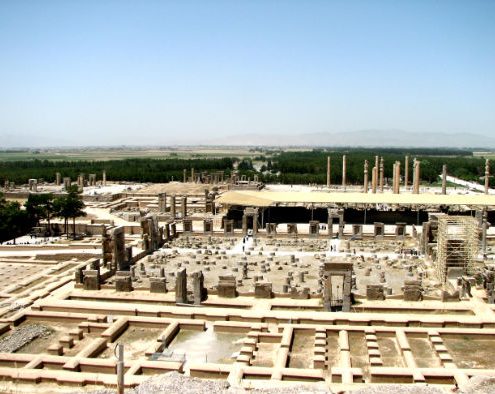
Genral View of Part of Persepolis

Genral View of Part of Persepolis


One of the best-known and glorious sites of ancient world, Persepolis, is located in the plain of Marvdasht, about 75 km northwest of Shiraz. It was one of the dynastic centers in Achaemenid era. UNESCO has registered this impressive manifestation of Achaemenid architecture at the list of World Heritage Sites in 1979.

In about 518 BCE, Darius the Great ordered the construction of a palace complex on a platform at the foot of a mountain called Kooh-e Mehr (Mount Mithra). Subsequently, the structures were extended by Darius’ Successors, Xerxes and Artaxerxes I. The whole platform covered an area of about 125,000 square m. This complex consist of ceremonial palaces, provisional residential palaces, a treasury, and a chain of fortification.

Function of Persepolis

There is a wide-ranging debate on the function of Persepolis. Many scholars believe Achaemenids have built it as a ceremonial palace complex mainly for celebrating Nowruz, the Persian New Year festival. Others deny any evidence of celebrating Nowruz in Achaemenid period, and therefore, at Persepolis. Some scholars, on the other hand, see the site as a manifestation of royal power, or think of it as a political, economic, and administrative center of the empire.

Achaemenid Architecture at Persepolis

The palaces and their annexes of the site benefited from such luxury and glory that could raise a sense of respect and humility in every visitor. In constructing the palaces, not only the best materials were provided from all over the empire, but also all the ethnic groups living under the empire cooperated by offering their industries and skills as a sign of interest in unity.
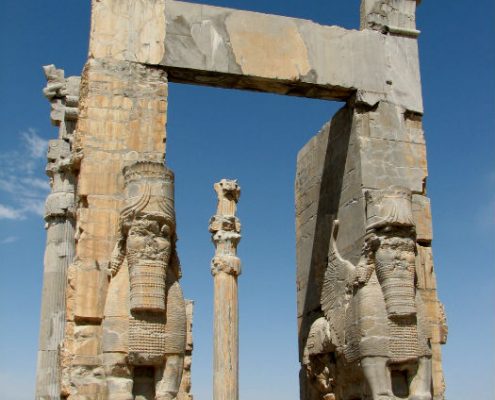
The Gate of All Nation at Persepolis

The Gate of All Nation at Persepolis


The entrance gate to the site was originally from the south, through a staircase. To the right of this gate, you can see four cuneiform inscriptions in the name of Darius the Great on a huge block: Two in Old Persian, one in Elamite, and the fourth in Babylonian. These inscriptions informed visitors of the nature of Persepolis, people who contributed to its construction, and the Darius’ beliefs and ideals.

In the following, you can learn more about Achaemenid architecture by passing through different parts of this unique site. They’re as follows:

1. The Gate of All Nations: It was a four-columned square hall with three stone doorways. Two enormous carved winged-bulls are at the inner side of eastern as well as western doorways. The gates are decorated in the upper part with six cuneiform inscription sections. The eastern doorway leads to the Hundred Column Hall, and the southern doorway has a view of the Apadana, the administration hall of the Darius the Great. Xerxes built this gate later to lead the delegations from various nations to enter the site.

2. The Apadana: The audience palace of Darius and the largest building of the site. Its double-reversed stairways are the most splendid parts of Persepolis. The facades of these stairways are decorated by friezes and bear inscriptions of Xerxes. Once there were 72 columns supporting the roof of the palace but today only 13 of them are still standing.
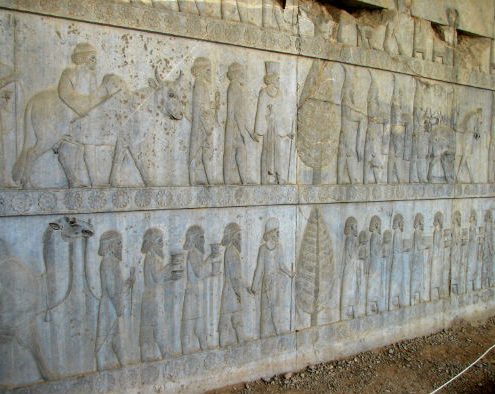
Rock Reliefs on the eastern wall of Apadana palace

Rock Reliefs on the eastern wall of Apadana palace


3. The Tachara: The private palace of Darius and the oldest one at the site. In this charming structure, you can find three different scripts carved in various historical periods: one in cuneiform from Achaemenid era, one in Pahlavi from Sassanid era, and the other one in modern Persian from Qajar era. Representations of servants and attendants are carved on the inner walls of the stairways, and the façade of the staircase shows two sphinxes, palm trees, and Persian soldiers.
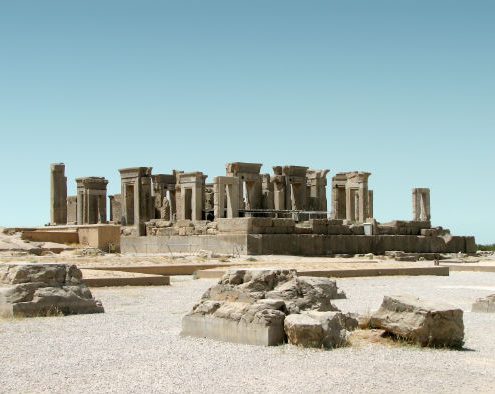
General view of Tachara palace, the private palace of Darius the Great

General view of Tachara palace, the private palace of Darius the Great


4. The Harem of Xerxes: A two-wing structure to the west of the Treasury. Here, you can see the largest monoliths at Persepolis in form of two flanking pillars. Building the entire floor of the structure on a natural bedrock, not something man-made, indicates a subtle use of natural space in Achaemenid Architecture. Today, this building is the museum of Persepolis and administrative center of Achaemenid research.

5. The Tripylon or The Central Palace: This small structure, located at the center of the site, must be attributed to Xerxes and Artaxerxes I. Achaemenids have ornamented it lavishly. They had fully engraved its façade. This building was linked to the other palaces by three doorways, a couple of corridors and staircases. They used this building for meetings and consultation with high ranking officials.
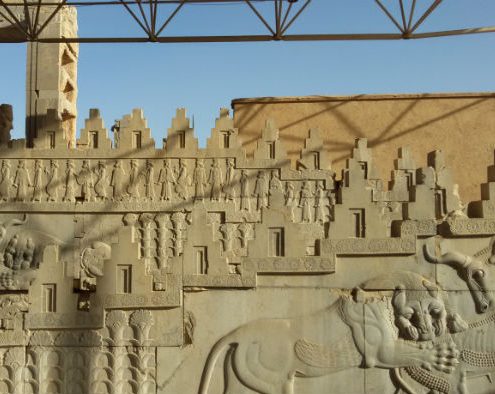
Achaemenid Art at the Central Palace of Persepolis

Achaemenid Art at the Central Palace of Persepolis

6. The Hadish: The palace and temporary residence of Xerxes which was twice the size of the Tachara. Its two double reversed staircases are decorated in reliefs. Some parts of the inner façade also show representations of people carrying utensils or leading wild goats or similar animals. You can’t find similar representations anywhere else in Persepolis.

7. The Treasury: built by Darius, extended and formed like a fortress by Xerxes. A thick, mud brick wall has surrounded it leaving only a single entrance at the northeastern corner. This structure accommodated a large part of the huge wealth accumulated by Achaemenid emperors.

8. The Hundred Column Hall: The second largest palace of Persepolis functioned as an audience hall. It’s located to the north of the Treasury and east of the Apadana. The main feature of it was a square hall provided with ten rows of ten columns supporting the ceiling. In fact, Xerxes has built this palace to receive audience from different parts of the empire.
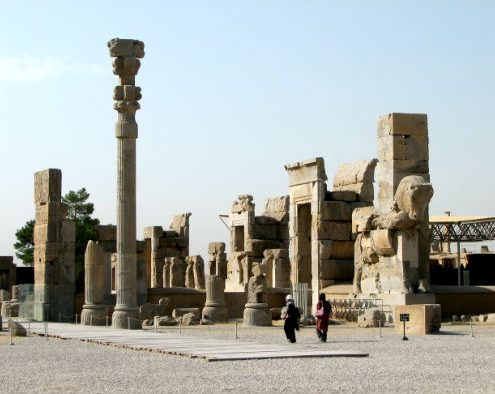
Entrance of 100-Column Palace

Entrance of 100-Column Palace


9. Royal Hill: The other monument part of Persepolis are the rock tombs of Artaxerxes III, Artaxerxes II and Darius III beautifully decorated by rock reliefs. These rock tombs are just some of the burial monuments of Achaemenids. They overlook the entire site.

The End of Story for Persepolis

Persians planned and directed the construction of this magnificent palace complex. The best artisans and artists from all the nations under the Persian Empire executed the project. This manifestation of Achaemenid architecture was being extended and maintained until 330 BCE, when Alexander of Macedonia brought its glory to an end by looting and burning it.

By setting Persepolis on fire, Alexander destroyed numerous books and a great part of Achaemenid art and culture. He plundered all gold, silver, and riches of the Persepolis treasury. It was the biggest treasury of Achaemenids.

Excavations and Discoveries:

So far, more than 30000 clay tables have been discovered through excavations of Persepolis most of which in Elamite. They’re the most valuable documents from Achaemenid era in terms of content. They contain important information on payment systems or payment records, work groups, social rights, and materials used in construction of this monument.
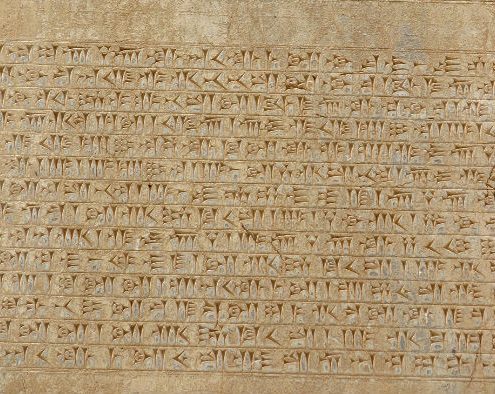
Cuneiform Script on Persepolis Walls

Cuneiform Script on Persepolis Walls


nscriptions of these clay tablets prove that Achaemenids had not used forced labor to construct Persepolis. They had paid all the workers. They also benefited from a kind of labor insurance.

Another discovery is a complex water disposal system with underground channels about 2 km long, and in some parts, up to 5 to 6 m high. Sewage and rainwater was led toward the southeastern corner of the complex to leave it through this drainage system. A sizable well at the foothills is dug and connected to this sewage system that functions like a flash tank to clear the channels and unblock any possible clogged spots.

Administration of the Site
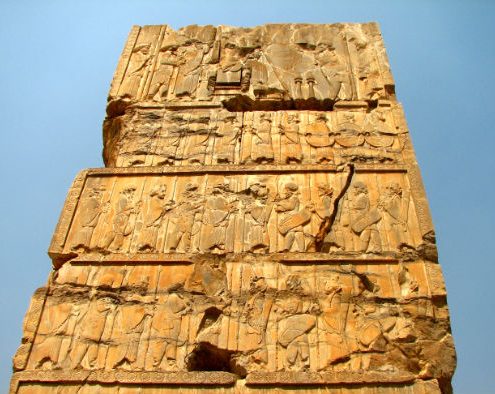
Persian & Median Guards below the Xerxes Throne on Persepolis Walls

Persian & Median Guards below the Xerxes Throne on Persepolis Walls


A board of trustees is elected as the administrator. Legal entities consisted of the governor of Fars Province, Deputy Head of Cultural Heritage Organization, Head of Iran’s Cultural Heritage, Handicrafts, and Tourism Organization, representative of Arsanjan, Pasargad, and Marvdasht, governor of Marvdasht, Head of Global Database of Persepolis, Mayor of Marvdasht, and some respectable trusted individuals.

What I told you here is just a drop in the bucket. You have to feel the real glory of Persepolis at first hand. I’m sure it will be one of your memorable experiences.

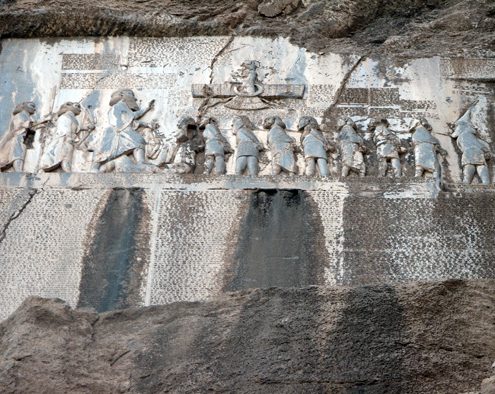
General View of Takht-e Soleyman, an Iranian Archaeological Site

General View of Takht-e Soleyman, an Iranian Archaeological Site


Takht-e Soleyman is an Iranian archaeological site, located 45 km northeast of Takab County in West Azerbaijan province, northwest of Iran. It covers an area of about 124000 sq. m, and the name is Persian equivalent for Solomon’s Throne.

In different historical periods, Medians, Parthians, Sassanids, and Mongols had settled at this area. This historical-cultural complex includes traces of human settlement from the first millennium BC. According to some historians, it has been the birthplace of Zoroaster. UNESCO has approved this monumental complex as World Heritage Site in 2003.

Exploring Takht-e Soleyman

Around the entire site, there is a round fortified platform with the height of about 60 m above the surrounding plains. An artesian lake, a Zoroastrian fire temple, and Anahita temple are located on this platform. There are remarkably interesting points both inside this site and in its vicinity. Here’s a short introduction:

  • The artesian lake
Lake of Takht-e Soleyman In the Middle of the Archaeological Site

Lake of Takht-e Soleyman In the Middle of the Archaeological Site


Thousands of years ago it was just a spring. But, during years, sediments from its water raised a wall around the outer edge, and the result is a lake 60 meters deep you can see today. Several streams branch off the lake, which waters surrounding lands.

  • The Zoroastrian fire temple
Ruins of Azar-Goshansb fire temple

Ruins of Azar-Goshansb fire temple

It was the third principal fire temple for Iranians in Sassanid period, located to the north of the lake, known as Azargoshasb fire temple. The royal family and military commanders had a sole right to worship there. As a symbol of national unity, the government and people of the time highly respected the temple. The fire in it has been a symbol of Zoroastrianism authority for about seven centuries.

  • Anahita temple


Inside Anahita Temple at Takht-e Soleyman

Inside Anahita Temple at Takht-e Soleyman


A temple attributed to Anahita, the goddess of water which is located to the northeast of the lake. People used to praise water in this temple. In some periods it was customary, in time of wars, to throw valuable and precious votive objects to the lake and believed that Anahita would protect them against enemies. So, there is hope for great treasure lying at the lake bed!

There are also two adjacent sites, namely Kooh-e Belgheys (Belgheys Mountain) and Zendan-e Soleyman (Solomon’s Prison). Belgheys was the name of the Queen of Sheba, Solomon’s wife, according to Islamic tradition.

  • Belgheys Mountain

It lies 8 km northeast of Takht-e Soleyman with two peaks of about 3200 and 3655 m high. The citadel and fortifications of Belgheys Throne are located on the southern peak. Fortifications have watchtowers overlooking the region.

At the mountain, you can enjoy the beautiful scene of a lake between the two peaks created by melting snow. It’s a scenic view for most part of the year although in recent years the lake dries up in summers because of low rainfall.

  • Solomon’s prison
Zendan-e Soleyman near Takht-e-Soleyman

Zendan-e Soleyman near Takht-e-Soleyman


It’s a conical hill lying 3 km west of Takht-e Soleyman with the height of about 100 m above the surrounding plains. At the summit of this hill, there’s a deep crater about 60 m in diameter which most likely was filled with water two thousand years ago.

The reason for such naming is local legend which says here is the place in which Solomon imprisoned disobeyed demons. It was a Zoroastrian place of worship and sacrifice in Sassanid era.

Ups and Downs over the Years

This archaeological site was the largest educational, religious, and social center in pre-Islam era in Iran. There are some indications of the earliest settlement during the first millennium around the site. Sometime in the early years of Achaemenid era, The rulers constructed some structures at Takht-e Soleyman. Also, there are some traces showing Parthians had been using the site.

Sassanids constructed a mud-brick wall around the central lake, gates and temples. The site gained its religious importance during this period. Zoroastrian government moved the holy fire to the temple here and called it Azar Goshansb, which turned to be one of the three major temples of Sassanid era.

One of the Gateways at Takht-e-Soleyman

One of the Gateways at Takht-e-Soleyman


But in 624 AD, the Roman Emperor, Heraclius, destroyed it in an attack to Iran. It happened in the reign of Khosrow Parviz, the late Sassanid king.

After the decline of Sassanid Empire and acceptance of Islam by Iranians, this huge complex couldn’t revive again after the severe damages it had received in the war between Iran and Rome .

It went on until 13th century when Abagha Khan, the second Mongol ruler of the Persian Ilkhanid, gave new life to Takht-e Soleyman by doing extensive repairs and construction of new buildings. They used it as the royal summer resort for some time. Most of the construction occurred at the Southern side of the site little of which is remained. In 14th century Mongol princes stopped inhabiting this site and left it.

And as my last word to finish: if you’re interested in mysterious issues, this Iranian archaeological site has remarkable ones to offer, so don’t miss it.

Allah Allah Domes at Sheikh Safi al-Din Khangah & Shrine Ensembles

Allah Allah Domes at Sheikh Safi al-Din Khangah & Shrine Ensembles


Shah Ismail ascended to power in early 16th century and founded Safavid dynasty in North West of Iran. He and his successors were the followers of a Sufi who had died three centuries before their time, but had kept his popularity and respect among the people. The World Heritage Site I’m going to explain here is the burial place of Shah Ismail and Sheikh Safi as well as a few other dignitaries of Safavid Era. It’s named after this Sufi: Sheikh Safi al-Din Khangah & Shrine Ensembles.

Who Was Sheikh Safi al-Din?

Courtyard between various structures of Sheikh Safi-al Din Shrine Complex

Courtyard between various structures of Sheikh Safi-al Din Shrine Complex


This Sufi used to live 700 years ago, meaning 3 centuries before Shah Ismail came to power. He was the son-in-law of the Grand Master of Sufi orders in Iran, Sheikh Zahed Gilani. As a spiritual leader of his time, Sheikh Safi inherited Zahediyeh from his master, a Sunni Muslim, and transformed it into his order called “Safaviyya”, believing in twelve Imam denomination of Shiite branch. As he’d been given the Ardabil and its dependencies, Safaviyya managed to gain authority over all those areas.

Eventually, the followers of this order managed to obtain the political and military control over that area. In early 17th century, a group of his followers headed by Shah Ismail founded Safavid dynasty in Iran and brought a religious government to power. This was the second time in Iranian history that religious-political leaders ruled the country. The name of this Dynasty comes from the name of this Sufi. So, the monument I introduce here is called “Sheikh Safi al-Din Khangah & Shrine Ensembles” after him.

Who Was Shah Ismail?

Ceiliing decoration inside Sheikh Safi-Al Din Shrine

Ceiliing decoration inside Sheikh Safi-Al Din Shrine

He was born in Ardabil and turned into a fervent follower of Safaviyya militant order and founded Safavid dynasty. He unified Iran at a time when foreign invasions and political influence had strongly weakened Iranian authority over its territory. This was the largest and mightiest empire established in Iran after the Arabs’ invasion leading to the Iranian political decline.

Shah Ismail brought together different parts of Greater Iran – all the countries ruled by major powerful Iranian empires from Medes to Qajar era. These countries and territories included Azerbaijan, Armenia, Georgia, North Caucasus, Kuwait, Iraq, Afghanistan, and even some parts of today’s Uzbekistan, Pakistan, Syria, Turkey, and parts of Turkmenistan. Iran became a strong nation again. He converted Iran from Sunni Islam to Shi’a Islam. This differentiated religious and national identity of Iranians and helped Iran’s territorial integrity. Many argue this was a wise political movement strengthening Iran as a nation.

He was also a prolific poet composing poems in both Azerbaijani and Persian. His pen name was Khatai.

Sheikh Safi al-Din Khangah & Shrine Ensembles

Khangah is a spiritual retreat in the Sufi order. This UNESCO site is a complex consisting of several sections with different functions: a mosque, mausolea, a library, a school, a hospital, a cistern, kitchens, a bakery, and some offices. Iranians refer to it all as “Sheikh Safi Shrine in Ardabil”. In addition to its historical significance, the site is of high value in Iranian architecture. Also, from Islamic architecture point of view, it’s a landmark of Safavid era.
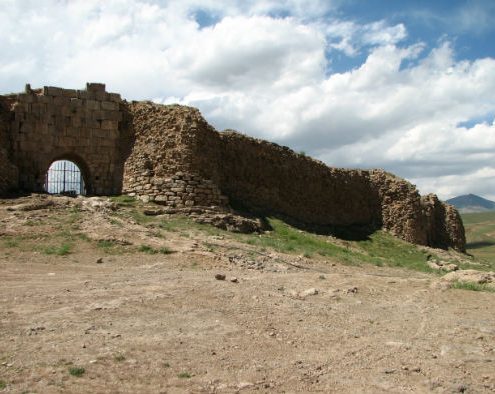
Entrance to Sheikh Safi al Din Shrine in Ardabil

Entrance to Sheikh Safi al Din Shrine in Ardabil


The ensemble in this complex refers to a series of spectacular inherited items including:

  • A series of richly decorated and preserved facades and interiors, and
  • An exemplary collection of antique artifacts.

Altogether, it constitutes a rare collection of unique elements of medieval Islamic architecture.

The construction of Sheikh Safi al-Din Khanghah & Shrine Ensembles started in 16th century and continued till the end of Safavid rule, 18th century.  It’s an artistic and architectural accomplishment of Iranians setting an example for all such Sufi retreats built later in Iran. Aesthetics and religion have come together and created a beautiful complex in Ardabil. The dark blue tiles, gilded ceilings of the interior and space allocation for various functions in carefully devised plan and proportion have made it a unique collection of structures.
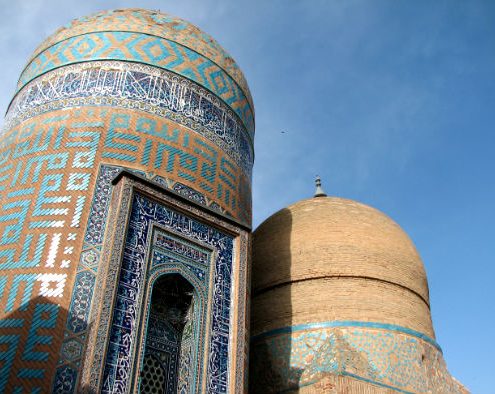
 

The ceiling inside the Sheikh Safi al-Din Shrine

The ceiling inside the Sheikh Safi al-Din Shrine

afavid architecture is the heir of its predecessors, Ilkhanids and Timurids. Therefore, their arts and architectural features are clearly distinguishable. The delicate ornamentation and spacious inner sections at Sheikh Safi al-Din Khangah & Shrine Ensembles represent the new architectural style of this era.
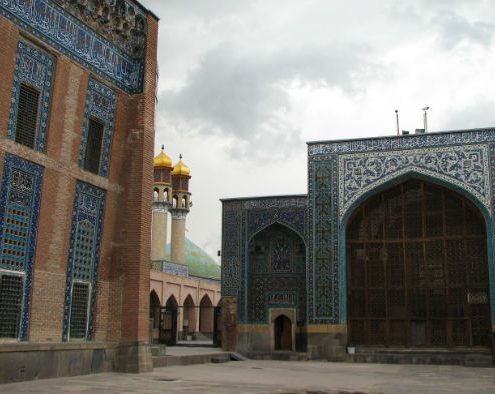
The social, religious and cultural influence of the Safavid period have lead to the formation of Safavid architecture. The other Sufi shrines built after that have been largely inspired by it.

Other Details About Sheikh Safi Shrine in Ardabil

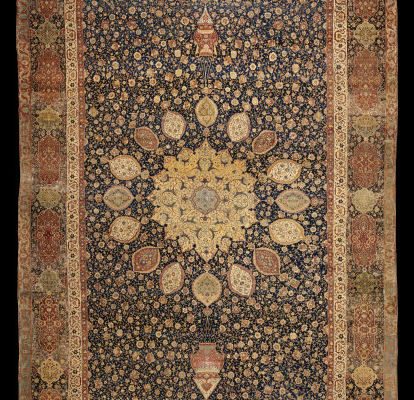
The famous Ardabil Carpet is in Victoria & Albert Museum

The famous Ardabil Carpet is in Victoria & Albert Museum


The famous “Ardabil Carpet” was an Iranian masterpiece and the best carpet woven in Safavid period for this complex. It’s now in Victoria and Albert Museum in London. A copy has been recently woven in Iran, which is kept by this shrine.

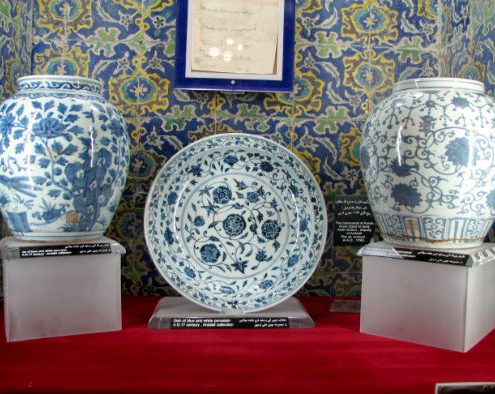
Chinaware at Chini Khaneh of Sheikh Safi Shrine Complex in Ardabil

Chinaware at Chini Khaneh of Sheikh Safi Shrine Complex in Ardabil

Chini Khaneh is the name of a section of this Sheikh Safi Shrine that accommodates several Chinaware from a collection imported from China during Safavid era. A lot of them were plundered at the time of Russians’ invasion to Iran. Most of the vessels displayed here bear the seal of Shah Abbas indicating he had endowed them to this shrine.

Conclusion

Sheikh Safi al-Din Khangah & Shrine Ensembles is  collection you don’t want to miss if you travel to Iran one day. It’s a magnificent set of buildings with circular dome chambers accommodating tombs of Safavid kings, princes, Sufis, etc. The domes themselves known as Allah Allah are quite spectacular.


Bazaar of Tehran

Bazaar of Tehran

Iranian Bazaars (Persian Bazaars), these very old structures, were first formed as a set of shops at the sides of water streams or rivers in the cities.

Later, they were roofed and changed into present forms we see today in some parts of the world. Bazaars can be seen in almost all of old cities and towns of Iran. They are still in function.

Definitions of Bazaar-Related Terms:

To better understand the function of bazaars, we need to get acquainted with some words and terms used in Farsi. Here are some of the commonly used ones:

  1. Rasteh Bazaar: It refers to the main passageway with shops of the same guilds.
  2. Dalan: It is a corridor that connects passageways in a straight or non-straight way.
  3. Qeisarieh: It is a passageway in which light-weighed and expensive goods are sold.
  4. Tim & Timcheh: They refer to large and small, enclosed areas in which heavy-weighed and expensive goods are sold. The roofs in such structures are most beautifully decorated implementing various fields of art.
  5. Carevansara: It is the sleeping place for travelers, sometimes used as a warehouse. Offices can be at the same area too.
  6. Sara: It functions as a caravansary, but the goods there are samples and small items. Offices and warehouses are in this one place. Like caravansaries, wholesalers work in Saras.
  7. Chaharsu/Charsu: It is an intersection where two Rastehs of a big bazaar meet. They are architecturally built as beautifully as possible. It is served as the station of the head guard of a bazaar.
  8. Bazarcheh: It is a roofed bazaar in a smaller scale at any quarter of a city where local people can easily do shopping.
  9. Bazaary: it refers to a person who has a business in a bazaar as a merchant, wholesaler, retailer, broker, money exchanger, etc.

The biggest square of a city was situated at the entrance or exit of a bazaar like Naqsh-e-Jahan Sq. in Esfehan.

Therefore, in a more general and comprehensive sense, a bazaar consists of a set of roofed stores along with passageways and corridors as well as caravansaries, Saras, Timchehs, etc. There are also other public services like bathhouses, schools and mosques and so on in the same complex to satisfy various needs of the people inside bazaars.

Arrangement of Shops in Iranian Bazaars

People belonging to different walks of life were living near or far from bazaars. Bazaars were either too live or too dead quarters of a city at various times or occasions.

Knowing all above said information is not enough to come to feel the life inside bazaars. We need to know:

Social Aspects of Iranian Bazaars

People of the same guild have to have their shops next to each other to prevent any disturbances or add to their security. Bazaaries have played key roles in the policies of Iran, because the main means of economy used to be bazaars. Today, as a result of modernization, they are gradually losing their former influence.

There are various jobs for those who are working inside bazaars like, merchants, distributors, brokers, money exchangers, porters, etc. It will not be precise to introduce all bazaaries as one, but there are lots of characteristics in common among them. Many of the people still working in bazaars are not educated compared to the other guilds of Iranian society. They know enough to run their own business. Also, the quality of life among those guilds inside the bazaars who make a lot of money is usually lower than middle-class educated people outside bazaars.

As the cities are growing in a huge scale in Iran, the distances are growing longer and longer within them. Therefore, it will be quite time consuming to take a trip from a spot in a large city to the other spot where the bazaar of the city is located. So, people prefer to go shopping in their neighborhood unless they need to buy plenty of items. Then, it will be worth to take such a trip and time to buy things all in a place and relatively cheaper.

Temporary Bazaars in Iran

In addition, in villages or less populated spots, there are two other types of temporary bazaars: 1) Seasonal bazaars, and 2) Day bazaars.

  1. “Seasonal bazaars” are the gatherings in which some of the seasons? products are temporarily put to sale. They still can be found in some areas of Iran.
  2. “Day bazaars” are the gatherings held once a week in the areas with dispersed population, like in various corners of north Iran or desert areas. One may see entertainers, tea sellers, colorfully dressed people and many other attractions producing an atmosphere like shopping festivals, but in a traditional way.